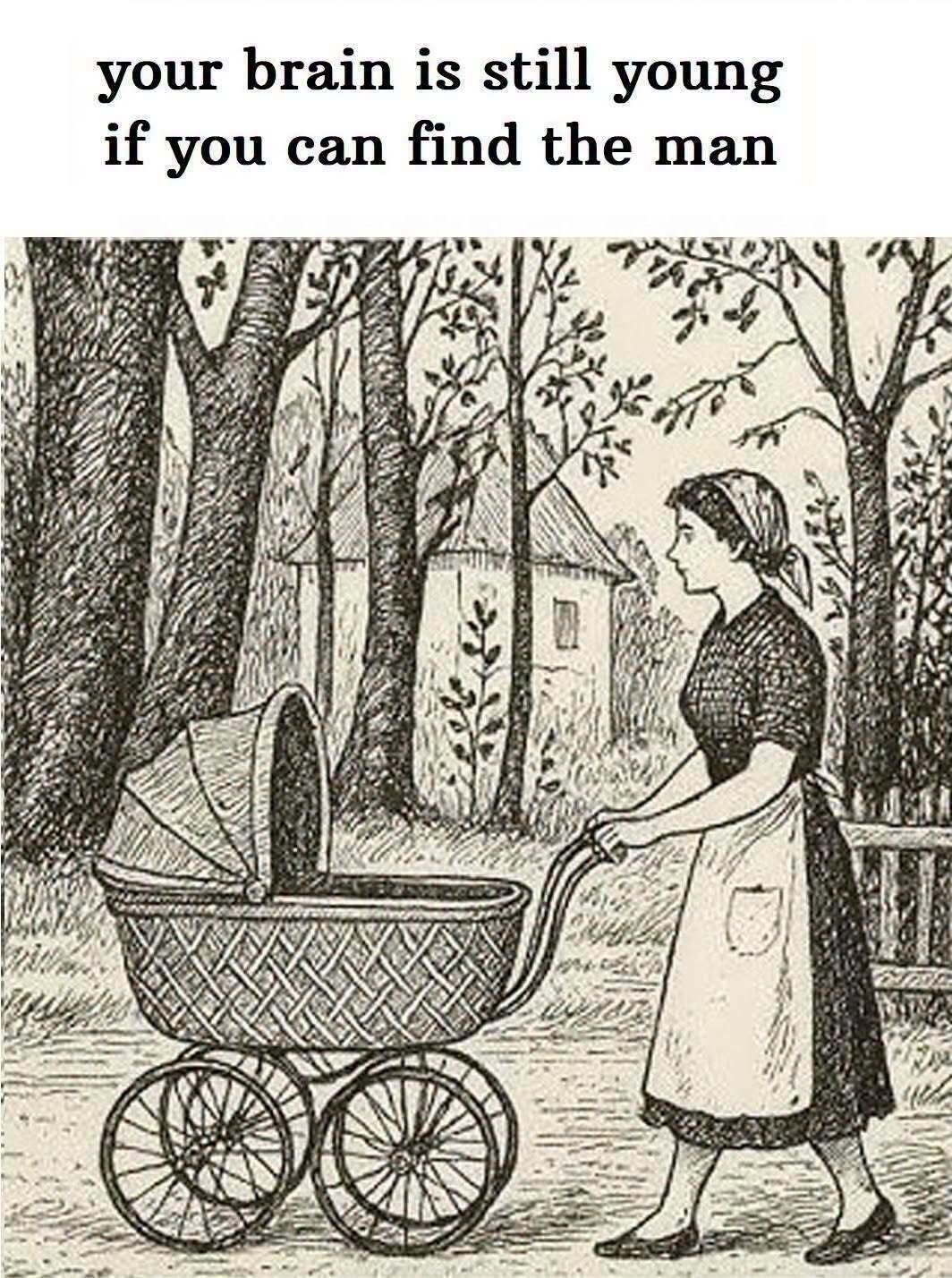
A quiet park. A woman. A stroller. And a hidden figure staring straight back at you. This vintage illustration looks perfectly innocent, almost forgettable—until your brain suddenly catches something it wasn’t expecting. The peaceful scene seems to split open, revealing a second image hiding beneath the first. Somewhere among the branches, shadows, and empty spaces, a man is concealed in plain sight.
Once you stop looking only at the woman and stroller, the entire picture begins to change. The trees no longer seem like ordinary trees. They start to look like carefully placed brushstrokes forming something much larger. A curved branch begins to resemble the outline of a forehead. A dark patch suddenly looks like an eye. The empty space between two trunks appears to create the bridge of a nose.
And then it happens.
The scattered pieces suddenly connect.
What looked like random scenery locks into the unmistakable shape of a face. Once your brain recognizes it, the hidden man becomes almost impossible to ignore. You can look back at the original scene, but your eyes keep finding him.
That moment of recognition is more than a clever optical illusion. It offers a fascinating glimpse into how the brain processes what we see. Your mind immediately categorized the image as a simple park scene, then filtered out details that didn’t seem important. It wasn’t looking for a face, so it didn’t initially interpret those shapes as one.
Only when you challenged that first impression did the hidden figure emerge.
The image never changed.
**You did.**
And that may be the most unsettling part of the illusion: sometimes something can be sitting directly in front of us, completely visible, while our minds remain incapable of seeing it—until the exact moment everything suddenly falls into place.