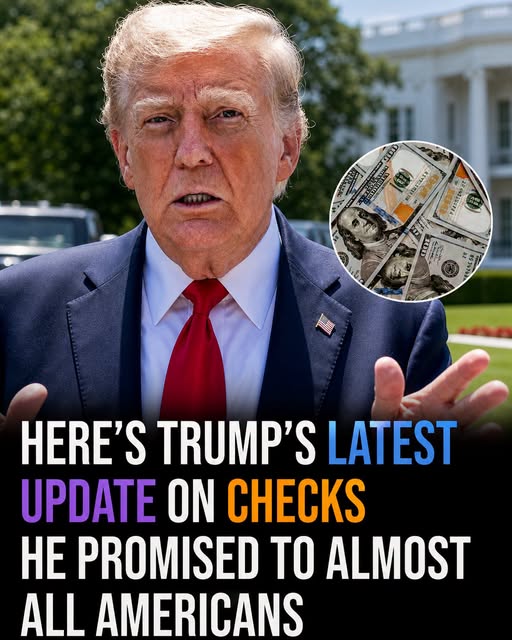
For months, millions of Americans have been waiting for the $2,000 checks Donald Trump has repeatedly talked about. Now, his latest comments have left that promise hanging by a thread. Each new “update” seems to bring more questions than answers, while uncertainty continues to grow among people hoping the money will actually arrive. Is this genuine financial relief, or simply another political promise designed to dominate the headlines? The money, the timeline, and even the basic details remain unclear.
Trump’s proposed “tariff dividend” began as a bold, simple-sounding idea: tariffs would generate “hundreds of billions” of dollars in revenue, and Americans could potentially receive roughly $2,000 each. The promise sounded straightforward. But once basic questions are asked—who would qualify, when payments would arrive, how they would be distributed, and whether Congress would need to approve them—the certainty starts to disappear.
Trump has offered confident statements about the concept while also leaving himself room to change course. At different points, he suggested payments could come relatively soon, only to later soften the timeline and acknowledge that no firm commitment had actually been made. For families waiting to see whether the promised money will become real, those shifting statements have created more confusion than reassurance.
Behind the political rhetoric, key officials have also pointed toward significant obstacles. Treasury Secretary Scott Bessent has indicated that legislation may be necessary, while Congress has not authorized a new nationwide $2,000 payment program or directed the IRS to begin sending checks. Without the necessary legal authority and funding structure, a presidential statement alone cannot simply place thousands of dollars into Americans’ bank accounts.
Even the separate $1,776 “warrior dividend” announced for service members adds another layer to the story. Rather than representing a new pool of tariff revenue, the payment appears to have been funded through money already available within military accounts. That distinction matters because it does not demonstrate that tariff collections have somehow created a ready-made fund for $2,000 checks to the broader public.
For now, the promise remains caught somewhere between politics and policy.
There is a proposal.
There are public statements.
There are headlines.
But there is still no authorized $2,000 payment sitting on the calendar for ordinary Americans.
And until Congress acts, the necessary details are finalized, and an actual payment program is established, people should be careful about treating the promise as guaranteed income.
**For now, the $2,000 check exists mostly as a political promise—not as money waiting in anyone’s bank account.**