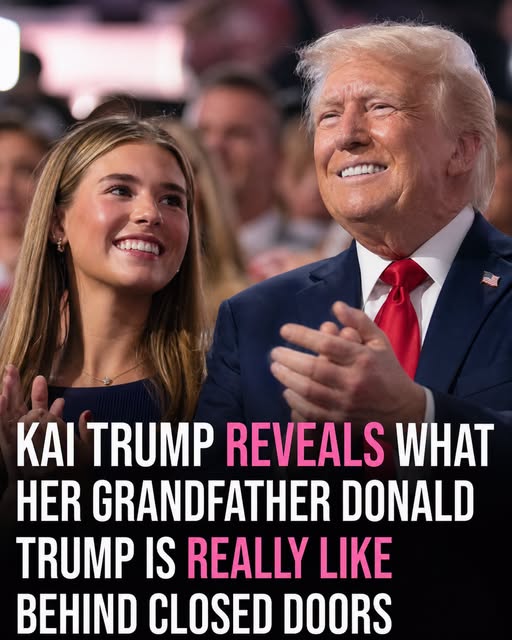
For years, Donald Trump has been portrayed as a ruthless powerbroker, a political showman, and a man who seems to exist permanently at the center of the headlines. But behind the motorcades, cameras, and armed security, his eldest granddaughter, Kai Trump, describes a very different side of him. At 19, she is offering a glimpse into the private world most people never see—family dinners, golf-course competitions, playful arguments, and the strange, sometimes lonely reality of growing up inside one of the most recognizable families in the world.
Away from podiums and political rallies, Kai says Trump is simply “grandpa”—the family member who talks about golf swings, debates sports, jokes around, and treats dinner conversations much like any other grandfather might. Their relationship appears to be shaped less by politics and more by competition, teasing, and the familiar dynamic they share on the golf course. Even when they are playing on the same team, she says, he still tries to get inside her head and challenge her.
That constant pressure, she believes, has unexpectedly taught her something valuable.
How to block out the noise.
Growing up with her grandfather’s name attached to almost everything she does means Kai has faced opinions from strangers since she was young. People judge her because of her family, her politics, her lifestyle, and even things that have nothing to do with her personally. The relentless attention can be difficult to escape, especially when millions of people already have an opinion about someone before hearing them speak.
But her relationship with Trump has given her a different perspective.
The golf-course mind games that might sound frustrating from the outside have become, in her telling, a kind of preparation. Learning to ignore distractions, stay focused, and refuse to let other people’s voices determine how she feels has helped her navigate a world where privacy is almost impossible.
Yet her life is still far from ordinary.
Armed security can follow her when she goes out at night, accompanies her into public spaces, and remains nearby even during moments when she would probably prefer to forget they are there. Ordinary experiences—meeting friends, going out, walking around, enjoying a quiet evening—can carry an invisible layer of caution that most teenagers never have to consider.
Kai has had to learn how to live around that reality without allowing it to completely define her.
She has learned to act as though the security detail isn’t there. She has learned how to create small pockets of normalcy inside a life that is anything but normal. And she has learned that being related to one of the world’s most controversial and recognizable political figures means that even ordinary family moments can become subjects of public curiosity.
Still, when she talks about her grandfather, her words repeatedly return to something much simpler.
For the rest of the world, Donald Trump may be a president, a politician, a businessman, or a symbol that inspires fierce loyalty and fierce opposition.
But for Kai, he is something much more personal.
**He’s just Grandpa.**
And behind all the cameras, arguments, headlines, and security details, that may be the version of him she wants to remember most.