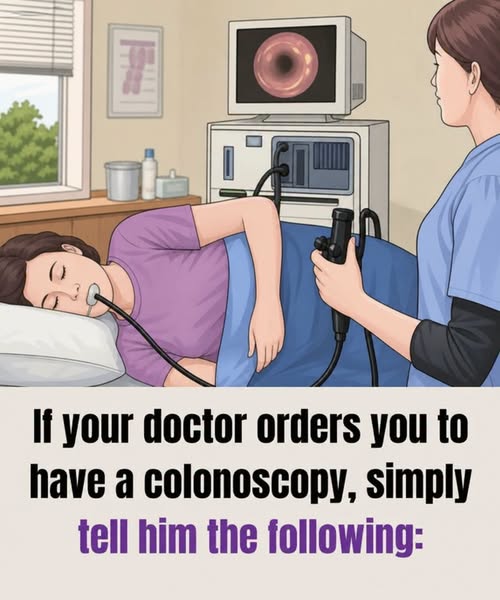
The fear hits before the facts do.
Sometimes, the word alone is enough to make your stomach drop.
Colonoscopy.
You hear it and immediately imagine discomfort, embarrassment, awkward conversations, and everything that could possibly go wrong. Your mind races ahead before you’ve even learned what the procedure actually involves.
You picture pain.
You picture humiliation.
You picture the worst-case scenario.
And somewhere in the back of your mind, one thought keeps repeating:
“Not me.”
But what if the test you’re avoiding out of fear is actually one of the most powerful tools you have for protecting your future?
What if the uncomfortable conversation today could prevent a much more devastating one years from now?
What if the thing you don’t want to look for is precisely the thing you need to find early?
That’s the part many people overlook.
We imagine a colonoscopy as a punishment.
In reality, it is designed as protection.
While you’re worrying about embarrassment or the inconvenience of preparation, your doctors are thinking about something entirely different: diseases that can develop quietly, sometimes without obvious warning signs.
Colorectal cancer can begin with changes that are easy to miss.
Sometimes there is no dramatic pain.
No obvious signal.
No moment when the body clearly announces that something is wrong.
And that is exactly why screening matters.
A colonoscopy doesn’t simply look for trouble.
It can sometimes prevent trouble altogether.
During the procedure, doctors can identify abnormal growths called polyps and, when appropriate, remove them. Some polyps can eventually develop into cancer, so finding and removing certain types before that happens can interrupt the process rather than waiting for a future diagnosis.
That changes the way the procedure should be viewed.
You’re not simply going into a medical room to search for something terrible.
You’re giving doctors an opportunity to find something early—or remove a potential problem before it becomes one.
For many people, that is an enormous difference.
The reality of the procedure is also often less dramatic than the picture people create in their minds.
Most colonoscopies are performed with sedation, and many patients remember little or nothing about the examination itself. They may wake up afterward wondering why they spent so much time worrying about the actual procedure.
The preparation is often the part people find most difficult.
And yes, preparation can be inconvenient.
It can involve dietary restrictions and a bowel-cleansing process that requires you to stay near a bathroom and follow instructions carefully.
It isn’t exactly anyone’s idea of a good time.
But compared with the fear people sometimes associate with the examination itself, the reality can be surprisingly uneventful.
You arrive.
You are prepared.
The medical team explains what is happening.
Sedation is given when appropriate.
The procedure takes place.
And before long, you’re awake again.
For many people, the biggest feeling afterward isn’t pain.
It’s relief.
Relief that it is over.
Relief that they finally did something they had been postponing.
And, perhaps most importantly, relief from the uncertainty.
Because fear thrives on imagination.
When you don’t know what will happen, your mind fills the empty spaces with the most frightening possibilities.
Learning what the procedure actually involves can take away some of that power.
You can ask questions.
You can discuss sedation.
You can ask about the preparation.
You can find out why the screening has been recommended for you.
You can ask what your personal risk factors are.
You can understand what happens if a polyp is discovered.
The more information you have, the less mysterious the experience becomes.
And that matters because delaying screening out of fear can have consequences.
A hidden polyp doesn’t necessarily cause symptoms while it is developing.
A cancer in its early stages may also be easier to treat than one discovered after it has had more time to grow or spread.
That is why screening is about more than reacting to symptoms.
It’s about looking for problems before they become obvious.
This is one of the hardest ideas for people to accept about preventive medicine.
We are naturally more comfortable treating something we can feel than looking for something we can’t.
If your back hurts, you pay attention.
If you have a fever, you notice.
If something suddenly changes, you know there is a reason to investigate.
But a condition that grows silently can be much more difficult psychologically.
You may feel perfectly healthy.
You may have energy.
You may look well.
You may have no reason to believe anything is wrong.
And that’s precisely why recommended screening exists.
It isn’t an accusation that you’re sick.
It’s an opportunity to make sure you aren’t missing something simply because it hasn’t announced itself yet.
Of course, screening recommendations aren’t identical for everyone.
Age, family history, personal medical history, previous polyps, genetic factors, symptoms, and other considerations can influence when and how someone should be screened.
That’s why the right approach is to talk with a qualified healthcare professional about what makes sense for you.
Don’t rely on fear.
Don’t rely on a friend’s experience.
And don’t assume that because someone else had a certain test at a certain age, your situation must be exactly the same.
Ask.
Understand.
Make an informed decision.
The goal isn’t to pretend that medical procedures are pleasant.
Sometimes they aren’t.
The goal is to put a temporary inconvenience into perspective.
A day of preparation.
An appointment.
A procedure.
A little embarrassment.
Those things may feel enormous when you’re standing on the other side of them.
But they can become surprisingly small compared with the possibility of discovering a serious problem early—or preventing one entirely.
That’s why the way we think about colonoscopy matters.
If you see it as suffering, every step feels like punishment.
If you see it as self-care, the same steps can feel completely different.
You’re not being punished for getting older.
You’re not being embarrassed because you’ve done something wrong.
You’re taking care of a part of your body that deserves the same attention as your heart, your skin, your teeth, or anything else you routinely protect.
And there is something empowering about that.
You are choosing information over uncertainty.
Prevention over avoidance.
Action over fear.
You are giving yourself a chance to know.
For some people, the result will be reassuring.
For others, doctors may find polyps that can be removed or other findings that need follow-up.
And if something serious is discovered, finding it earlier can provide important opportunities for treatment.
That doesn’t mean screening guarantees a perfect outcome.
It doesn’t.
No medical test can promise that.
But it can improve the odds of detecting certain problems before they become harder to manage.
That alone can make the temporary discomfort worthwhile.
Perhaps the most important thing to remember is that fear doesn’t necessarily mean you shouldn’t do something.
Sometimes fear simply means you don’t know enough about it yet.
The unfamiliar can feel enormous.
Once you understand the process, it often becomes much more manageable.
Ask your doctor what you should expect.
Ask how to prepare.
Ask what sedation options are available.
Ask how long recovery typically takes.
Ask why the screening is recommended based on your age and personal history.
There is no embarrassing question when the goal is protecting your health.
And if you’ve been postponing a recommended screening because the word “colonoscopy” makes you uncomfortable, you’re not unusual.
Many people feel exactly the same way.
But don’t let an imagined experience become more frightening than the real one.
The procedure is temporary.
The information you gain can be important for years.
And in some cases, what doctors find—or remove—can change the entire future of your health.
We often think of self-care as something comfortable.
A good meal.
A relaxing day.
A walk outside.
A good night’s sleep.
But sometimes self-care looks less glamorous.
Sometimes it means making the appointment you’ve been avoiding.
Sometimes it means drinking the preparation you don’t want to drink.
Sometimes it means allowing a medical team to examine something you’d rather not think about.
And sometimes the most loving thing you can do for your future self is to tolerate a little discomfort today.
Not because you should be afraid.
Because you deserve the chance to stay healthy.
In the end, it’s not really about one uncomfortable day.
It’s about what that day might protect.
It’s about catching something while it is still manageable.
It’s about removing a potential problem before it has the chance to become something much more serious.
It’s about replacing the question “What if something is wrong?” with something far more useful:
“What can I do now to find out?”
The fear may arrive first.
But the facts deserve the final word.
And sometimes, the test you most want to avoid is the very thing standing between you and a future you get to keep.