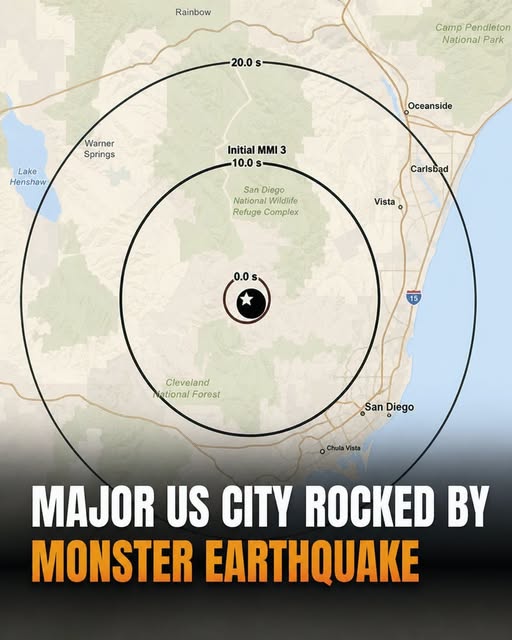
The first jolt felt like an explosion under the bed.
Then the floor rolled.
For a few seconds, nobody knew exactly what was happening. A quiet Southern California night suddenly shattered into panic, flashing phone screens, barking dogs, rattling windows, and whispered questions in the darkness.
Was that an earthquake?
Was it getting stronger?
Was something worse coming?
Walls creaked.
Cabinets trembled.
Objects shifted on shelves.
And thousands of people reached instinctively for their phones, searching for an explanation while the ground beneath them continued moving.
What had been an ordinary night instantly became a reminder that the earth beneath Southern California never truly feels as stable as it appears.
What shook San Diego County that night was more than a magnitude 5.2 earthquake near Julian.
It was the illusion of safety.
One moment, children were sleeping peacefully.
Dogs were twitching in their dreams.
Cars were parked outside.
Dishes sat neatly inside kitchen cabinets.
People were thinking about tomorrow.
Then, without warning, every fragile certainty in the room began vibrating.
A bed moved.
A window rattled.
A wall groaned.
And suddenly, the familiar surroundings of home felt completely different.
People rushed toward doorways.
Parents checked on children.
Families grabbed loved ones.
Pets became restless and confused.
For those few seconds, everyone had the same question running through their minds:
Is this the beginning of something much bigger?
People who had lived through previous earthquakes knew the feeling. The first jolt is only the beginning of the uncertainty. You don’t immediately know whether the shaking will stop after a few seconds or build into something far more destructive.
So people waited.
They braced themselves.
They listened.
They watched objects sway.
And some waited for the “big one” that Southern California has spent generations discussing.
Mercifully, it never came.
The shaking eventually stopped.
The floor became still again.
The windows stopped rattling.
The phones remained in people’s hands.
But the psychological impact didn’t disappear when the movement did.
That is one of the strange things about earthquakes.
The physical event may last only seconds.
The memory can last for years.
Afterward, people replay those moments.
What did I hear first?
How long did it last?
Where was my family?
Did the warning arrive before the shaking?
Could I have moved faster?
What if it had been stronger?
What if the shaking had continued?
Those questions can linger long after the ground becomes quiet.
And that is where ShakeAlert becomes more than an abstract technology project.
For people who received an early warning, those few seconds can feel completely different when you’re standing in the middle of a shaking room.
A warning doesn’t stop an earthquake.
It doesn’t prevent buildings from moving.
It doesn’t eliminate danger.
But it can provide something incredibly valuable:
Time.
Even a few seconds can create an opportunity to react.
To move away from a dangerous area.
To drop, cover, and hold on.
To move a child away from a falling object.
To stop certain equipment.
To open an emergency route.
To simply understand that what you’re feeling is an earthquake rather than some unknown disaster.
Five seconds can sound insignificant when you say it casually.
But during an earthquake, five seconds can feel enormous.
It can be the difference between standing beside a window and moving away from it.
Between remaining beside a shelf and getting underneath something sturdy.
Between being caught completely unaware and having a moment to make a decision.
That is the promise of earthquake early warning.
Not enough time to escape an earthquake.
Enough time to respond to it.
And that distinction matters.
The system detects the earliest seismic waves and can send alerts before stronger shaking reaches some locations. The amount of warning varies depending on the distance from the earthquake and other factors, meaning some people may receive several seconds while others may receive little or none.
But when an alert arrives before the strongest shaking, even a short window can matter.
For those who experienced the San Diego County earthquake, the technology suddenly became very real.
It wasn’t something discussed in a conference room.
It wasn’t simply another engineering project.
It was a sound or vibration on a phone while the room itself was beginning to move.
It was an alarm in trembling hands.
It was a moment to decide what to do.
And perhaps that is the most important lesson from the event.
People often imagine earthquake preparedness as something dramatic.
Emergency bunkers.
Massive supplies.
Elaborate evacuation plans.
But preparedness often begins with much smaller things.
Knowing what to do when the shaking starts.
Knowing where the safest places are inside your home.
Keeping heavy objects secured.
Understanding how your phone’s emergency alerts work.
Having basic supplies available.
Talking with family members about what everyone should do.
These actions can feel unnecessary on an ordinary evening.
Until the floor moves.
Then they become very important.
The earthquake also exposed something psychological.
Most people spend their daily lives assuming the ground beneath them is permanent.
We walk across floors without thinking about them.
We put furniture against walls.
We hang televisions above beds.
We stack dishes in cabinets.
We place heavy objects on shelves.
We go to sleep believing tomorrow will look essentially like today.
An earthquake briefly destroys that assumption.
Everything familiar becomes capable of moving.
A cabinet can open.
A picture can fall.
Glass can break.
A shelf can tip.
And suddenly, ordinary household objects become part of the emergency environment.
That is why the most useful response isn’t panic.
It’s preparation.
Experts have repeatedly emphasized that Southern California’s earthquake risk is not defined by one event. The region sits within a complex network of faults, and damaging earthquakes remain a long-term possibility.
The San Diego County earthquake was therefore not necessarily a prediction of an imminent catastrophe.
It was something more useful.
A reminder.
A rehearsal.
A real-world demonstration of what happens when the ground decides to move beneath a community that has spent years knowing it could.
The question isn’t whether the next earthquake will look exactly like this one.
It won’t.
Every earthquake is different.
The location will be different.
The magnitude may be different.
The depth may be different.
The amount of warning will be different.
The damage could be greater—or there may be little damage at all.
The point is that nobody gets to choose the timing.
That is why early warning matters.
And why preparation matters even more.
Technology can give you seconds.
But you still have to know what to do with them.
An alert cannot think for you.
It cannot automatically move your family away from danger.
It cannot guarantee that every person will receive a warning.
It can only create an opportunity.
The decision that follows belongs to you.
Drop.
Cover.
Hold on.
Move away from obvious hazards.
Check on the people around you when it is safe.
Don’t rush into danger simply because the shaking has stopped.
And remember that aftershocks can occur.
The ground becoming quiet doesn’t necessarily mean the event is completely finished.
For the people who experienced that night, the strongest shaking may have lasted only moments.
But those moments changed the way they looked at their homes.
They changed the way they listened to strange noises at night.
They changed the way they thought about emergency alerts.
And they reminded thousands of people that “safe” is sometimes only a temporary feeling.
The illusion of permanence can disappear in seconds.
One moment you’re lying in bed.
The next, the entire room is moving.
One moment your phone is just another device on the nightstand.
The next, it may be the thing giving you precious information.
That’s why the five-second window matters.
It isn’t a guarantee.
It isn’t a shield.
It isn’t enough to make an earthquake harmless.
But it is a chance.
A chance to move.
A chance to protect yourself.
A chance to grab a child.
A chance to get away from glass.
A chance to choose instead of simply react.
And that may be the most important lesson of all.
The earthquake wasn’t just a demonstration of how powerful the ground can be.
It was a demonstration of how valuable preparation becomes when there is no time to think.
Experts have warned that Southern California should treat events like this as reminders rather than anomalies.
Not because every earthquake is a preview of catastrophe.
But because every earthquake offers another opportunity to learn.
To improve warning systems.
To secure homes.
To educate communities.
To practice responses.
And to replace fear with preparation.
The big one didn’t arrive that night.
But the lesson did.
The ground shook.
People woke up.
Phones lit up.
Families reached for one another.
And for a few unforgettable seconds, thousands of people were reminded of something they usually don’t have to think about:
The earth beneath them is always moving.
Most of the time, we simply don’t notice.
And when we finally do, the question isn’t whether we can stop it.
We can’t.
The question is whether, when those few seconds arrive again, we’ll know exactly what to do with them.