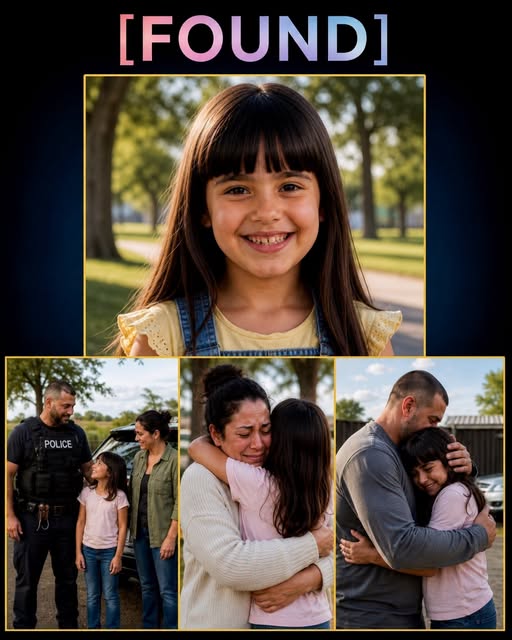
The child is home—but nothing feels simple.
The door may have opened, the family may finally have seen the child standing safely in front of them, and the world may have breathed a collective sigh of relief. But beneath that relief is something far more complicated. Joy crashes into fear. Gratitude collides with questions no one knows how to ask. A family that spent days, weeks, or even longer imagining the worst is suddenly expected to return to normal, even though normal may no longer feel like something they recognize.
Neighbors want answers.
Headlines want a story.
Social media wants details.
Everyone wants the disappearance to have a clean ending.
But for the child and the family, this may be where the hardest part quietly begins.
The moment a missing child returns safely is often described as a miracle. And in many ways, it is. After the fear, uncertainty, and endless waiting, having that child home can feel almost impossible to believe. Families may cry, hug, pray, laugh, or simply sit in silence because there are no words large enough to describe what they are feeling.
But a safe return does not automatically erase what happened.
It does not erase the nights of fear.
It does not erase the unanswered questions.
And it does not mean that everyone involved can simply go back to the way life was before.
Behind closed doors, families are often learning how to breathe again. They are discovering how to sleep without waking up in panic, how to sit together without constantly checking the door, and how to begin rebuilding routines that may have been completely disrupted.
For the child, the experience can be even harder to understand.
A child may return physically safe while still carrying memories, emotions, confusion, or gaps in their understanding of what happened. They may not have the words to explain what they experienced. They may behave differently. They may become unusually quiet, anxious, angry, clingy, withdrawn, or frightened. Or they may appear completely normal one moment and struggle unexpectedly the next.
There is no single correct way to react.
And there is no timetable for feeling okay again.
What the outside world celebrates as an ending can actually be the beginning of a long and delicate process.
The search is over.
But healing may only be starting.
That distinction is important.
When a missing child is found, people naturally want to celebrate. They want to share the good news, post photographs, express gratitude, and tell the story of the miraculous return. But once the immediate danger has passed, the child’s need for privacy and stability becomes just as important as the community’s desire to know what happened.
A child is not a headline.
A family is not a mystery for strangers to solve.
And trauma is not something that can always be explained in a single interview or summarized in a few paragraphs online.
The pressure for answers can sometimes become overwhelming.
People want to know where the child was.
What happened.
Who was responsible.
Why it happened.
How the child survived.
What the family knew.
What authorities discovered.
Some of those questions may eventually be answered through an investigation. Others may never receive the kind of explanation the public wants.
But the child should not have to carry the burden of satisfying everyone’s curiosity.
Real healing usually happens far away from cameras, comment sections, and breaking-news banners.
It happens in quiet rooms.
It happens during conversations that take time.
It happens when a trusted adult listens without forcing a child to speak before they are ready.
It happens when professionals patiently help a family understand what comes next.
Counselors, doctors, advocates, investigators, teachers, and other professionals may become part of the safety net surrounding the child and family. Their work may not be visible to the public, but it can be essential.
The goal is not simply to celebrate that the child has returned.
The goal is to help the child feel safe again.
Those are two very different things.
Safety may need to be rebuilt slowly.
Trust may need time.
Daily routines may need to be reestablished.
The family may need support learning how to respond to difficult emotions without making the child feel responsible for everyone else’s fear.
And the child may need reassurance that they are not to blame for what happened.
That last part can be especially important.
Children often interpret events differently from adults. They may believe they caused something, failed to do something correctly, or somehow made the adults around them suffer. Adults may understand the situation intellectually, but a child may experience it emotionally.
That is why patience matters.
So does consistency.
A steady environment can communicate something words sometimes cannot: you are safe now.
You are surrounded by people who care about you.
You do not have to explain everything today.
You do not have to be okay immediately.
You have time.
The community’s role also changes once the child returns.
During a disappearance, people may search, share photographs, distribute information, call authorities, organize volunteers, and spread alerts. Those actions can be enormously important when coordinated appropriately.
But once the child is home, the instinct to keep investigating publicly can become harmful.
The responsibility shifts from searching to protecting.
From sharing to respecting.
From demanding information to allowing the family space.
That can be difficult in an age when everyone carries a camera and every event can become content.
People may believe they are helping by posting theories.
They may think they are helping by identifying supposed clues.
They may share rumors because they want justice.
But speculation can quickly become another burden placed on an already traumatized family.
The most compassionate response may therefore be surprisingly quiet.
Do not demand photographs.
Do not pressure relatives for interviews.
Do not spread unverified stories.
Do not turn private pain into entertainment.
And do not assume that silence means something is wrong.
Sometimes silence simply means a family is trying to heal.
There may also be complicated emotions within the family itself.
Relief can exist alongside anger.
Love can exist alongside confusion.
Gratitude can exist alongside fear.
A parent can be overwhelmingly grateful to have their child home and still struggle with nightmares about what almost happened.
A child can be happy to see familiar faces and still feel frightened by things that remind them of the experience.
These emotions do not cancel each other out.
They can exist at the same time.
That is why recovery should not be measured by how quickly someone appears to return to normal.
Healing is rarely a straight line.
There may be good days and difficult days.
There may be moments when everyone believes things are getting better, followed unexpectedly by a difficult night or painful memory.
That does not necessarily mean progress has disappeared.
It may simply mean the person is processing something that takes time.
For a child especially, healing may happen in ways adults cannot immediately see.
It may happen through play.
Through drawing.
Through routine.
Through sleep.
Through laughter.
Through sitting beside a trusted person without needing to say anything.
The world may want a dramatic conclusion.
A final headline.
A photograph of the reunion.
A statement saying everything is okay.
But real life rarely provides such a neat ending.
The return is not the conclusion.
It is a transition.
And what happens afterward can shape the child’s recovery for years.
That is why the people around the child matter so much.
Parents and relatives can provide stability.
Professionals can provide guidance.
Teachers can provide understanding.
Friends can provide normalcy.
And the wider community can provide something equally valuable: space.
Space to heal.
Space to be private.
Space to grow.
Space to eventually decide what parts of the story belong to the child and what parts should remain private forever.
There may be a day when the child wants to talk about what happened.
There may be a day when they do not.
Both choices deserve respect.
Because surviving something does not mean someone owes the world their story.
The child does not owe strangers an explanation.
The family does not owe the internet every detail.
And the healing process does not need to happen on a public timetable.
Sometimes the most loving response is not another question.
Not another camera.
Not another theory.
Not another spotlight.
Sometimes it is simply a quiet, steady message:
You are home.
You are safe.
You are loved.
And you have time.
Time to sleep.
Time to ask questions.
Time to be confused.
Time to laugh again.
Time to be a child.
The world may eventually move on to another headline, another crisis, another story. That is what news cycles do.
But for the child and family, this moment may remain with them for a very long time.
And perhaps that is why the most important thing the community can do now is resist the urge to make the story bigger.
Let the family breathe.
Let professionals do their work.
Let investigators establish facts.
Let the child have privacy.
And let healing happen away from the noise.
Because a missing child coming home is an extraordinary moment of relief.
But it is not necessarily the end of the story.
It is the beginning of a different one.
A quieter story.
A slower story.
A story about rebuilding trust, restoring safety, finding ordinary moments again, and learning that joy can return without pretending the fear never happened.
The child is home.
And now, perhaps more than anything else, they deserve the time and space to simply be home.