You’ve been yanking it out for years.
Pulling it from cracks in the patio.
Tossing it into the trash.
Watching it return a few weeks later as if nothing had happened.
You may have thought it was just another stubborn weed—an annoying little plant that somehow managed to survive heat, drought, footsteps, and neglect.
But that “useless” weed may actually be purslane, a plant that has been eaten and valued in different cultures for generations.
And once you know what you’re looking at, those fleshy green leaves suddenly seem a lot more interesting.
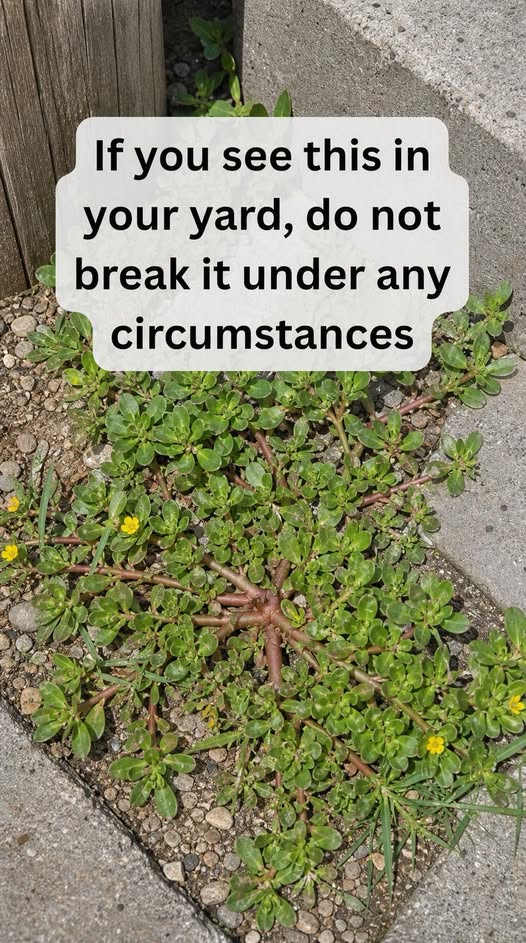
Purslane tends to grow close to the ground, spreading outward with thick, succulent-like stems and small rounded leaves. It can appear in gardens, along sidewalks, between paving stones, and in other places where you might least expect an edible plant to thrive.
Its appearance is easy to overlook.
Its nutritional profile is harder to ignore.
Purslane contains a variety of vitamins and minerals, including magnesium, calcium, potassium, and iron, along with antioxidant compounds that help protect cells from oxidative stress.
But one of its most unusual nutritional features is its omega-3 fatty acid content.
Plants containing meaningful amounts of omega-3s are relatively uncommon, and purslane is particularly notable because it contains alpha-linolenic acid, or ALA.
ALA is an essential fatty acid, meaning the body cannot make enough of it on its own and needs to obtain it from food.
That doesn’t mean eating purslane suddenly turns it into a miracle medicine.
It doesn’t.
But it does make this humble plant surprisingly interesting from a nutritional perspective.
And then there is the taste.
Purslane isn’t simply something you eat because it’s healthy.
It can actually be good.
The leaves have a crisp, juicy texture and a slightly tart, refreshing flavor. Some people describe it as mildly sour or lemony, while others notice a subtle vegetal taste.
Fresh purslane can be added to salads.
It can be mixed with other greens.
It works alongside grilled vegetables.
It can be stirred into soups or cooked dishes.
Or it can simply be scattered over a meal as a fresh garnish.
That versatility may explain why purslane has remained part of traditional cuisines in different parts of the world.
For centuries, people have looked at this plant and seen food rather than nuisance.
Modern nutrition research has also made purslane interesting because of compounds beyond its basic vitamins and minerals.
It contains antioxidants and plant compounds that researchers continue to study for their potential biological effects.
Purslane also contains magnesium, an essential mineral involved in hundreds of processes throughout the body.
Magnesium plays roles in muscle and nerve function, energy production, and normal blood pressure regulation.
However, it’s important not to turn that nutritional fact into a promise that purslane will treat headaches, migraines, anxiety, insomnia, or other medical conditions.
Food can contribute nutrients to the diet.
It isn’t a substitute for medical treatment.
Another fascinating component is melatonin.
Purslane naturally contains melatonin, the hormone involved in regulating the body’s sleep-wake cycle. That sounds extraordinary when you first hear it, but the amount obtained from an ordinary serving of a plant should not be treated like a sleep medication.
The same caution applies to tryptophan.
Purslane contains this amino acid, which the body uses in pathways involved in serotonin and melatonin production.
That makes it nutritionally interesting, but eating purslane shouldn’t be viewed as a guaranteed way to improve mood or sleep.
The real story is more grounded.
This little plant contains a surprisingly broad collection of useful nutrients and bioactive compounds.
And that’s enough to make it worth knowing.
Some people also explore purslane as part of a diet designed to support cardiovascular health. Its omega-3 content and overall nutritional profile make it an interesting addition to a balanced diet, although eating it should never be presented as a treatment for high cholesterol or heart disease.
There is another reason to be cautious.
Not every plant that looks like purslane actually is purslane.
Some wild plants can resemble edible species, and confusing one plant with another can have serious consequences.
If you’re considering eating something you’ve found growing outdoors, identification needs to be certain.
Don’t rely on a vague resemblance.
Don’t assume that a plant is safe simply because an online photograph looks similar.
And don’t harvest plants from areas that may have been treated with pesticides, herbicides, roadside chemicals, animal waste, or other contaminants.
A plant growing between patio stones may be edible in theory, but that doesn’t mean the particular plant growing in your yard is suitable for eating.
If you’re confident you’ve identified purslane correctly and it’s been grown or harvested from a clean, appropriate location, it can be a surprisingly useful addition to meals.
And suddenly, that little weed you’ve been pulling from the garden looks very different.
Instead of reaching immediately for weed killer, you might pause.
Look at the leaves.
Look at the stems.
Consider what you’ve been removing.
For generations, people have searched for food in places others overlooked.
Purslane is a perfect example of how nature doesn’t always package nutrition in something that looks valuable.
Sometimes it arrives as a plant growing between stones.
Something you step over.
Something you pull out.
Something you throw away.
And sometimes, with the right identification and a little knowledge, that same plant can become part of dinner.
The next time you see those thick, fleshy leaves spreading along the ground, don’t automatically assume they’re worthless.
Take a closer look.
Because the most surprising thing about purslane isn’t that it looks like a weed.
It’s that we’ve spent so much time treating it like one.
Just remember: the goal isn’t to eat every wild plant you find.
The goal is to know what you’re looking at.
And once you’re certain, you may discover that the little green plant you’ve been trying to destroy has been offering something useful all along.