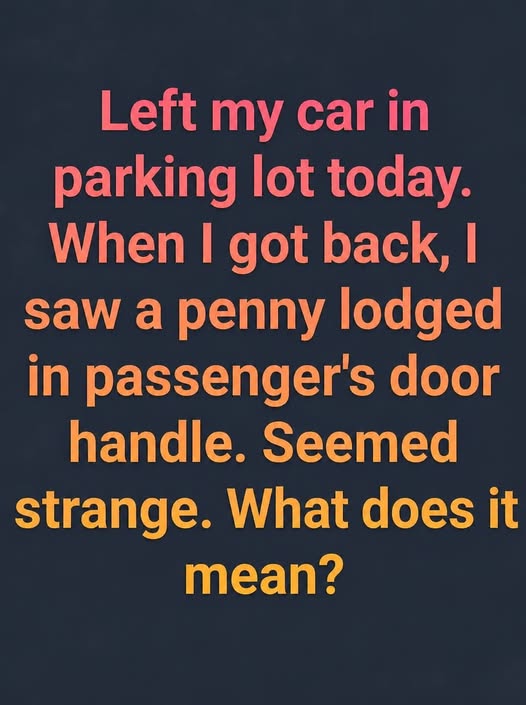
A single coin can stop your heart. You spot it jammed into your car door handle, and suddenly every viral warning you’ve ever scrolled past feels real. Is someone watching you? Are you being marked, targeted, tested? You hesitate in the parking lot, keys in hand, pulse racing, wondering if this tiny piece of metal means someone deliberately chose your car.
But the truth is far less dramatic than the internet often makes it sound.
Finding a coin wedged into your car door doesn’t automatically mean you’re moments away from being robbed. In many modern vehicles, a simple coin placed near the door handle or latch does not magically defeat the locking system. Depending on the vehicle and exactly where the object is placed, it may do nothing at all.
The coin itself isn’t the important part.
Your awareness is.
If you discover something unusual around your vehicle, don’t immediately assume the worst—but don’t rush past it either. Take a moment to look around before getting inside. Is anyone standing unusually close to your vehicle? Does anything else appear disturbed? Is another door open? Are there scratches, damage, or other signs that someone may have tampered with the car?
And most importantly, check whether your vehicle actually locked.
Modern cars can behave differently depending on the model, keyless-entry system, and circumstances. A door may appear closed without necessarily being secured in the way you expect. Before driving away, make sure the doors are properly locked and that nothing else about the vehicle seems unusual.
The viral stories surrounding coins in car doors often turn a relatively ordinary object into evidence of an elaborate criminal strategy.
That can create unnecessary fear.
A coin may have been placed there as a prank.
It may have fallen or become lodged accidentally.
Someone may have done something unrelated to theft.
Or, in some circumstances, someone could indeed be attempting to interfere with a vehicle.
The object alone doesn’t tell you which explanation is true.
That’s why context matters more than the coin.
If you notice a coin and everything else around your car looks completely normal, there’s no reason to assume you’ve been selected by a sophisticated criminal operation. But if the discovery is accompanied by other suspicious circumstances, that’s when you should take the situation more seriously.
For example, imagine walking toward your car late at night and noticing the coin. You also see someone lingering nearby who appears to be watching you.
That’s different.
Or perhaps you notice damage around the lock, an open door, a broken window, or belongings that appear disturbed.
That’s different too.
In those situations, you don’t need to investigate the mystery yourself.
You can simply walk away.
Go somewhere brighter.
Enter a nearby business.
Ask security personnel for help.
Call someone you trust.
If you believe a crime is occurring or you are in immediate danger, contact local emergency services or law enforcement.
Your safety is more important than finding out why a coin was there.
There is another useful habit that can prevent problems regardless of whether a coin is involved: develop a routine for checking your vehicle.
Before walking away, make sure the doors are locked.
Don’t leave valuables visible inside.
Pay attention to your surroundings when entering or leaving a parking area.
If something feels unusual, give yourself permission to pause.
You don’t have to prove that you’re brave by walking toward something that makes you uncomfortable.
At the same time, you don’t need to live in fear of every strange object you encounter.
That’s where viral warnings can become counterproductive.
A frightening story spreads because it creates an immediate emotional reaction. “A coin means you’re being targeted” is much more memorable than “sometimes an unexplained object may be meaningless.”
But memorable doesn’t necessarily mean accurate.
The safest response is somewhere between panic and complacency.
Don’t assume the coin means nothing.
Don’t assume it means everything.
Look at the circumstances.
Check your vehicle.
Observe your surroundings.
Trust reasonable instincts.
And if the situation genuinely feels unsafe, leave.
The tiny piece of metal isn’t what determines whether you’re in danger.
Your surroundings, the condition of your vehicle, the behavior of people nearby, and the evidence of actual tampering are far more informative.
So if you ever find a coin unexpectedly wedged into your car door, take a breath.
Look around.
Make sure the vehicle is secure.
And if something else doesn’t feel right, don’t stand there trying to solve the puzzle.
Move somewhere safe first.
You don’t need to live in fear of every viral warning.
But you also don’t have to ignore that quiet, nagging feeling that tells you to pay closer attention.