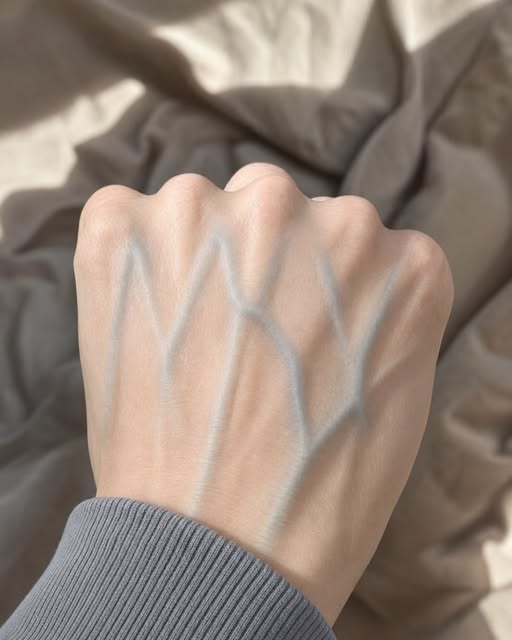
Your veins are not just showing—they’re shouting. One day your skin looks completely normal, and the next, blue lines seem to stand out across your hands, arms, legs, or chest. You tell yourself it’s age. Maybe it’s the gym. Maybe you lost some weight. Maybe it’s simply the heat. Often, there is a harmless explanation. But when a change is sudden, dramatic, painful, or accompanied by other symptoms, it can be worth paying attention instead of automatically dismissing it.
Your veins are messengers, but visible veins do **not** automatically mean something dangerous is happening. Veins can become more noticeable for completely ordinary reasons. Lower body fat can make them easier to see. Exercise temporarily increases blood flow and can make veins appear more prominent. Hot weather causes blood vessels near the skin to widen. Pregnancy and hormonal changes can alter circulation, while long periods of standing or sitting can also make veins more noticeable.
The important distinction is **what has changed**.
If veins suddenly become much more prominent, especially when they appear twisted, enlarged, or knotted, they may be associated with conditions such as varicose veins or chronic venous insufficiency. In venous insufficiency, valves inside the veins don’t work effectively, allowing blood to pool rather than moving efficiently back toward the heart.
That pooling can create more than a cosmetic change.
Some people experience aching or throbbing.
Others notice heaviness, burning, itching, swelling, or tiredness in the affected leg, particularly after standing for long periods. Over time, chronic venous problems can contribute to skin changes and, in more advanced cases, sores or ulcers around the lower legs and ankles.
But there is another reason sudden changes deserve attention: not every swollen or painful vein is simply a varicose vein.
A blood clot in a deep vein, known as deep vein thrombosis or DVT, can cause swelling, pain, warmth, or redness, often affecting one leg more than the other. A DVT can be dangerous because part of the clot can break away and travel to the lungs, causing a pulmonary embolism.
That does **not** mean every visible vein is a blood clot.
It means that certain combinations of symptoms should never be ignored.
A new, unexplained swelling in one leg is different from veins that have always been visible.
A painful, warm, red area is different from ordinary veins becoming more noticeable after exercise.
And sudden shortness of breath, chest pain, coughing up blood, fainting, or severe difficulty breathing requires urgent medical attention because those symptoms can occur with a pulmonary embolism.
The body can give subtle signals before a problem becomes obvious, but it is important not to turn every visible change into a worst-case scenario.
Sometimes the explanation is simple.
You lose weight and suddenly notice veins you couldn’t see before.
You spend an hour exercising and your arms look dramatically more vascular.
The temperature rises and the veins in your hands become more prominent.
You have been standing all day and your legs look different by evening.
None of these automatically indicates a dangerous condition.
The real warning sign is a **new pattern that doesn’t make sense for you**, especially when it persists or comes with other symptoms.
Pay attention to whether one side looks noticeably different from the other. Notice whether there is swelling. Look for changes in color or temperature. Pay attention to pain, tenderness, heaviness, burning, or a sensation that wasn’t there before.
And don’t rely on photographs or internet searches to diagnose what you are seeing.
A healthcare professional can examine the area, review your symptoms and risk factors, and determine whether further testing is appropriate. If a blood clot is suspected, imaging such as an ultrasound may be used to investigate it.
Your body is not necessarily “shouting disaster” every time a vein becomes visible.
Sometimes it’s simply showing you what was already there.
But when something changes suddenly, your job isn’t to panic.
It’s to notice.
New veins.
New swelling.
New pain.
New warmth or redness.
A significant difference between one leg and the other.
Those changes deserve attention rather than dismissal.
Because the safest approach isn’t assuming that every visible vein is dangerous—or assuming that none of them could be.
It’s knowing the difference.
Your veins may be completely harmless.
But if your body is showing you a pattern you’ve never seen before, don’t guess for weeks and hope it disappears. Pay attention, seek appropriate medical advice, and let a professional determine whether there’s actually something that needs treatment.