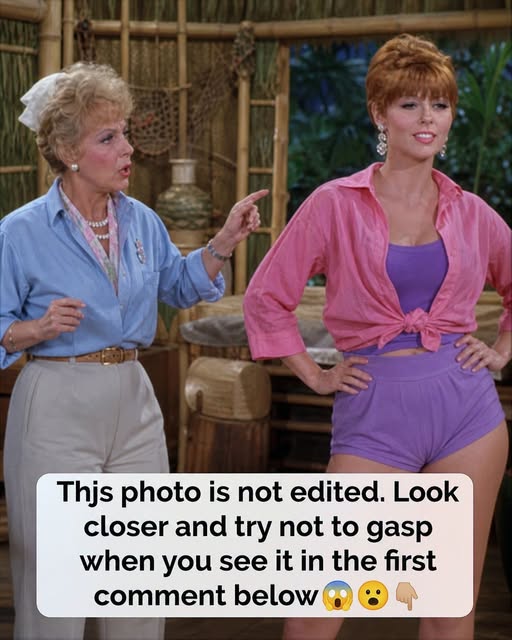
The illusion shatters in a single frame.
One moment, you’re completely lost in the goofy charm of *Gilligan’s Island*; the next, you’re counting eight people on a boat that supposedly carried only seven. A stray building suddenly appears beyond the palm trees. A microphone shadow seems to ripple across the “ocean.” A piece of studio equipment catches the light. And for a second, the tropical fantasy collapses, revealing the machinery that created it.
But somehow, those mistakes make the show even more fascinating.
Once you start looking closely, you begin noticing things that were never supposed to be seen. Stand-ins appear where characters should be. The edges of studio tanks become visible. Equipment emerges beneath supposedly endless Pacific waters. Background structures sit just beyond the carefully constructed scenery. What once looked like a perfect deserted island suddenly reveals itself as a television set assembled under pressure.
Yet these aren’t simply bloopers.
They’re windows into how television was actually made.
The crew had limited time, limited money, and an enormous amount of work to accomplish. They had to transform ordinary studio spaces, beaches, backlots, props, costumes, and camera tricks into a tropical world that audiences would accept as real.
And most of the time, they succeeded.
That is what makes the mistakes so charming.
They remind us that *Gilligan’s Island* wasn’t created by computers or unlimited digital effects. It was built by people physically moving scenery, constructing sets, positioning cameras, operating lights, and doing everything possible to make the illusion work before the next shooting day arrived.
The cast and crew were essentially building an entire world out of sand, lumber, paint, fabric, and imagination.
Sometimes the seams showed.
A stand-in might accidentally become visible.
A studio wall might slip into the background.
A microphone might enter the edge of a shot.
A reflection might reveal something that wasn’t supposed to exist.
But the audience kept watching.
The story was stronger than the mistake.
That is perhaps the greatest compliment a television show can receive.
If viewers are so invested in the characters that they overlook the machinery surrounding them, the illusion has already succeeded.
The S.S. Minnow itself becomes one of the most entertaining examples. The boat was supposed to feel like a stranded vessel carrying seven castaways, yet careful viewers can occasionally spot extra people or equipment during certain scenes. Sometimes what appears to be another character is a stand-in or crew member helping position a shot.
The fantasy says seven people.
The production sometimes says otherwise.
Then there are the buildings.
The island was supposed to be isolated from civilization, but viewers with sharp eyes can occasionally spot structures beyond the carefully positioned foliage. Once you know what you’re looking for, those little intrusions become almost impossible to ignore.
The same thing happens with the water.
Scenes that appear to take place in the endless Pacific were often filmed using controlled studio environments. Tank edges, lighting equipment, and other production elements could occasionally become visible.
Today, viewers might expect visual effects to erase such imperfections instantly.
Back then, the goal was different.
The camera had to be positioned correctly.
The set had to be constructed convincingly.
The actors had to hit their marks.
The crew had to capture the scene.
And then everyone moved on.
There wasn’t always time or money to obsess over every tiny detail.
The show also contains strange little moments that reveal the personalities of the actors themselves.
The Professor, famously portrayed as highly knowledgeable and controlled, can occasionally be seen doing things that seem inconsistent with the character’s established traits.
Gilligan’s real wedding ring has also become one of those details eagle-eyed viewers enjoy spotting.
And then there are the physical details of the cast themselves—the little signs of real human life that no television makeup department could completely erase.
Mrs. Howell’s eyes, for example, can remind viewers that behind the glamorous character was a real actress living through the same passage of time as everyone watching.
These details become more poignant when viewed from the present.
The cast that once seemed permanently frozen in television history was never actually frozen at all.
People aged.
People married.
People lost loved ones.
People continued their lives after the cameras stopped.
And some eventually disappeared from the world entirely.
That reality is particularly striking when the show is viewed through the historical circumstances surrounding its production.
At one point, flags visible during filming were lowered to half-staff following the assassination of President John F. Kennedy.
It is a tiny detail that could easily go unnoticed.
But suddenly, the fantasy island becomes connected to the real world.
While audiences were watching a comedy about shipwrecked castaways, the country itself was experiencing grief.
The juxtaposition is strangely moving.
The characters were trapped on an imaginary island.
America was dealing with a very real tragedy.
And the cameras continued rolling.
That is one of the unexpected powers of old television.
It preserves more than scripted dialogue.
It captures fragments of the world that existed around the production—the clothes people wore, the technology they used, the buildings surrounding the set, the historical events happening outside the studio, and even the imperfections that modern productions would immediately remove.
The mistakes become time capsules.
They show us how people actually worked.
How much effort went into creating entertainment.
How little technology was available compared with today.
And how much depended on human ingenuity.
The cast members themselves left fingerprints throughout the production.
Actors brought their own habits, expressions, physical characteristics, and personal histories into the characters they played.
Sometimes those details contradicted the fictional world.
Sometimes they made the characters feel more believable.
And sometimes they simply created funny continuity mistakes that fans could discover decades later.
That’s part of why *Gilligan’s Island* remains so enjoyable to revisit.
You can watch it once for the story.
Then again for the jokes.
Then again to look for mistakes.
And eventually, you realize that the mistakes are part of the story too.
They reveal the people behind the illusion.
Today, with most of the original cast gone and Tina Louise the last surviving member of the seven main castaways, those imperfections carry an additional emotional weight.
A microphone shadow isn’t just a technical mistake anymore.
A visible stand-in isn’t merely a continuity error.
A studio wall isn’t simply something that slipped into the frame.
They are reminders that real people built this imaginary world.
People stood behind the cameras.
People moved props.
People painted sets.
People operated equipment.
People waited for actors to hit their marks.
People laughed when something went wrong.
And then they did it again.
That’s what lingers beneath the comedy.
The show wasn’t perfect.
The island wasn’t real.
The ocean wasn’t always the ocean.
The boat didn’t always contain exactly seven people.
And the camera occasionally betrayed the illusion.
But perhaps perfection was never the point.
The magic came from the fact that everyone involved convinced millions of viewers to believe for a little while.
They made a few pieces of wood, some painted scenery, a boat, a handful of costumes, and a group of talented actors feel like an entire world.
And now, decades later, the cracks in that world are part of its charm.
Once you start noticing the stand-ins, the visible tank edges, the stray buildings, the equipment, and the tiny inconsistencies, you can’t unsee them.
But instead of ruining the show, they may make you appreciate it more.
Because every mistake tells you something.
Someone was there.
Someone built that set.
Someone held that camera.
Someone created that illusion.
Someone gave millions of viewers a place to escape for half an hour.
The lagoon may have been artificial.
The island may have been a studio.
The mistakes may have been real.
But the memories they created were anything but.