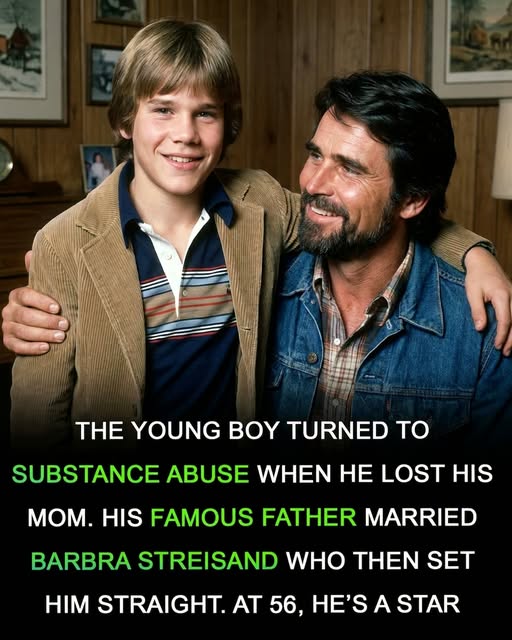
Josh Brolin’s childhood was not a fairy tale. It was a test of survival. Behind the Hollywood name, the famous father, the red carpets, and the future blockbuster roles was a boy who learned far too early that home could be unpredictable and frightening. Fame, money, and awards could never completely erase the memories he carried from those years.
One of the strangest and most disturbing memories involved his mother and the wild animals that sometimes surrounded their property. Brolin has spoken about childhood experiences in which his mother would encourage or allow frightening encounters with animals, turning moments of genuine danger into something that felt almost like a game.
For a child, however, there was nothing entertaining about being chased by something larger and more powerful than you.
He remembered the fear.
He remembered running.
He remembered wondering whether the adults around him understood how terrifying the situation actually was.
And yet, despite those memories, he still craved his mother’s presence.
That contradiction would follow him for years. Childhood relationships are rarely simple, especially when love and fear exist side by side. A child can recognize that something is frightening while still desperately wanting affection from the person responsible for creating that fear.
Brolin eventually grew up and entered Hollywood himself.
The industry offered him opportunities, recognition, money, and a career that would eventually span decades. He became known for dramatic performances and major blockbuster roles, eventually appearing in films and television projects that turned him into one of the industry’s most recognizable actors.
But success didn’t erase the past.
If anything, it gave him more room to confront it.
Loss became one of the major turning points in his life.
His mother died at just 55.
For Brolin, that number carried a particular weight.
It wasn’t simply the age at which he lost his mother. It became a number that forced him to think about his own mortality and the assumptions he had made about how much time he had.
When he eventually reached and passed the age at which his mother died, something shifted.
He had outlived her.
That realization forced him to confront a truth he had once avoided: life could end much earlier than people imagine, and the future was never guaranteed.
Instead of treating aging as something to fear, he began seeing it differently.
Growing older became evidence that he had survived.
It meant he had been given time his mother never received.
It meant he had opportunities to change things he once believed could never change.
But getting there wasn’t easy.
Addiction had followed Brolin through much of his life.
He has spoken publicly about experimenting with drugs when he was still young, long before he understood how deeply addiction could eventually affect a person’s life. What may begin as curiosity or rebellion can gradually become something far more difficult to control.
For Brolin, alcohol eventually became another major problem.
There were years when drinking wasn’t simply an occasional escape. It became part of the chaos he was trying to outrun.
One of the moments that forced him to confront himself came when he was visiting his 99-year-old grandmother on her deathbed.
Instead of arriving fully present, he showed up hungover.
The contrast was devastating.
His grandmother was nearing the end of an extraordinarily long life, while Brolin was still young enough to change the direction of his own.
Standing beside her, he was confronted with the difference between simply existing and actually living.
The shame finally broke through.
He couldn’t continue pretending that his drinking wasn’t a serious problem.
And other people around him weren’t willing to let him pretend either.
His stepmother, Barbra Streisand, was among those who confronted him with painful honesty.
She didn’t soften the problem into vague language.
She called his alcoholism what it was.
That kind of confrontation can be uncomfortable, especially for someone who has spent years finding explanations for destructive behavior. But sometimes the person who loves you most is the person willing to tell you something you don’t want to hear.
Brolin needed that honesty.
Tough love became part of the process of breaking through his denial.
He had spent years believing that chaos was simply part of his personality, part of his upbringing, perhaps even part of what made him strong.
But strength and self-destruction are not the same thing.
Surviving something doesn’t mean you have to keep repeating it.
Eventually, Brolin chose sobriety.
And with sobriety came something he hadn’t always known how to experience: time.
Clear time.
Time without waking up wondering what he had done.
Time without allowing alcohol to dictate his decisions.
Time to be present for his family.
Time to work without constantly fighting the consequences of his own behavior.
Time to look back at the child he had been and understand that surviving childhood did not mean he had to remain trapped inside it.
Now, aging carries a different meaning for him.
At 56, he could look back at the years he once assumed might disappear in chaos and recognize how valuable they actually were.
Every additional birthday became a kind of victory.
Not because getting older is easy.
Not because the past suddenly disappears.
But because he had made it through.
He had outlived the age that once seemed significant because his mother had died so young.
He had survived addiction.
He had survived grief.
He had survived years of believing that certain patterns were simply unavoidable.
And he had chosen something different.
Life.
That choice doesn’t erase everything that happened.
The memories of childhood remain.
The loss of his mother remains.
The years affected by addiction cannot simply be rewritten.
But recovery doesn’t require pretending the past never happened.
Sometimes it means finally looking directly at the past without allowing it to control the future.
Brolin’s story is therefore less about Hollywood than it is about survival.
The awards, films, characters, and fame are only the visible part.
Behind them is a man who learned that a difficult childhood doesn’t have to become a permanent destiny.
A person can inherit chaos without passing it forward.
A person can struggle for decades and still change.
A person can reach an age they once feared and discover that getting older isn’t a punishment.
It is a privilege.
And perhaps the most powerful part of Brolin’s story is that he no longer seems interested in pretending he was always okay.
He wasn’t.
He struggled.
He made mistakes.
He hurt himself.
He disappointed people.
He nearly allowed addiction to become the defining story of his life.
But it didn’t have to be.
Now, sobriety has given him the chance to experience the years he once risked losing.
The boy who once ran from danger eventually learned to stop running from himself.
The grieving son learned to live beyond his mother’s early death.
The man who once stumbled into a deathbed hungover learned to value the ordinary miracle of waking up clear.
And the actor who spent much of his life playing characters built for the screen has discovered that his most important role was never fictional at all.
It was simply choosing, day after day, to remain alive.
To grow older.
To stay sober.
To be present.
To keep going.
For Josh Brolin, that may be the greatest second chance of all.