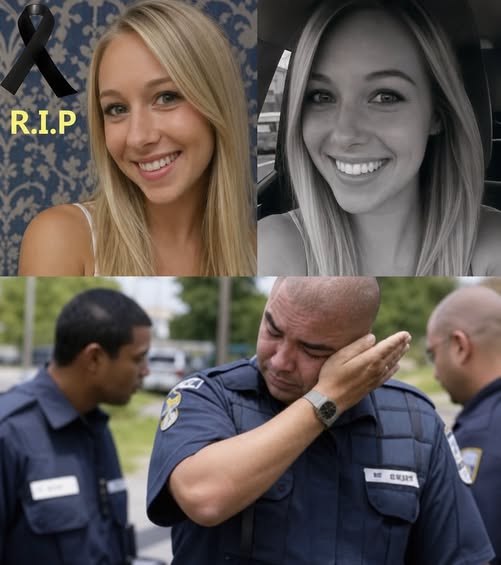
I couldn’t shake the story. Two 18-year-old twins, missing for days, a desperate city-wide search, and then the worst possible ending. The posts were raw, pleading, and unforgettable, spreading rapidly as people shared their photos and expressed fear for their safety. But when people started asking the simplest questions—Where did this happen? Which police department was involved? What was the family’s name?—the answers suddenly collapsed into silence. No surnames. No clear city. No case number. No identifiable police agency. Just grief without a verifiable story behind it.
The tale of Carolina and Luiza shows how easily the internet can manufacture certainty out of almost nothing. Article after article repeats the same haunting outline: teenage twins disappear, volunteers begin searching, authorities investigate, and a community is left mourning. The wording may change slightly from one post to another, but the emotional structure remains almost identical. Yet when you look for the anchors that define real cases—full names, specific locations, police statements, case numbers, local reporting, or identifiable family members—everything begins to dissolve into vagueness. “The city.” “Authorities.” “Police.” “The family.” The emotional details feel sharp and specific; the verifiable details are strangely absent.
That contrast should make any careful reader pause. A genuine missing-person case normally leaves a trail of information. There may be a police department asking for tips, a missing-person bulletin, a local news report, a family statement, a specific date and location, or some other identifiable record. None of those details automatically proves that a story is true, but their absence becomes significant when a supposedly major tragedy is being presented as established fact.
The internet makes this especially difficult because repetition can create the illusion of verification. One page publishes a dramatic story. Another copies the wording. A third reposts the same photograph with slightly different details. Soon, dozens of pages appear to be reporting the same event. But twenty copies of the same unverified claim are still one unverified claim.
The emotional intensity can make that distinction even harder to notice.
People see photographs of two young women and immediately imagine their parents waiting for them to come home. They imagine search teams walking through streets, volunteers calling their names, and families receiving devastating news. Those emotions are understandable. Nobody should become so skeptical that they stop caring about people simply because a story appeared online.
But compassion and verification do not have to compete.
Responding wisely means holding two truths at once. First, missing-person cases are real, urgent, and deserve compassion. Families living through them experience unimaginable uncertainty, and every legitimate lead can matter. Second, compassion does not require believing every viral tragedy without question. Caring about victims also means being careful not to attach a real person’s name, family, city, or fate to a story that has not been established.
That is why the absence of basic information matters.
If Carolina and Luiza are real missing people connected to a real case, there should ultimately be some identifiable source that can establish who they are and where the case occurred. If the story is legitimate but incomplete, the original source should be able to provide those details. If the information cannot be traced beyond recycled social-media posts, then certainty is not justified.
And that is where responsible readers have an important role.
Instead of immediately sharing the story with dramatic captions, ask simple questions.
What is the full surname?
Where did the disappearance happen?
When were they last seen?
Which police department is investigating?
Is there an official missing-person notice?
What local news organization reported it?
Where did the original photograph come from?
Can the family or authorities be independently identified?
These questions are not cruel.
They are responsible.
They do not mean you doubt every family experiencing tragedy. They mean you understand that the internet can turn uncertainty into certainty faster than facts can catch up.
There is another danger in accepting an unverified story as fact: it can unintentionally hurt the very people readers are trying to support. False reports can create panic, encourage harassment, send strangers searching in the wrong places, and overwhelm legitimate authorities with misinformation. They can also exploit photographs of real people who have nothing to do with the story.
That is why refusing to invent missing details is so important.
If the city is unknown, say the city is unknown.
If the surnames cannot be verified, do not create them.
If the police department has not been identified, do not name one simply because a similar case exists.
If the outcome cannot be confirmed, do not turn a rumor into a death announcement.
A blank space is better than a fabricated fact.
The temptation to fill those spaces is understandable. Readers want complete stories. Writers want dramatic narratives. Social-media pages want engagement. But reality does not always arrive with a perfect beginning, middle, and ending.
Sometimes the honest answer is: **we don’t know yet.**
That answer may feel unsatisfying, but it protects the truth.
It also protects real families.
Imagine discovering that thousands of strangers are sharing a fabricated story about your missing daughter, sister, or friend. Imagine seeing people confidently discuss her death even though you are still searching for her. Imagine watching strangers invent details about your family because the original post left them out.
That is not compassion.
That is another form of harm.
The Carolina and Luiza story therefore becomes a useful lesson in how to navigate viral grief. Emotional language should never substitute for evidence. A photograph should not automatically be treated as proof. Repetition should not be confused with confirmation. And a dramatic narrative should not be allowed to fill gaps that the available evidence cannot support.
None of this means we should become cynical.
It means we should become careful.
There is a difference between saying, “I don’t believe this,” and saying, “I cannot verify this yet.”
The second response leaves room for reality.
If reliable evidence eventually appears, the story can be evaluated again. If authorities confirm the case, the information can be shared responsibly. If the original source provides names, locations, records, and statements, the uncertainty can begin to disappear.
Until then, restraint is appropriate.
In a world where content can be copied thousands of times in minutes, verification has become an act of respect. It means slowing down when everyone else is rushing to share. It means asking for sources before repeating devastating claims. It means recognizing that behind every photograph may be a real person whose life deserves accuracy as much as sympathy.
The most responsible response to the story of Carolina and Luiza is therefore not to manufacture an ending.
It is to acknowledge what can and cannot be established.
The story may represent a real tragedy.
It may be incomplete.
It may have been distorted through repeated reposting.
Or it may be entirely unverified.
Without reliable sources, we simply cannot know.
And admitting that uncertainty is not a failure of compassion.
It is compassion with responsibility attached.
In the end, careful readers become a quiet form of justice. They refuse to turn someone’s possible suffering into entertainment. They refuse to add fictional details simply because the original story left gaps. They refuse to let repetition replace evidence.
They still care.
They still hope missing people are found.
They still understand the pain families experience.
But they also understand that truth matters, especially when the subject is someone’s life, disappearance, or death.
In a digital world filled with copy-and-paste grief, sometimes the most humane thing you can do is stop, ask for the source, and say:
**Before we share this as fact, let’s make sure it is true.**