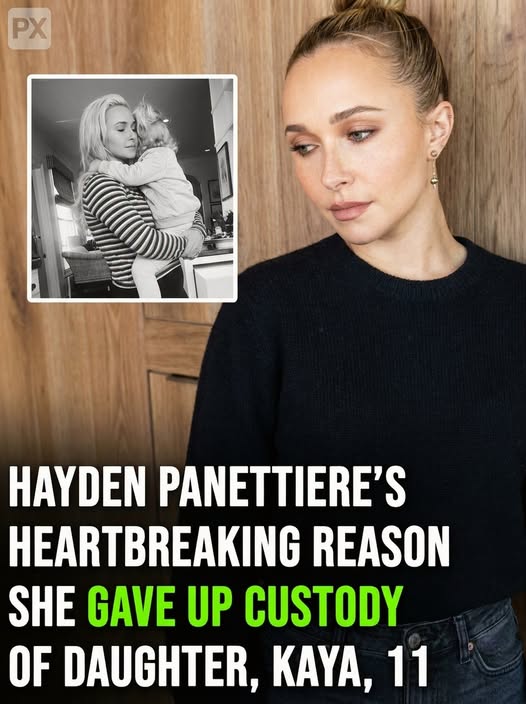
Hayden Panettiere is gone, and the truth behind one of the most painful decisions of her life is breaking hearts all over again. Fame, addiction, motherhood, and the darkness of postpartum depression pushed her into a choice no parent ever wants to face: stepping back from raising her only child, Kaya, on a daily basis. It was not a decision she described as easy or painless. She called it “gut-wrenching,” and the grief surrounding it followed her for years. To the outside world, giving up custody could look like abandonment. But for Hayden, the decision was rooted in something far more complicated—a painful belief that loving her daughter sometimes meant admitting that she was not yet capable of giving her the stable life Kaya deserved.
Hayden Panettiere’s life looked golden from the outside. She had become a successful child actress, grown into a recognizable Hollywood star, and earned millions of fans through roles in *Heroes* and *Nashville*. Cameras captured her smiling at premieres, walking red carpets, and standing confidently beneath the bright lights of an industry she had known since childhood. But behind that polished image, Hayden was fighting battles that could not be solved by fame or money. Her personal struggles became increasingly difficult, and after Kaya’s birth, postpartum depression added another layer of darkness to an already complicated period in her life. At the same time, she was struggling with addiction, making it harder to maintain the stability she desperately wanted.
Motherhood was supposed to be one of the happiest chapters of her life, yet it also confronted her with fears she could not simply perform her way through. Hayden understood that raising a child required consistency, safety, patience, and emotional stability. She also knew that her own life had become chaotic and unpredictable. The person the public saw on magazine covers was not necessarily the person she felt she was behind closed doors. She was dealing with pain that affected her ability to function, while simultaneously carrying the enormous responsibility of being a mother.
That realization forced Hayden to confront one of the hardest questions imaginable: what was truly best for Kaya? A parent can love a child with every part of their heart and still recognize that they are struggling to provide the environment that child needs. For Hayden, acknowledging that reality was devastating. She did not stop loving her daughter. If anything, the decision came from a place of love so painful that she was willing to sacrifice the part of motherhood she wanted most—the ordinary, everyday presence of being there.
Ultimately, Hayden allowed Kaya’s father, former heavyweight boxing champion Wladimir Klitschko, to take primary custody of their daughter. The decision meant that Kaya would have greater stability while Hayden worked through her own struggles. It also meant Hayden had to live with an absence that could not be fixed by a phone call or a public appearance. She could still love her daughter, speak with her, and remain part of her life, but she could not always be there for the moments that other mothers might take for granted.
That reality haunted her. There were bedtime stories conducted over FaceTime instead of beside a child’s bed. There were birthdays, holidays, school moments, and milestones experienced from a distance. There were ordinary afternoons she could not simply walk into. Those moments may sound small to people outside the situation, but for a mother who desperately wanted to be present, they could carry enormous emotional weight.
Hayden later spoke honestly about how painful the arrangement was. She did not pretend that stepping away had been easy or that she had somehow escaped the consequences without suffering. She understood exactly what she had lost. She had to watch parts of her daughter’s childhood unfold from a distance while knowing that another parent was providing the stability she felt unable to provide at that moment.
There is a particular kind of grief that comes with being separated from someone you love while knowing the separation may be necessary. It is not the grief of losing someone forever. It is the grief of missing pieces of a life that is continuing without you physically present for every moment. Hayden had to live with that complicated reality. Kaya was growing, learning, changing, and becoming her own person, while her mother had to work on becoming healthy enough to be the mother she wanted to be.
For Hayden, the decision was also connected to her own childhood experiences. She had grown up in an entertainment industry that demanded an enormous amount from her at an early age. She knew what it felt like for childhood to be shaped by circumstances that were far from ordinary. She wanted something different for Kaya. She wanted her daughter to have stability and protection from the chaos that had become part of her own adult life.
That may be the most heartbreaking part of the story. Hayden was not simply deciding whether she wanted custody. She was confronting the kind of mother she wanted to become. She could either insist on keeping Kaya close while struggling to maintain stability, or accept the pain of distance while giving her daughter an environment that felt safer and more predictable. Neither option was painless. She chose the one she believed would protect Kaya.
The decision did not mean Hayden disappeared from her daughter’s life. She remained Kaya’s mother. The bond between them did not vanish simply because they were not living together every day. Love does not depend entirely on physical proximity. Hayden could still call, talk, listen, celebrate, encourage, and remain emotionally connected. But she also had to accept that there were moments she could not personally witness.
For someone accustomed to having millions of people watch her every move, that private loss must have been especially difficult. The world could see Hayden on television, but it could not see the moments when she was alone with the pain of missing her daughter. The cameras captured performances and red-carpet appearances. They did not capture the quiet moments after a video call ended, when the screen went dark and Hayden was left with the reality of how much she missed.
Her struggle also challenges the simplistic way society often talks about motherhood. There is an expectation that a mother should always be able to handle everything, regardless of her circumstances. But addiction, postpartum depression, trauma, and emotional instability can overwhelm even someone who desperately wants to do the right thing. Asking for help does not necessarily mean a parent does not care. Sometimes, recognizing the need for help is the first responsible decision a parent can make.
Hayden’s story is therefore not simply about a mother who “gave up” custody. That description misses the emotional complexity of what happened. She made a painful decision while struggling with serious personal issues and believing that her daughter needed stability. The choice cost her deeply. She lost the everyday moments she wanted, endured judgment from people who did not know the full story, and carried the guilt of wondering whether she was failing the child she loved most.
But there was another side to the decision: Hayden was trying to put Kaya’s needs ahead of her own wishes. She wanted her daughter to have a childhood that was not dominated by instability. She wanted Kaya to grow up feeling safe, loved, and protected. Sometimes love looks like holding someone close. Sometimes, tragically, it looks like stepping back because you know you are not yet capable of giving them what they need.
Her journey toward recovery was never presented as simple. There were setbacks, painful revelations, and difficult conversations. But there were also moments when Hayden tried to rebuild her relationship with herself and with the people she loved. She became increasingly open about her experiences, discussing addiction and postpartum depression in the hope that other people would recognize that they were not alone.
Her willingness to speak publicly about those struggles gave another dimension to her story. Instead of pretending that fame had protected her from pain, she acknowledged that being famous could sometimes make private suffering even harder. People assumed they knew her because they had watched her on television, yet very few understood what she was experiencing when the cameras were gone.
Kaya also became part of the reason Hayden continued trying to move forward. Her daughter represented not only something Hayden loved, but something she wanted to protect. The hope was that by confronting her own problems, she could eventually build a healthier relationship with her child. The goal was never to erase the years that had been difficult. It was to make the years ahead better.
That is why Hayden’s decision should not be remembered only as a heartbreaking loss. It should also be understood as an act of painful responsibility. She knew that being physically present was not enough if she could not provide emotional stability. She knew that a child needs more than a famous mother. A child needs safety, consistency, and someone capable of being there when life becomes difficult.
Hayden paid an enormous emotional price for making that choice. She missed moments she could never get back. Childhood moves forward only once. A bedtime story missed cannot be repeated years later in exactly the same way. A birthday happens once. A first step, first day of school, or ordinary family afternoon can become precious precisely because it cannot be recreated. Hayden knew she was surrendering some of those memories, and that knowledge hurt.
Yet her love for Kaya remained unmistakable. She did not choose distance because she wanted less of her daughter. She chose it because she believed Kaya deserved more stability than Hayden could provide at that particular time. That distinction matters. Sometimes the most loving decision is also the one that causes the greatest personal pain.
Now that Hayden is gone, those choices are being viewed through an even more emotional lens. People naturally look back at her life and wonder what she was carrying, what she feared, and what she hoped would happen. Her death cannot change the decisions she made, but it can change how people understand them. The woman who stepped away from daily custody was not necessarily walking away from motherhood. She was a woman struggling to survive while trying to protect the child she loved.
Her story leaves behind a difficult lesson about love and sacrifice. Parents are often told that love means being there every second, but real life is more complicated. Sometimes circumstances force parents to make impossible choices. Sometimes protecting a child means admitting that you need help. Sometimes love means accepting that someone else can provide something you temporarily cannot.
Hayden Panettiere wanted to be a mother. She wanted to be present. She wanted to give Kaya the childhood she believed every child deserved. Her struggles made that dream painfully complicated, but they never erased the love underneath it.
The world knew Hayden as a star. Kaya knew her as her mother. That distinction matters more than any headline. Behind the actress, behind the addiction headlines, behind the painful interviews and public scrutiny, there was a woman who loved her daughter and was willing to endure an enormous amount of personal grief because she believed it could give that daughter a safer and more stable life.
She called the decision “gut-wrenching.” She lived with the grief of missing moments. But perhaps the most heartbreaking truth is that she was willing to lose the everyday closeness she wanted most if it meant Kaya could have the stability she needed.
In the end, Hayden’s decision was not simply about giving something up. It was about trying to give something to her daughter: safety, stability, and a chance to grow beyond the chaos that had once surrounded her mother. And that may be the most painful form of love there is—the kind that asks a person to step away from what they desperately want so the person they love can have a better chance at life.