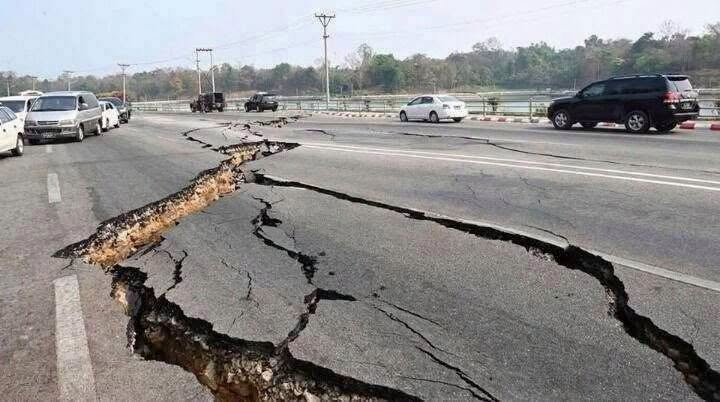
Panic hit before the dust even settled. Phones lit up, alarms blared, and families rushed into the streets as the ground convulsed beneath them. In a matter of seconds, ordinary routines disappeared and were replaced by confusion, fear, and the instinct to get somewhere safe. From crowded neighborhoods in Lashio to remote communities across Yunnan and northern Thailand, people were forced to confront how fragile the idea of “normal” really is. Buildings that had seemed permanent suddenly felt uncertain, while sirens, rumors, and the threat of aftershocks kept thousands of people from knowing when it was safe to return indoors.
For many residents, the first moments were defined by instinct rather than information. People grabbed children, called relatives, searched for neighbors, and moved toward open spaces. Some stood in streets and fields staring at buildings they had entered only minutes earlier, wondering whether the structures were still safe. Others tried desperately to reach family members by phone as communication networks became overwhelmed by the sudden flood of calls and messages.
The shaking itself may have lasted only a short time, but its psychological impact continued long afterward.
In Lashio, residents gathered in open areas because returning home felt too risky. Families stayed close together, listening for additional tremors and watching buildings for signs of damage. Rescue teams moved through affected neighborhoods, checking houses, schools, markets, and other structures for cracks or hidden weaknesses that might not have been immediately visible.
Every sound seemed capable of triggering another wave of fear.
A door closing.
A vehicle passing.
A distant siren.
Even a small vibration beneath someone’s feet could make people wonder whether another earthquake was beginning.
Emergency shelters became temporary homes for people who were too frightened to sleep indoors. Thin mattresses, bottled water, blankets, and basic supplies offered some physical comfort, but they could not eliminate the uncertainty. Many residents knew that even if the first earthquake had passed, aftershocks could follow.
For families with young children, the experience was especially difficult. Parents tried to remain calm while quietly struggling with their own fear. Children who had never experienced a major earthquake before often had no way to understand why adults suddenly seemed nervous or why everyone had been told to leave the house.
The disaster therefore affected more than buildings.
It disrupted a sense of security.
Across the border in Yunnan and northern Thailand, the tremors produced similar reactions. Communities that had prepared for emergencies discovered both the value and the limitations of that preparation. Evacuation plans, warning systems, emergency drills, and public awareness campaigns could save precious time when people knew what actions to take.
But preparation could not eliminate uncertainty.
Residents still had to wonder whether older buildings were structurally sound. Families still had to locate loved ones. Authorities still had to assess roads, bridges, utilities, schools, and public buildings.
A building can appear fine from the outside while suffering damage that requires professional inspection.
That reality kept many people away from their homes even after the strongest shaking had stopped.
Emergency workers faced a difficult balance between moving quickly and remaining cautious. Rescue operations require speed, but entering a damaged structure without properly assessing the risks can place responders in danger as well.
Teams therefore worked methodically through affected areas, looking for people who might need assistance while documenting visible damage.
The uncertainty was made worse by the flood of information moving through phones and social media.
Some messages provided useful warnings.
Others were incomplete.
Some were exaggerated.
Some were simply rumors.
During a disaster, people naturally search for information, and that creates an environment where unverified claims can spread rapidly. A rumor about another major earthquake, a damaged bridge, or a collapsed building can trigger another wave of panic before authorities have time to confirm whether it is true.
For frightened communities, the difference between information and rumor can become critically important.
That is why official emergency updates matter so much during earthquakes and other disasters.
The hours following a major tremor are often filled with uncertainty because the full extent of damage may not be immediately visible. Rescue teams have to inspect areas carefully, communication systems may be strained, and some communities may be difficult to reach.
The absence of information can itself become frightening.
People may know that something happened but have no idea how severely their neighborhood was affected.
They may know their relatives are somewhere nearby but be unable to contact them.
They may see reports of damage in another city and wonder whether similar problems exist where they live.
That uncertainty can keep the nervous system on high alert long after the ground stops moving.
In Lashio, the sight of people sleeping outside carried a message that went beyond the immediate earthquake. It showed how quickly confidence in familiar surroundings can disappear.
A home normally represents safety.
After an earthquake, the same home can become a source of fear.
A bedroom that felt comfortable the night before can suddenly feel dangerous if cracks appear in the walls or ceiling.
A school that children normally associate with routine can become a place parents hesitate to send them.
A market filled with familiar faces can become an area people avoid until structural inspections are completed.
This is one reason earthquake preparedness cannot begin when the ground starts shaking.
By then, many of the most important decisions have already been made.
The strength of buildings matters.
Emergency planning matters.
Public education matters.
Warning systems matter.
Accessible evacuation routes matter.
And knowing how to respond during and after an earthquake matters.
The tremors across the region demonstrated that preparation is not simply a government responsibility. Families also benefit from knowing where to go, how to communicate, what emergency supplies to keep available, and which sources to trust when information becomes confusing.
Yet preparedness also has limits.
No plan can predict exactly how a disaster will unfold.
No drill can perfectly reproduce the fear of feeling the ground move beneath your feet.
No emergency kit can eliminate grief or uncertainty.
What preparation can do is reduce the number of decisions people have to make in the middle of chaos.
When the ground begins shaking, instinct takes over.
When the shaking stops, preparation helps restore control.
Across Southeast Asia, that distinction became painfully visible.
The earthquake exposed weaknesses, but it also revealed resilience. Neighbors checked on neighbors. Rescue workers entered damaged areas. Families shared supplies. Communities gathered in open spaces and waited together rather than facing the uncertainty alone.
That human response matters.
Natural disasters can destroy structures quickly, but recovery depends heavily on relationships between people.
Someone bringing water to an elderly neighbor matters.
Someone checking an empty-looking house matters.
Someone helping a frightened child matters.
Someone sharing verified information instead of spreading rumors matters.
These actions may seem small compared with collapsed buildings or damaged infrastructure, but they are part of how communities recover.
Eventually, the immediate panic begins to fade.
People return cautiously to damaged homes.
Businesses begin assessing losses.
Schools inspect buildings.
Authorities evaluate infrastructure.
Families begin thinking about what comes next.
But earthquakes leave psychological marks that can last much longer than the physical damage.
A person who has experienced strong shaking may react nervously to ordinary vibrations afterward. A child may become frightened when hearing an alarm. Someone who slept outside for several nights may struggle to feel safe indoors again.
Recovery is therefore not simply about rebuilding walls.
It is also about rebuilding confidence.
The earthquake became a stark reminder that geography alone does not determine disaster risk. The level of preparedness, building quality, emergency planning, public awareness, and community cooperation can all influence how devastating an event becomes.
The shaking itself cannot be prevented.
The vulnerability created before the shaking can sometimes be reduced.
That may be the most important lesson.
Safety is not something that begins when the sirens sound.
It begins years earlier, when buildings are designed, infrastructure is maintained, emergency plans are practiced, and communities learn what to do before the ground moves.
For the people who experienced the earthquake, those ideas were no longer abstract.
They had felt the ground move.
They had watched normal life disappear in seconds.
And they had seen how quickly fear can spread when nobody knows what will happen next.
But they also witnessed something equally powerful.
People helping people.
Rescuers continuing their work.
Families staying together.
Communities sharing limited resources.
And strangers offering reassurance when certainty was impossible.
The earthquake reminded everyone that the ground beneath us is never as permanent as it feels.
But it also showed that resilience can be built.
Not just into buildings.
Into communities.
Into emergency systems.
Into families.
And into the habits people develop long before the next tremor arrives.
Because when the ground finally starts moving, there is no time to begin preparing.
The real work has already been done—or it hasn’t.