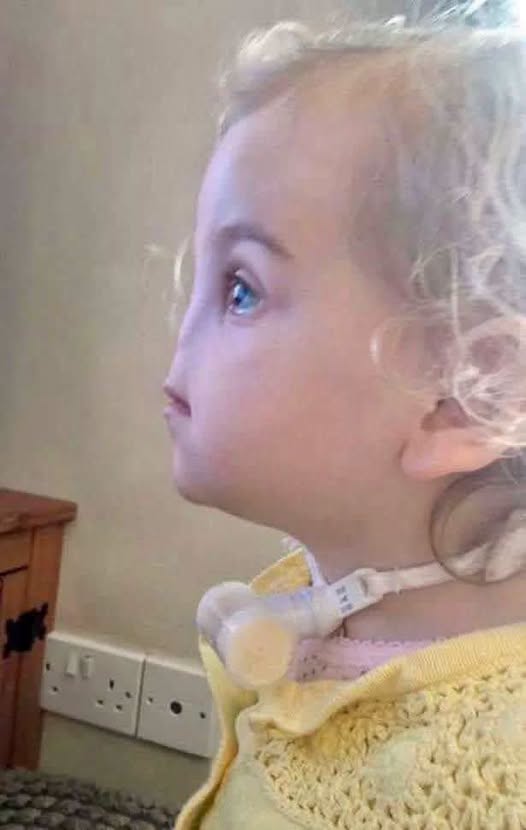
Tessa was born without a nose on Valentine’s Day. Doctors were stunned. Her parents, Grainne and Nathan, were terrified and overwhelmed by the reality facing their newborn daughter. Nothing had prepared them for the moment they first saw her, and suddenly the future they had imagined for their child seemed filled with questions they had never expected to ask. How would she breathe? How would she eat? What would her life look like? What medical procedures would she need? Yet from those first frightening moments came a decision that would change not only their daughter’s future, but also contribute to a remarkable chapter in modern reconstructive medicine. From private fears and radical surgery to painful procedures, cruel stares, and eventually a global community of support, Tessa’s story became one of determination, medical innovation, and a family refusing to let fear define their little girl.
Tessa was born with Bosma arhinia microphthalmia syndrome, an extremely rare congenital condition that affects the development of the nose and eyes. Her arrival was especially shocking because her parents had not been warned during pregnancy that their daughter might be born with such a significant difference. Instead of having time to prepare emotionally and medically, Grainne and Nathan were forced to absorb the news almost immediately after Tessa entered the world. Their initial reaction was filled with fear and grief—not because they loved their daughter any less, but because they suddenly understood how many challenges she might face.
Without a normally developed nose, breathing presented an immediate medical problem. Tessa could not simply breathe in the same way most newborn babies do, and her parents had to rely on doctors to determine how to keep her safe. At just two weeks old, she underwent a tracheostomy, creating an alternative airway so that she could breathe and feed more safely. For her parents, watching such a tiny baby undergo an invasive procedure was terrifying. Yet the operation was necessary to give her the basic ability to breathe while doctors considered what would come next.
That early surgery marked the beginning of a medical journey that would continue for years. Procedures that might sound extraordinary to most people became part of Tessa’s childhood. Her parents had to learn medical routines, monitor her closely, attend appointments, and make decisions about treatments that would affect her future. They were not simply raising a child; they were also learning how to navigate a complicated medical world while trying to give their daughter as normal and joyful a childhood as possible.
The challenge was never only medical. As Tessa grew older, her appearance naturally attracted attention. People stared. Some did not know how to react when they saw a child who looked different from what they were accustomed to seeing. For her parents, those moments could be painful, particularly because they knew that Tessa would eventually become aware of how other people responded to her. They wanted her to understand that being different did not make her less beautiful, less valuable, or less deserving of friendship and respect.
By the age of two, Tessa became the youngest person to receive a cosmetic nasal implant, representing an extraordinary step in her treatment. The procedure was made possible through advanced medical planning, including the use of 3D-printing technology and careful reconstructive work. Rather than simply treating her appearance as a cosmetic concern, the procedure formed part of a much larger effort to help her develop physically and emotionally while giving her a facial structure that would grow with her.
The technology involved in her treatment demonstrated how medicine and engineering can work together in highly individual cases. 3D imaging and printing allowed specialists to plan the reconstruction with a level of precision that would have been far more difficult in previous generations. Every detail had to be considered carefully because Tessa was still extremely young and would continue growing. Her treatment therefore required not only surgical skill but also long-term planning and a willingness to adapt as her body changed.
Even after receiving the implant, Tessa continued to face challenges that most children never have to think about. She cannot smell in the ordinary way, meaning she cannot rely on one of the body’s natural warning systems to detect dangers such as smoke or spoiled food. Her parents therefore have to remain especially vigilant. What other families might take for granted—such as a child recognizing a dangerous smell—requires additional precautions in Tessa’s world. Their attention has become a quiet, constant form of protection surrounding her.
But Tessa’s story has never been defined solely by what she cannot do. Her parents have worked hard to make sure that her identity is not reduced to a medical diagnosis. Through their Facebook page, “Tessa; Born Extraordinary,” they have shared parts of her journey with people around the world. The purpose has not simply been to document surgeries or explain a rare condition. It has been to show the person behind the diagnosis—a child growing, learning, laughing, and experiencing life like any other child.
Their decision to share her story has also helped challenge the way people think about physical differences. Instead of presenting Tessa as someone who should be pitied, her family has emphasized her strength and individuality. They have shown that a child can face extraordinary medical challenges without becoming defined by those challenges. Her story encourages people to look beyond an appearance that may initially surprise them and recognize the personality, emotions, hopes, and dreams of the person standing in front of them.
For Tessa’s parents, the journey has required courage of its own. They have had to make difficult medical decisions while knowing that no choice could completely eliminate the challenges their daughter would face. They have also had to protect her from unnecessary cruelty while preparing her to eventually navigate a world where not everyone will understand her condition. Their role has been part medical advocate, part protector, and part teacher—helping Tessa understand that her differences are part of her story, but they do not determine her worth.
The most remarkable part of Tessa’s story may therefore not be the technology or the surgeries, although both are extraordinary. It is the decision her parents made immediately after the initial shock: they chose to move forward rather than hide. They chose treatment rather than surrender, openness rather than shame, and education rather than allowing strangers to define their daughter.
Tessa entered the world in circumstances that terrified her parents and challenged the medical team caring for her. Yet she has continued growing through every procedure, every challenge, and every unfamiliar moment. Her journey has shown what can happen when determined parents, skilled doctors, innovative technology, and a resilient child come together.
Her face may have required extraordinary medical attention, but her future does not have to be defined by medicine. Through the love of her family and the community that has grown around her story, Tessa has become a reminder that difference does not have to mean limitation. Her parents once feared that the world might only see what their daughter did not have. Instead, they have worked to make sure the world sees everything she does have: courage, personality, possibility, and a life still unfolding.
Tessa’s story is ultimately not a story about being born without something. It is about everything she was born with—the capacity to grow, to connect, to inspire, and to show others that extraordinary circumstances do not have to produce an ordinary definition of a life. She was born different, but her family chose to make that difference a source of strength rather than shame. And in doing so, they helped create a story that has reached far beyond one little girl, changing the way many people understand difference, medical innovation, and what it truly means to be born extraordinary.