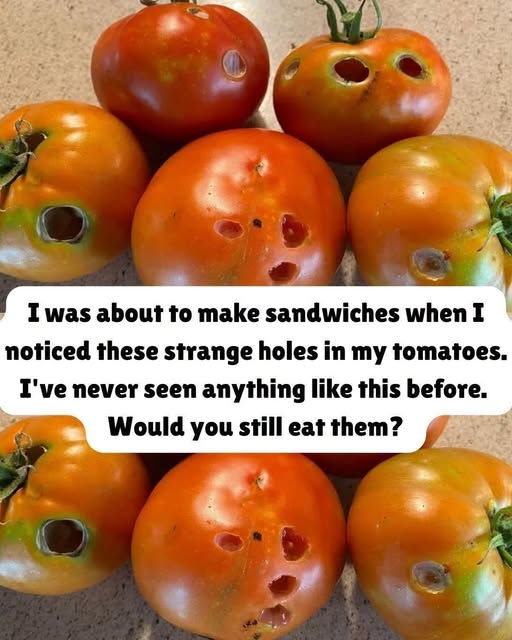
A perfect tomato can feel like one of the greatest rewards of a garden—until you pick it up and discover a single hole running through the skin. Suddenly, that beautiful piece of fruit looks damaged, and your first thought may be that something has gone terribly wrong. You may wonder whether pests have invaded the entire garden or whether everything you’ve worked so hard to grow is slowly being destroyed.
But one small hole doesn’t automatically mean disaster.
In many cases, that tiny wound is simply a message from your garden. It tells you that something has been feeding, exploring, or testing the fruit. Instead of seeing the damage as a failure, take it as a clue. A closer look can often reveal what happened and help you prevent the problem from spreading.
One possible culprit is the tomato fruitworm. These small caterpillars can enter the fruit and leave holes that may appear surprisingly clean at first. They often hide around the stem or inside damaged areas, making them easy to overlook until the tomato begins to soften or develop signs of decay.
Hornworms can also cause trouble, although their behavior is usually much easier to notice. These large caterpillars are famous for eating tomato leaves, but they can occasionally damage the fruit as well. Because they blend remarkably well with green foliage, gardeners may discover the damage before they discover the insect responsible.
Then there are birds.
A bird looking for food or simply testing whether a tomato is ripe can puncture the skin with its beak. Once the skin is broken, moisture and insects can enter, causing the damaged area to deteriorate faster than the rest of the fruit.
Slugs and snails create a different kind of evidence. Their feeding often leaves irregular, ragged edges rather than a clean puncture. If you notice a trail of slime around the plant or damaged fruit, nighttime visitors may be responsible.
The important thing is not to panic when you see the first damaged tomato.
Gardens are living ecosystems. Insects, birds, microorganisms, soil organisms, weather, and plants are constantly interacting. A few damaged fruits are not necessarily evidence that the entire garden is failing.
Instead, slow down and investigate.
Look closely around the damaged fruit.
Check underneath leaves.
Inspect the soil around the plant.
Look for droppings, feeding marks, webbing, slime trails, or additional holes.
Sometimes the evidence is obvious once you stop and search carefully.
Other times, you may never know exactly what caused the damage.
And that’s okay.
You don’t need to identify every single visitor in your garden to respond effectively. What matters is noticing whether the problem is isolated or becoming widespread.
If the tomato is otherwise healthy and the damage is limited, you may still be able to use much of the fruit. Cut away the damaged section generously and inspect the remaining flesh carefully. If the tomato has extensive mold, an unpleasant odor, widespread decay, or other signs of spoilage, it’s safer to discard it.
The same principle applies throughout the garden.
Not every imperfection means something must be thrown away.
A tomato with a small blemish can still be delicious.
A leaf with a few holes can still continue producing energy for the plant.
A slightly imperfect harvest can still represent months of work and care.
Gardeners sometimes become so focused on perfection that they forget what gardening is actually about.
Plants are not manufactured products.
They grow in dirt.
They face insects.
They experience heat, rain, wind, disease, and changing temperatures.
Their leaves become damaged.
Their fruit develops strange shapes.
And sometimes something takes a bite before you get there.
That doesn’t mean the garden has failed.
It means the garden is alive.
Still, prevention can make a difference.
If hornworms are present, hand-picking them can be an effective way to reduce their numbers, especially when only a few plants are affected. Check the foliage carefully because these caterpillars can be surprisingly difficult to spot.
Keeping the garden beds tidy can also help.
Remove heavily damaged or rotting fruit rather than allowing it to remain beneath the plants. Fallen produce can attract insects and other unwanted visitors, creating an environment where problems become easier to continue.
You can also pay attention to the time of day when damage appears.
If tomatoes look fine in the evening but show fresh feeding marks the following morning, nighttime activity may be involved. That information can help narrow down what you are dealing with.
Some gardeners also use companion planting as part of their broader garden strategy. Marigolds, basil, and other plants are sometimes grown alongside vegetables because they can contribute to garden diversity and may help discourage certain pests, although they should not be treated as guaranteed pest control.
The most useful habit is observation.
Walk through your garden regularly.
Don’t just look at the tomatoes you plan to harvest. Examine the leaves, stems, soil, and surrounding plants.
Look for changes before they become major problems.
A small hole is much easier to deal with than an infestation that has been allowed to grow unnoticed for weeks.
This is where gardening teaches a lesson that extends far beyond tomatoes.
The first reaction to damage is often fear.
We see something wrong and immediately imagine the worst.
One hole becomes the possibility of losing the entire harvest.
One damaged plant becomes the belief that the garden is collapsing.
But observation creates space between the problem and the reaction.
Instead of saying, “Everything is ruined,” you can ask, “What happened here?”
That question changes everything.
It turns frustration into curiosity.
It encourages you to investigate rather than react.
And with every season, you become better at recognizing the signs your plants are giving you.
Experienced gardeners often develop an almost instinctive ability to notice when something isn’t quite right.
They see a leaf that looks different.
They notice a stem that has been damaged.
They recognize the feeding pattern of a particular insect.
They understand that certain changes in weather can create certain problems.
That knowledge doesn’t come from having a perfect garden.
It comes from paying attention to imperfect ones.
Every damaged tomato can become part of that education.
Maybe it teaches you what a fruitworm looks like.
Maybe it helps you recognize bird damage.
Maybe it shows you where slugs are hiding.
Maybe it simply reminds you that nature doesn’t operate according to our expectations.
And that is one of the most beautiful parts of growing food.
You are never completely in control.
You can plant carefully.
Water consistently.
Feed the soil.
Protect the plants.
Watch for pests.
But ultimately, the garden remains an ecosystem with countless moving parts.
Your job isn’t to eliminate every imperfection.
It’s to understand the environment well enough to respond when something changes.
So the next time you reach for a beautiful tomato and discover a small hole, don’t immediately assume your harvest is doomed.
Put it down.
Look closer.
Inspect the surrounding plant.
Check the leaves.
Search beneath the foliage.
See whether the damage is isolated or part of a larger pattern.
Then decide what action makes sense.
Sometimes you’ll need to remove a pest.
Sometimes you’ll need to clean up damaged fruit.
Sometimes you’ll simply cut away the affected portion and enjoy what remains.
And sometimes you’ll discover that the tomato is telling you something you hadn’t noticed before.
That is the quiet lesson of gardening: **Inspect, Don’t Panic.**
A garden doesn’t have to be flawless to be successful.
The imperfect tomato still grew.
The plant still produced.
The harvest still happened.
And you still learned something.
That small hole may have ruined the appearance of one tomato, but it doesn’t have to ruin the entire season.
In fact, the fruit that survives despite a little damage can become a reminder that nature doesn’t demand perfection—and neither should you.