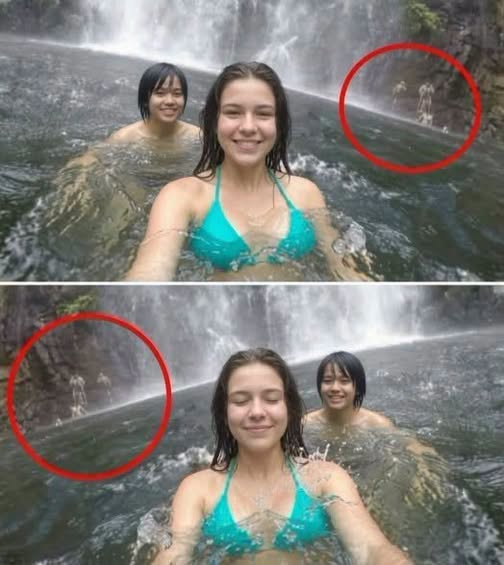
We miss things every single day—and most of the time, we never realize it. Our eyes move across rooms, streets, faces, and photographs, giving us the comforting impression that we have seen everything in front of us. But seeing something and truly noticing it are not the same thing. Somewhere in the background, a small detail may be hiding in plain sight, waiting for the exact moment when our attention finally catches up.
It might be an unusual object.
A strange reflection.
A figure standing where it shouldn’t be.
A tiny inconsistency that completely changes the meaning of the scene.
And once you finally notice it, you may wonder how you could have missed it in the first place.
The human brain is remarkably good at simplifying the world. Every second, our eyes receive an enormous amount of visual information. Processing every detail individually would be exhausting, so the brain quickly identifies what appears important and fills in the rest.
You look at a kitchen and recognize a kitchen.
You see an office and recognize an office.
You look at a familiar person’s face and immediately know who they are.
The brain doesn’t need to examine every object from scratch.
That efficiency is incredibly useful.
It allows us to walk through crowded streets, find familiar places, recognize people, and perform everyday tasks without consciously analyzing every detail around us.
But there is a trade-off.
When our attention is focused on one thing, we can completely overlook something else that is directly in front of us.
This phenomenon is often described as inattentional blindness.
It doesn’t mean that our eyes failed to see the object.
It means our attention never fully registered it.
That distinction is important.
You can look directly at something and still fail to notice it.
Imagine walking through your home while thinking about work. You pass the same table you have walked past hundreds of times. You know what is there, so your brain doesn’t need to inspect it carefully.
Now imagine someone places an unfamiliar object on that table.
You might walk past it several times before realizing something has changed.
The object was visible.
Your eyes received the information.
But your attention was elsewhere.
This is one reason hidden-object puzzles can be so difficult.
The object isn’t necessarily invisible.
It is simply blended into a scene your brain has already categorized.
Once you know where it is, however, the entire experience changes.
Suddenly the object becomes obvious.
You can’t understand how you failed to see it before.
That moment is more than a satisfying puzzle solution.
It reveals something important about perception.
We do not experience the world exactly as it exists.
We experience a version of it constructed by our brains.
Our minds constantly decide what deserves attention and what can safely be ignored.
That system keeps us from becoming overwhelmed.
But it also creates blind spots.
A busy street may contain hundreds of people, vehicles, signs, sounds, and movements. Yet you may remember only the person you were looking for.
A photograph can contain dozens of details, but you might focus on the main subject and completely overlook something unusual in the background.
A familiar room can contain an object that has been sitting there for years without ever becoming part of your conscious awareness.
The world doesn’t necessarily become more detailed.
Your attention simply changes.
That is why discovering a hidden detail can feel almost like watching reality rearrange itself.
A reflection suddenly looks different.
A shadow takes on a new meaning.
An object that seemed ordinary becomes suspicious.
A person in the background becomes the most interesting part of the photograph.
Your brain revises its interpretation.
And once that happens, it becomes difficult to return to the original way of seeing.
This is one of the reasons visual puzzles are so addictive.
They create a tiny version of the same experience that happens in everyday life.
At first, you see one thing.
Then you discover another.
Then you realize the scene was more complicated than you thought.
The challenge encourages you to slow down and question your first impression.
Instead of looking only at the center, examine the edges.
Instead of assuming an object belongs there, ask why it is there.
Instead of trusting the first interpretation, look again.
That habit can be surprisingly useful outside of puzzles.
We often move through life on autopilot.
We know our neighborhoods.
We know our homes.
We know our routines.
We recognize familiar people without consciously studying their expressions.
This familiarity saves energy, but it can also make the world feel flatter than it really is.
Slowing down can change that.
Look at a room you have known for years.
Notice the way light enters through the window.
Look at the objects you normally ignore.
Examine photographs you have seen dozens of times.
Pay attention to details around the edges.
You may discover that familiar places contain more information than you realized.
The same principle applies to people.
We often believe we know someone because we recognize their face, voice, habits, and personality.
But people are constantly changing.
A small expression can reveal worry.
A pause can communicate uncertainty.
A subtle change in behavior can tell us that something is different.
If we rush through interactions, we may miss those signals.
Attention is therefore more than a visual skill.
It is a form of presence.
When you genuinely pay attention, you are giving something your full awareness instead of allowing your brain to process it automatically.
That can make ordinary experiences feel richer.
A walk becomes more than getting from one place to another.
A conversation becomes more than exchanging words.
A photograph becomes more than an image.
A familiar room becomes something worth exploring again.
The extraordinary may not actually be rare.
It may simply be easy to overlook.
That is the unsettling and beautiful lesson behind hidden details.
Sometimes nothing has changed in the world around us.
We are the ones who have changed the way we look at it.
The figure was always in the background.
The reflection was always distorted.
The object was always sitting in the corner.
The strange detail was already there.
We simply weren’t paying attention.
And once we finally do, we cannot easily go back to not seeing it.
That is why the next time something feels completely familiar, it may be worth taking another look.
Slow down.
Scan the edges.
Question the obvious.
Look beyond the first impression.
Because your eyes may be telling you that you’ve seen everything.
Your brain may be telling you that the scene makes sense.
But somewhere inside that ordinary picture, there may be a detail waiting to completely change the story.
Sometimes, you don’t need a different world.
You simply need to look at the one you already have a little more carefully.