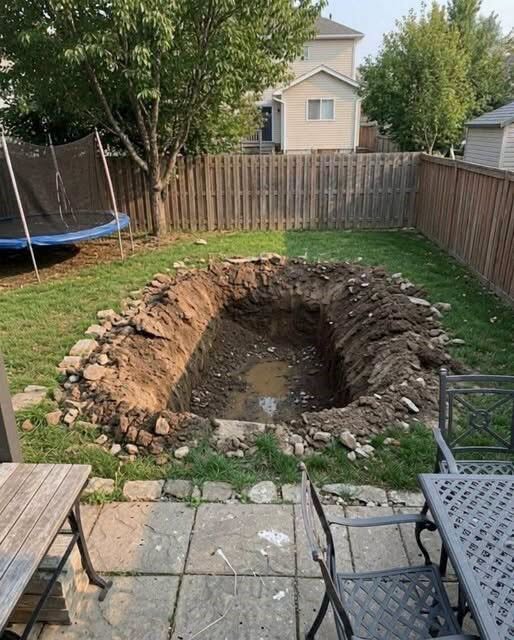
The first thing I saw was the crater.
My garden was gone, ripped open so violently that the backyard looked more like a crime scene than the peaceful place where I’d spent countless mornings drinking coffee and pulling weeds. Soil was piled everywhere. Plants I’d carefully tended were crushed or buried beneath mud. Police tape stretched across the property, flashing lights reflected against the windows, and strangers in uniforms moved through a space that had always felt completely private.
Then came the words I couldn’t immediately understand.
Robbery.
Buried.
Evidence.
The man I’d trusted with my keys, my home, and at times even my safety was suddenly gone without a trace. The same man who had smiled across the fence, helped carry my groceries, and fixed things around the house had apparently been hiding something I never imagined. Standing there, staring at the destruction, I felt as though everything I believed about my quiet street had been torn open along with the ground.
I never imagined my backyard would become the center of a criminal investigation. Nothing about our neighborhood suggested mystery or danger. It was the kind of place where people waved from driveways, borrowed tools, complained about the weather, and occasionally left spare keys with someone they trusted.
And I trusted him.
He had moved in next door and gradually become part of the ordinary rhythm of my life. There had been no dramatic moment when I decided he was trustworthy. Trust accumulated quietly through dozens of insignificant interactions. A conversation near the mailbox. A borrowed ladder returned exactly where he’d found it. A cup of coffee shared outside. Help repairing a broken section of fence.
Once, when I was struggling with grocery bags, he’d carried them inside without hesitation. Another time, he watched the house while I was away. Eventually, giving him a spare key didn’t feel dangerous. It felt practical.
That was the part that hurt most when detectives began explaining what they believed had happened.
According to them, his arrival had not been accidental. He hadn’t simply chosen the house next door because he liked the neighborhood. Investigators said he’d been chasing information connected to a robbery from roughly two decades earlier—a crime whose missing proceeds had apparently become the kind of legend people could obsess over for years.
There was an old map.
There were rumors about something valuable being buried.
And somehow, my property had become part of the story.
Detectives told me they believed he had studied that old information carefully. He had changed his name, constructed another identity, and eventually positioned himself close enough to investigate without attracting suspicion. The friendly neighbor I thought I’d met by chance had allegedly arrived with a purpose long before I ever shook his hand.
Get close.
Become familiar.
Earn trust.
Get inside.
Suddenly, every memory changed shape.
Every borrowed tool became suspicious. Every casual question about the property sounded different when replayed in my mind. Had he asked how long I’d lived there because he was being friendly, or because he needed information? When he offered to repair the fence, had he actually been studying the land? When he walked through the backyard, had he already been calculating where he would eventually dig?
Even the coffee bothered me.
I remembered sitting across from him, talking about completely ordinary things while believing we were simply two neighbors becoming friends. Afterward, I couldn’t stop wondering whether he’d been listening to me or waiting for something useful to slip into the conversation.
Every friendly wave seemed to belong to a script he’d written long before we met.
The police searched. They photographed. They measured. They dug through parts of the property until the garden I recognized disappeared beneath equipment, footprints, and disturbed earth. I watched from inside as investigators treated every patch of soil as though it might answer a question I hadn’t known existed.
For days, my home no longer felt like mine.
The physical damage could eventually be repaired, but the deeper damage was harder to explain. Someone had entered my life by using the very qualities I had always valued—openness, generosity, neighborliness—and turned them into vulnerabilities.
For a while, that realization made me suspicious of everyone.
A knock at the door made me tense. A neighbor asking an innocent question could trigger an uncomfortable pause. I began checking locks I’d never worried about before. Ordinary kindness suddenly seemed like something that required calculation.
Eventually, however, the police tape came down.
The investigators left.
The backyard remained.
Looking at the enormous wound in the earth, I realized I had two choices. I could spend years trying to restore everything exactly as it had been, pretending nothing had happened, or I could accept that the garden—like me—was going to look different afterward.
So I started rebuilding.
At first, it was painfully slow. Excavated soil was moved and leveled. Fresh stone replaced areas that had been destroyed. New plants went into spaces where the old ones couldn’t be saved. Every improvement felt almost absurdly small compared with the chaos that had happened there.
But slowly, the backyard began becoming a garden again.
I planted wildflowers in one of the areas that had been torn apart. I chose them partly because they didn’t demand perfection. They didn’t need everything arranged into neat, predictable rows. They grew around rocks, leaned toward whatever light they could find, and returned after storms looking battered but alive.
Watching them became its own kind of quiet healing.
I eventually understood that rebuilding didn’t require erasing what had happened. The garden didn’t need to look exactly as it did before in order to feel safe again. I didn’t need to become exactly the person I’d been before either.
What happened changed the way I understand trust.
I still want to believe people are capable of kindness. I still lend a hand. I still talk to neighbors. I refuse to let one person’s deception convince me that generosity itself was the mistake.
But I listen differently now.
When something feels slightly wrong, I don’t immediately dismiss the feeling because I worry about appearing rude or suspicious. I respect those small pauses inside me—the moment when a question seems too personal, when someone’s explanation doesn’t quite fit, when friendliness begins moving faster than trust should.
I once thought those instincts represented fear.
Now I understand they can also represent wisdom.
The backyard is beautiful again, although it isn’t the same garden that existed before the crater. Fresh stone follows a slightly different path. New plants grow where old ones were destroyed. And every year, the wildflowers return across soil that once sat behind police tape.
They remind me that healing isn’t always about putting everything back exactly where it was.
Sometimes it means growing around what happened.
I still offer kindness. I still believe trust is worth giving. But now I understand that kindness doesn’t require blindness, and trust doesn’t have to arrive all at once. The garden taught me something the man next door never intended to teach: surviving betrayal doesn’t mean becoming harder than you were before.
Sometimes it simply means growing deeper roots, paying attention to the ground beneath your feet, and allowing something beautiful to rise from the place that was once torn open.