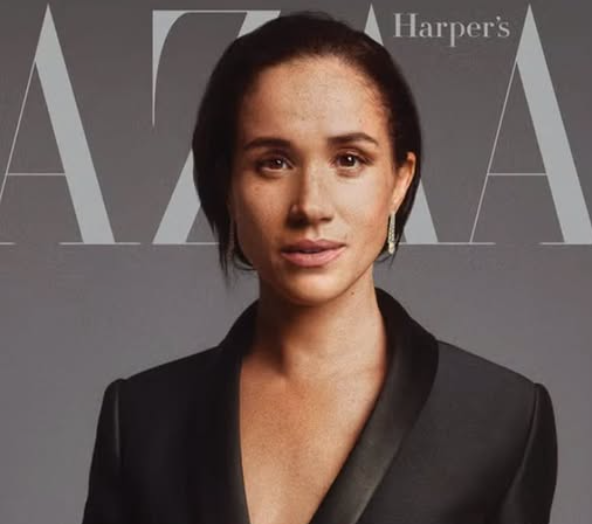
Meghan Markle’s latest magazine cover has ignited another fierce debate online.
This time, there is no tiara, dramatic styling, or heavily polished royal image.
Instead, Meghan appears in a deliberately understated portrait for *Harper’s Bazaar*, presenting a much simpler version of herself.
And almost immediately, people began judging every detail.
Some critics attacked her appearance, describing the photograph as unflattering and questioning everything from her expression to her hair.
Others saw something completely different.
To supporters, the stripped-back portrait represents confidence—a woman comfortable enough to appear without the elaborate presentation people have come to expect from celebrities.
That contrast quickly turned one photograph into another internet battleground.
But the conversation surrounding Meghan goes far beyond makeup.
In the accompanying interview, she reflects on mistakes, personal growth, boundaries, family, and what she has learned from living under extraordinary public scrutiny.
Her life changed dramatically when she married Prince Harry and became the Duchess of Sussex.
Suddenly, nearly everything she wore, said, or did became international news.
After Meghan and Harry stepped back as senior working royals, that attention didn’t disappear.
In many ways, it intensified.
Every interview became controversial.
Every photograph was analyzed.
Every new project generated competing interpretations from supporters and critics.
That history helps explain why even something as simple as a magazine portrait can provoke such an enormous reaction.
Some viewers see vulnerability.
Others see carefully constructed branding.
And others simply see a woman aging naturally beneath unforgiving public scrutiny.
Whatever someone’s opinion of Meghan, the intensity of the reaction demonstrates how harshly famous women’s appearances can be judged.
A wrinkle becomes a headline.
An expression becomes evidence of unhappiness.
A different hairstyle becomes a controversy.
And choosing a more natural-looking photograph can generate almost as much attention as appearing in full glamour.
Meghan’s comments about boundaries therefore carry additional significance.
After years of having strangers debate her marriage, family relationships, personality, motives, and appearance, she has increasingly emphasized deciding for herself which parts of her life remain public.
She also acknowledges that growth doesn’t come without mistakes.
There have been decisions she would approach differently and lessons learned through experience rather than perfection.
That’s a considerably more complicated story than either the fairy-tale princess narrative or the villainous caricature frequently attached to her.
And perhaps that’s why this particular cover has generated so much discussion.
It doesn’t offer the polished royal fantasy people once associated with Meghan.
Instead, it presents something quieter.
Whether viewers interpret that as authenticity, strategy, vulnerability, or simply another magazine photograph will depend largely on what they already think of her.
But one thing remains remarkably consistent.
Years after leaving royal duties, Meghan Markle can still appear in a single photograph—and get millions of people talking.