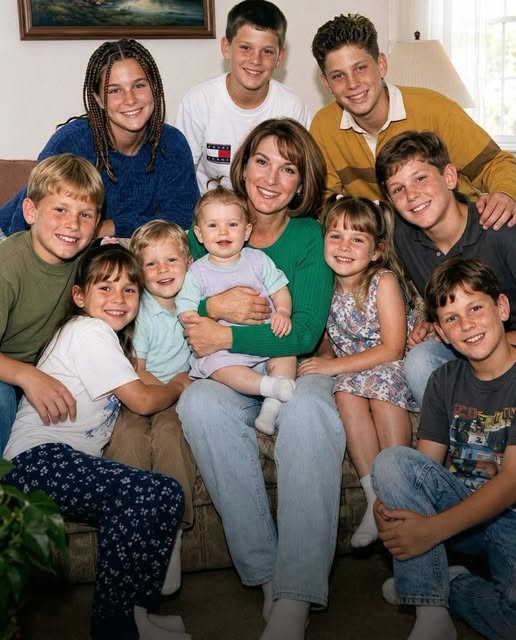
Three decades ago, the man I loved disappeared without warning, leaving me alone to raise his ten children. There was no argument, no goodbye, and no explanation beyond a short note that simply said he couldn’t do it anymore. For thirty years, I believed he had abandoned us because the responsibility was too great. I buried my heartbreak beneath endless work, sleepless nights, and the determination to give those children the life they deserved. Then, on an ordinary afternoon, a stranger knocked on my door carrying a letter that changed everything I thought I knew.
I first met Robert in the cereal aisle of a grocery store. He was a widower struggling to shop with ten energetic children, and exhaustion was written across his face. His youngest daughter reached toward me with a smile that instantly melted my heart, and before I knew it, I was helping him calm the chaos. What began as a simple conversation soon turned into friendship, and friendship slowly became love. I didn’t just fall in love with Robert—I fell in love with the remarkable family that surrounded him.
Over the following months, I became part of their daily lives. Every child had a distinct personality that made the busy household feel alive. Amanda naturally stepped into the role of older sister, always looking after the younger children. The twins competed over everything, the quadruplets filled the house with constant laughter and noise, and little Sophie rarely left my side. By the time Robert proposed during a quiet dinner at home, I already felt like I belonged with them.
Not everyone shared my enthusiasm. My mother begged me to reconsider, insisting that marrying a man with ten children would consume my entire future. She warned me that I would sacrifice my own dreams for responsibilities that weren’t truly mine. But by then, those children already felt like family. I couldn’t imagine walking away from them, no matter how complicated our future might become.
Then everything changed overnight.
One morning I woke to an empty bed, an empty driveway, and a silence that seemed impossible. Robert was gone. On the kitchen table sat a handwritten note with only a few heartbreaking words: “I’m sorry. I can’t do this anymore.” There was no explanation, no phone call, and no indication that he would ever return. Ten frightened children stared at me, searching for answers I didn’t have.
Friends and relatives urged me to contact social services or allow relatives to take the children. Even my mother insisted I couldn’t possibly raise all ten alone. But every time I looked into those frightened young faces, I knew I couldn’t abandon them the way they had already been abandoned once before. Eventually, I legally adopted them, making a lifelong promise that no matter how difficult life became, they would always have someone to call family.
The years that followed demanded everything I had. I worked long shifts in a warehouse before spending evenings sewing clothes and taking on extra work to cover expenses. Every dollar mattered. Every hour counted. The older children helped care for the younger ones, and together we built a home held together by teamwork, resilience, and unconditional love. We celebrated birthdays with homemade cakes, repaired worn-out clothes instead of buying new ones, and found joy in the smallest victories.
Life moved forward one milestone at a time. School graduations replaced bedtime stories. Children’s drawings on the refrigerator gave way to college acceptance letters. The family that many people believed would never survive grew stronger with every passing year. Watching each child become a successful adult—teachers, engineers, nurses, business owners, and parents themselves—became the greatest reward of my life.
Although people occasionally encouraged me to start dating again, I never truly opened my heart to anyone else. Potential relationships rarely lasted once they realized my life revolved around ten children and the responsibilities that came with them. Eventually, I stopped searching. The family we had built filled every corner of my life.
Exactly thirty years after Robert disappeared, a man in a gray suit arrived at my front door. He introduced himself as Mr. Johnson, an attorney, and quietly handed me a sealed envelope bearing handwriting I instantly recognized. My children, now grown adults with families of their own, gathered around as I slowly unfolded the letter.
Robert’s words revealed a truth none of us had ever imagined.
Before our wedding, he had been diagnosed with an aggressive, life-threatening illness. Doctors believed he had little chance of survival and warned that treatment would be expensive and uncertain. Terrified of leaving me a young widow responsible for ten grieving children and overwhelming medical debt, he convinced himself that disappearing was the only way to protect us. He believed that if I hated him, I would eventually rebuild my life instead of spending years watching him slowly die.
Then the impossible happened.
After agreeing to an experimental treatment as a final option, Robert recovered. Within two years, his illness was gone. He returned to our town intending to reunite with us, but before approaching the house, he watched from a distance. What he saw stopped him in his tracks. The children were thriving. The home was full of laughter. The family he feared would collapse had become stronger than ever.
Convinced that returning after such a betrayal would only reopen old wounds and destroy the stability we had fought so hard to build, Robert made another heartbreaking decision. He stayed away.
According to the attorney, Robert quietly followed our lives from afar for decades. Through private investigators and public records, he celebrated graduations, weddings, careers, and the births of grandchildren without ever making himself known. He never stopped loving the family he left behind, even though he believed revealing himself would only bring more pain. Before his death, he established a trust to help support the children and future generations of the family.
When I finished reading, no one spoke. For thirty years I had carried the belief that Robert abandoned us out of weakness. Instead, I learned that his decision had been driven by fear, love, and a desperate attempt—however misguided—to spare us from unimaginable hardship. It didn’t erase the pain we lived through or the years we spent wondering why he left. But it replaced anger with understanding.
I looked around the room at the ten adults who had once been frightened children sitting around our kitchen table. Together we had built something extraordinary from heartbreak. We had created a family defined not by blood alone, but by commitment, resilience, and love that refused to disappear even when hope seemed lost.
That evening, I placed a cup of tea on the empty chair where Robert once sat. For the first time in thirty years, it no longer represented abandonment. It represented forgiveness, closure, and the complicated truth that life is rarely as simple as the stories we tell ourselves. Some wounds never completely disappear, but understanding has a way of softening even the deepest scars. In the end, what mattered most wasn’t how our story began or how it nearly fell apart—it was that, together, we found a way to survive, heal, and become a family stronger than any of us had ever imagined.