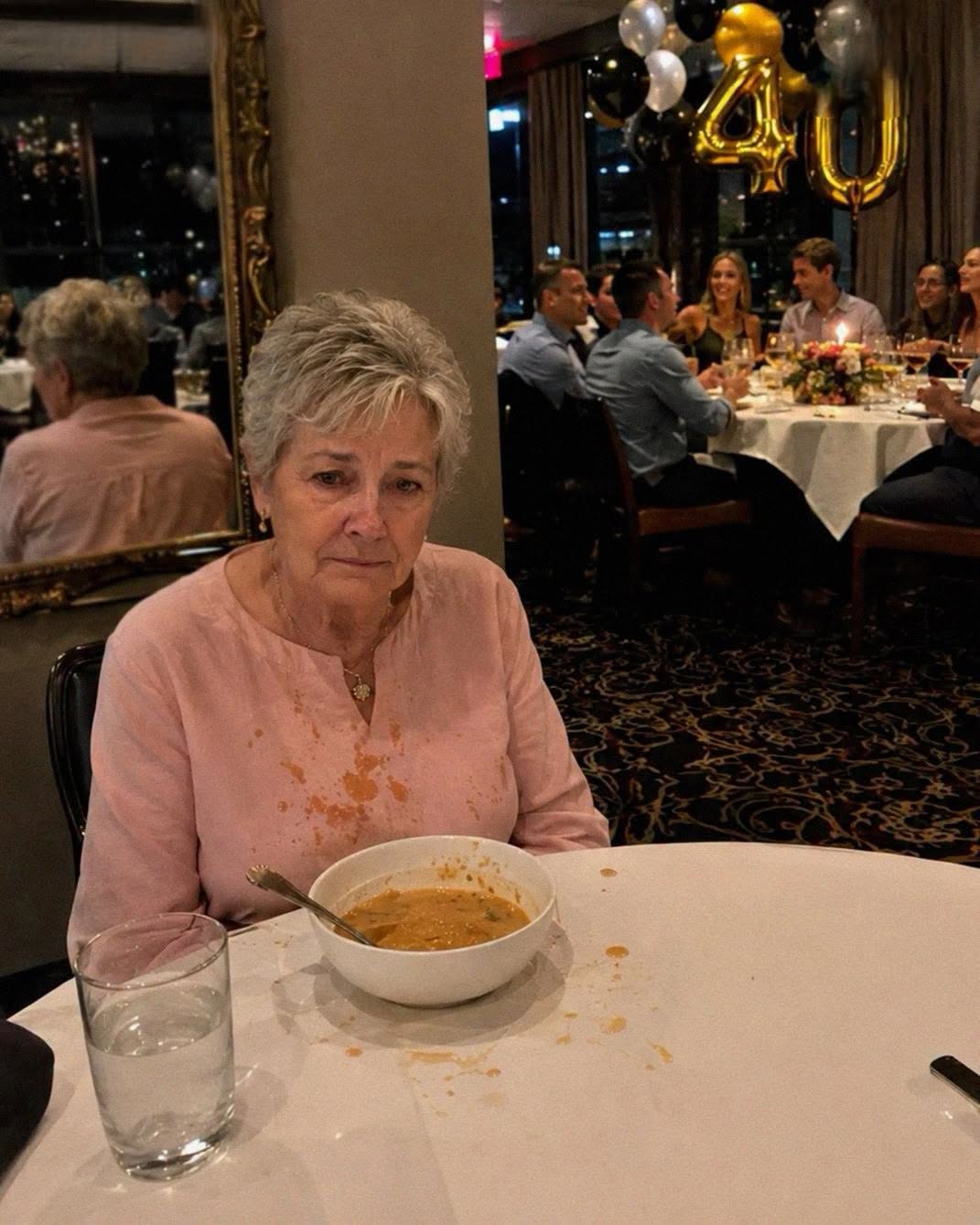
Soft golden chandeliers bathed the elegant restaurant in warm light as guests laughed over sparkling glasses and carefully plated dinners. It was supposed to be a joyful evening celebrating my son Alan’s fortieth birthday, a milestone I had looked forward to for months. Before leaving home, I promised myself I wouldn’t cry, no matter how emotional the night became. My Parkinson’s diagnosis six months earlier had already stolen enough from me, and I refused to let trembling hands overshadow my son’s special occasion. But nothing could have prepared me for the humiliation that awaited me before the night was over—or the decision that would finally change both of our lives forever.
My name is Margaret, and for forty years my life revolved around one simple goal: giving my son every opportunity I never had. His father passed away when Alan was still a toddler, leaving me to raise him alone. I worked double shifts at the local hospital, accepted every overtime hour available, and sacrificed countless comforts so he would never feel the weight of our financial struggles.
When Alan dreamed of attending university, I quietly sold my late mother’s gold wedding ring to cover the enrollment deposit. I never told him where the money came from. I simply smiled when he hugged me after receiving his acceptance letter, believing that some sacrifices didn’t need recognition.
Years later, when he married Melissa, I welcomed her into our family with an open heart.
When they struggled financially after buying furniture and paying off student loans, I offered them the main house on my property completely rent-free.
“It’s only temporary,” Alan promised.
“You’ve done enough already.”
I moved into the small guest cottage behind the house, convincing everyone—including myself—that I preferred the quiet.
Months became years.
The arrangement never changed.
I continued paying the property taxes, homeowners insurance, maintenance costs, and major repairs without complaint.
Every birthday.
Every holiday.
Every unexpected expense.
I simply wanted my son to have an easier life than I did.
Then Parkinson’s entered mine.
At first it was only a slight tremor in my right hand.
Soon simple tasks became difficult.
Buttoning a blouse required patience.
Pouring tea demanded concentration.
Holding utensils sometimes felt impossible.
Alan assured me everything would be alright.
“I’ll always be here for you, Mom.”
I believed him.
The birthday dinner began beautifully.
Friends, business associates, and extended family filled the private dining room with cheerful conversation. Alan looked proud introducing everyone to one another, while Melissa carefully orchestrated every detail of the evening, ensuring everything reflected the polished image she loved presenting.
I tried my best to blend quietly into the celebration.
Then the soup arrived.
As I lifted my spoon, an unexpected tremor ran through my hand.
The spoon slipped.
Cream soup splashed across the white tablecloth.
A few drops landed near Melissa’s designer handbag.
The room became painfully quiet.
“Oh, honestly,” Melissa sighed loudly.
Her voice carried across the table.
“This is exactly what I was worried about.”
Several guests exchanged uncomfortable glances.
“I’m so sorry,” I whispered, immediately reaching for my napkin.
“It was an accident.”
Melissa rolled her eyes dramatically.
“We’re trying to host an elegant dinner.”
“This is embarrassing.”
I looked instinctively toward Alan.
Waiting.
Hoping.
Praying he would simply say, “It’s alright, Mom.”
Instead, he looked away.
After an awkward silence, he quietly signaled the waiter.
“Could we move my mother somewhere a little more comfortable?”
The waiter hesitated.
Alan continued.
“Maybe one of the smaller tables near the kitchen.”
“I don’t want her feeling overwhelmed.”
Everyone understood what he really meant.
He didn’t want me ruining the evening.
The waiter looked visibly uncomfortable but politely guided me through the restaurant toward a small table beside the swinging kitchen doors.
The sounds of clattering dishes, shouting cooks, and humming refrigerators replaced the laughter of my family.
I sat alone.
Forgotten.
Every few minutes the kitchen doors swung open, releasing bursts of steam and hurried servers balancing heavy trays.
For the first time in years, I truly questioned every sacrifice I had ever made.
I remembered standing outside pawn shops holding my mother’s ring.
Working overnight shifts despite high fevers.
Skipping meals so Alan could attend school trips.
Moving out of my own home because newlyweds deserved privacy.
Every memory ended with the same thought.
I would have done it all again.
Until tonight.
Something quietly changed inside me.
Not anger.
Not revenge.
Simply clarity.
Earlier that afternoon, while leaving home, I had placed a heavy storage box inside my car trunk.
For years I kept it there for emergencies.
Inside were important legal documents I hoped I would never need.
Tonight, I finally understood why I had brought them.
I quietly stood.
Walked outside.
Retrieved the box.
Then returned to the dining room.
Conversations gradually faded as guests noticed me approaching.
Alan looked annoyed.
“Mom…”
“I just wanted to give you your birthday present before I leave,” I said calmly.
Setting the heavy box directly in front of him, I stepped back.
Melissa forced an uncomfortable laugh.
“Well… go ahead.”
“Open it.”
Alan lifted the lid.
Within seconds, every trace of color disappeared from his face.
His hands began trembling almost as much as mine.
“No…”
He whispered.
“This can’t be…”
He hurriedly tried closing the box.
“Mom, please.”
“You don’t have to do this.”
Curiosity spread through the room.
Guests leaned closer.
One elderly gentleman gently rested his hand on the lid before Alan could shut it completely.
Inside lay a neatly organized folder.
On top rested a formal eviction notice prepared by my attorney.
Beside it was a small faded baby bib.
Pinned to the bib was a handwritten note.
“My hands carried you into the life you have now.”
Silence filled the room.
Someone quietly picked up the eviction notice.
Another guest read the first page.
Expressions shifted from confusion to disbelief.
People slowly realized something Alan had never mentioned.
The beautiful house he proudly entertained everyone in…
Wasn’t his.
It belonged to me.
He wasn’t the homeowner.
He had simply been living there because I had allowed it.
Whispers spread across the tables.
“I thought they owned the property.”
“They’ve been living there rent-free?”
“He asked his own mother to leave?”
Alan suddenly turned toward Melissa.
“This wasn’t supposed to happen.”
She stared back in stunned silence.
Then he did something that surprised everyone.
He blamed her.
“It was Melissa’s idea.”
“She wanted everything perfect.”
“She said moving Mom would avoid awkwardness.”
Melissa looked horrified.
“You agreed!”
The argument unfolded in front of everyone.
Neither of them seemed to realize that every excuse only made the situation worse.
One by one, guests quietly stood.
Some offered me sympathetic smiles.
Others shook their heads in disappointment before leaving the restaurant altogether.
The celebration dissolved into uncomfortable silence.
Alan finally pushed back his chair and hurried after me.
I had already reached the restaurant entrance when he caught up.
“Mom…”
His voice cracked.
Then, to everyone’s astonishment, he dropped to his knees.
“I’m sorry.”
“Please don’t do this.”
“I made a terrible mistake.”
Tears streamed down his face.
For a long moment, I simply looked at him.
Not with hatred.
Not even with anger.
Only sadness.
“You embarrassed me for something I cannot control,” I said quietly.
“You saw my illness as an inconvenience instead of seeing your mother.”
He lowered his head.
“I know.”
“I’m sorry.”
I nodded slowly.
“I believe you’re sorry.”
“But consequences still matter.”
I handed him the envelope.
“You have thirty days.”
“Thirty days to move out of my house.”
Behind him, Melissa stood frozen near the doorway.
The confident woman who had spent the evening worrying about appearances now looked completely lost as the carefully crafted image she’d worked so hard to maintain crumbled around her.
Without another word, I walked into the cool evening air.
For the first time in years, my steps felt unexpectedly light.
The decision hadn’t been made out of revenge.
It had been made out of self-respect.
For decades I believed loving my son meant carrying every burden for him, solving every problem before he even knew it existed, and sacrificing pieces of my own happiness so his life would be easier.
But love without boundaries eventually teaches entitlement instead of gratitude.
Sometimes the greatest gift a parent can give an adult child isn’t another sacrifice.
It’s the opportunity to learn responsibility.
As I drove home that night, I glanced toward the small cottage where I had quietly lived while giving away the comfort of my own home.
I realized something that brought unexpected peace.
Parkinson’s had taken the steadiness from my hands.
But it had not taken my dignity.
And walking away from that restaurant wasn’t the moment I lost my son.
It was the moment I finally stopped losing myself.