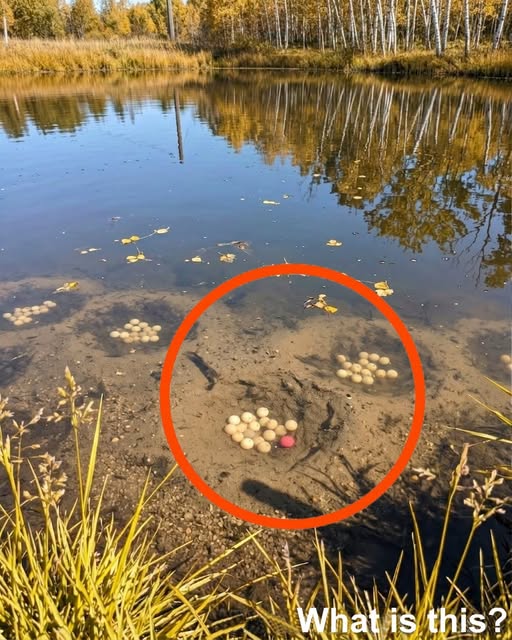
**I thought I’d stumbled on a silent massacre.** Dozens of perfect, ghostly white “eggs” rested beneath the surface of the shallow water, scattered in neat clusters as though some mysterious creature had chosen this quiet lake as its secret nursery before disappearing without a trace. The sight stopped me in my tracks. My pulse quickened as I stood frozen on the shoreline, unable to decide whether I was witnessing a rare natural phenomenon or something I was never meant to see. Every instinct urged caution, yet curiosity pulled me closer. The scene was so strangely beautiful—and so deeply unsettling—that I simply couldn’t look away.
The lake had always carried an unusual atmosphere. It wasn’t an ancient wilderness or a hidden forest pond, but a man-made reservoir tucked beside our peaceful village. Even so, there was something about its glass-like surface that made it feel older than it really was. On calm mornings, the water reflected the surrounding trees so perfectly that it was difficult to tell where the world ended and its reflection began. Locals often joked that the lake had a personality of its own, changing moods with the weather and keeping quiet secrets beneath its surface.
That particular morning, the water was unusually clear. Sunlight slipped through the gentle ripples, illuminating the sandy bottom with remarkable clarity. It was then that I noticed them. Dozens upon dozens of pale, perfectly rounded objects rested in shallow depressions beneath the water. They looked almost identical in size and color, arranged closely enough to resemble the carefully laid eggs of some enormous aquatic animal. My imagination immediately raced toward the most dramatic possibilities.
At first, I wondered whether they belonged to an unfamiliar species of amphibian. I had seen frog eggs before, suspended in jelly-like masses, but these looked completely different. They were larger, smoother, and strangely uniform. Could they belong to some rare salamander? Had an endangered species somehow appeared in our village lake? The more I stared, the more convinced I became that I had discovered something extraordinary.
Then another possibility crept into my thoughts. What if they weren’t native at all? Stories about invasive species suddenly flooded my memory. Perhaps some exotic animal had escaped captivity years earlier and quietly established itself here without anyone noticing. I imagined environmental scientists arriving with equipment, television crews documenting the discovery, and experts debating how such mysterious eggs had appeared in an ordinary lake.
The silence surrounding me only made everything feel more mysterious. No birds sang nearby. No fish disturbed the surface. Even the breeze seemed to pause, leaving the lake unnaturally still. It felt as though nature itself was holding its breath. Every ripple caught my attention. Every shadow beneath the water seemed alive. The quiet transformed an ordinary morning into something that felt almost cinematic.
I crouched closer to the shoreline, careful not to disturb the water. The objects appeared remarkably perfect, each one resting gently within shallow pockets formed by sand and silt. Their pale surfaces reflected sunlight softly, making them seem almost luminous beneath the water. The arrangement looked intentional, far too organized to be random. The closer I looked, the more convinced I became that I had uncovered some hidden chapter of the natural world.
For several minutes, I simply observed them. My mind continued building increasingly elaborate explanations. Perhaps biologists had secretly introduced a protected species into the lake. Maybe these eggs represented an animal so elusive that few people had ever documented it. Every possibility felt more fascinating than the last. The human mind has an incredible talent for constructing stories whenever information is incomplete, and mine was working overtime.
I even considered taking photographs and sending them to local wildlife organizations. Surely someone would want to examine such an unusual discovery. The excitement of potentially witnessing something genuinely rare made my hands tremble slightly. It wasn’t every day an ordinary walk around the lake transformed into what seemed like a scientific mystery.
Finally, curiosity overcame caution completely. I leaned even closer, squinting through the clear water in hopes of spotting tiny movements inside the mysterious spheres. If they truly were eggs, perhaps I could see developing embryos or some faint sign of life. Instead, something entirely unexpected caught my eye.
Beneath a thin layer of silt, one of the objects displayed the faint outline of printed lettering. At first, I assumed my eyes were playing tricks on me. I shifted slightly for a better angle as sunlight struck the surface differently. Suddenly, the shape became unmistakable. There, beneath years of sand and sediment, was a tiny manufacturer’s logo.
I couldn’t believe it.
They weren’t eggs at all.
They were golf balls.
Dozens and dozens of ordinary golf balls had settled at the bottom of the lake over many years, gradually collecting in shallow depressions created by gentle currents and shifting sand. Their faded white surfaces, softened by time underwater, had transformed them into something almost unrecognizable. What had looked like the mysterious nursery of an unknown creature was actually the unfortunate result of countless golfers slicing their shots into the water hazard beside the neighboring course.
For a moment, I simply laughed.
All the elaborate theories, imagined wildlife discoveries, and dramatic possibilities disappeared instantly. The terrifying mystery dissolved into one of the most ordinary explanations imaginable. Years of missed swings had quietly accumulated beneath the water until nature disguised them as something extraordinary.
The experience left me smiling long after I walked away from the lake. It reminded me how easily our brains fill empty spaces with stories, especially when confronted with something unfamiliar. Faced with incomplete information, we naturally search for patterns, meanings, and explanations—even if those explanations become far more dramatic than reality itself.
Psychologists often describe this tendency as pattern recognition. It’s one of humanity’s greatest strengths, allowing us to solve problems, recognize faces, and anticipate danger. Yet the same instinct can also convince us that ordinary things are mysterious simply because they appear in unexpected settings. A handful of golf balls becomes alien eggs. Shadows become monsters. Ordinary sounds become unexplained phenomena. Our minds prefer a compelling story over uncertainty.
Looking back, I’m almost grateful they turned out to be golf balls. Had they actually been the eggs of some unknown creature, the mystery might have ended in scientific reports and headlines. Instead, the moment became something far more personal—a quiet reminder of how imagination shapes the way we experience the world.
The lake itself hadn’t changed. The water remained calm. The shoreline remained peaceful. Only my understanding had shifted. The same objects that moments earlier inspired fear and fascination now seemed almost humorous. Reality hadn’t transformed—only my perspective had.
Since that day, I find myself approaching strange situations a little differently. Whenever something appears mysterious at first glance, I remember those pale spheres resting beneath the clear water. Sometimes life really does surprise us with remarkable discoveries. But just as often, the extraordinary hides an ordinary explanation waiting patiently beneath the surface.
In the end, I didn’t discover a rare species, uncover a forgotten ecological mystery, or stumble upon evidence of some unknown creature. I discovered something perhaps even more valuable: a lesson about perception itself. The world isn’t always hiding monsters, miracles, or unbelievable secrets. Sometimes it’s simply reflecting our own imagination back at us, reminding us how quickly curiosity can become certainty—and how wonderfully satisfying it can be to laugh when the truth turns out to be nothing more than a collection of forgotten golf balls resting quietly beneath the water.