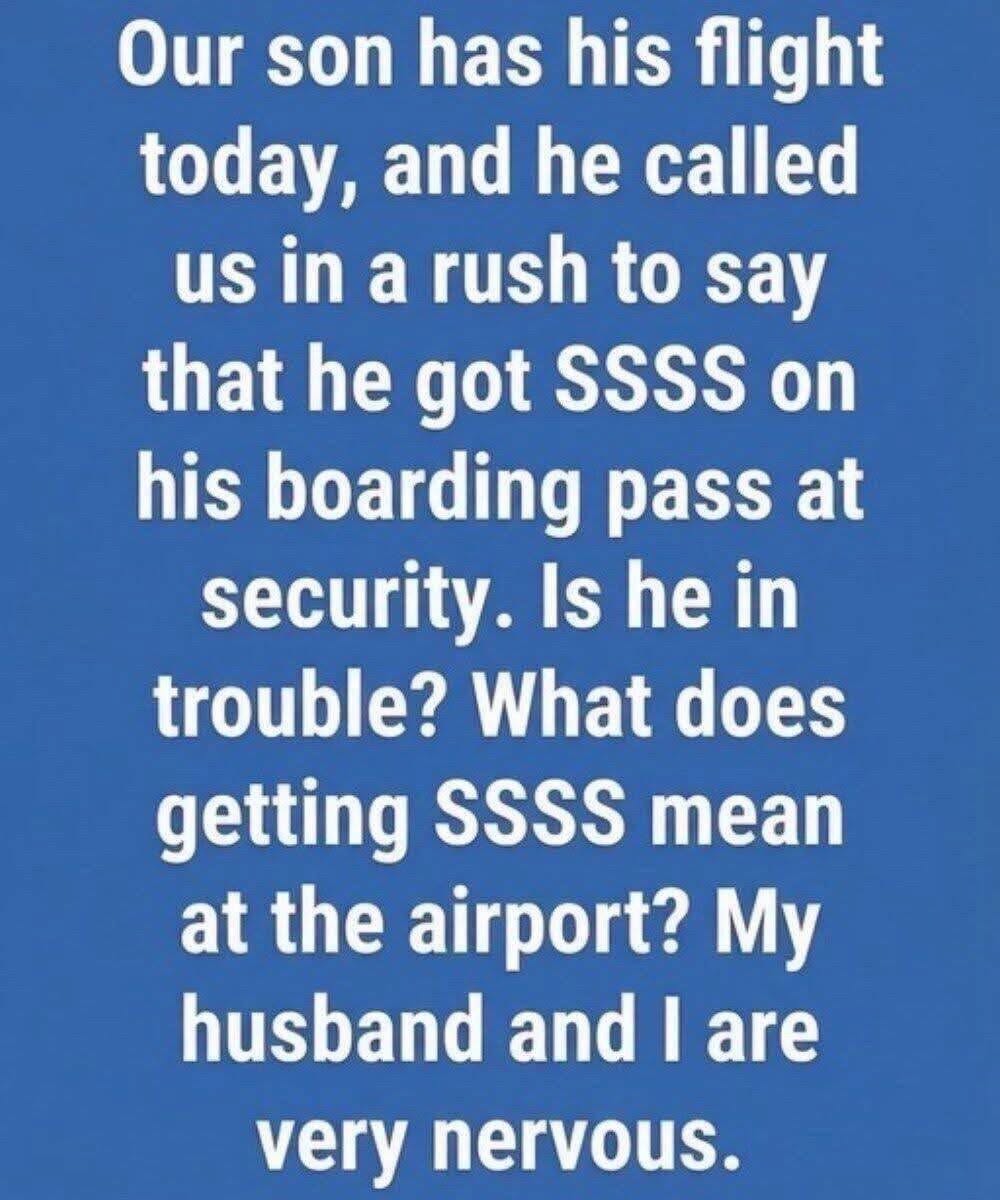
The moment your phone rings, something feels different. Before you even answer, a wave of anxiety washes over you. Then you hear your child’s voice—quieter than usual, tense, and uncertain. They tell you they’ve been stopped at airport security because their boarding pass has four unfamiliar letters printed on it: **SSSS**. In an instant, your imagination begins filling in the blanks. Questions race through your mind. Has something gone wrong? Are they in trouble? Is there some mistake with their identity? Those four letters seem far more frightening than they really are.
In reality, **SSSS** stands for **Secondary Security Screening Selection**, a designation used by airport security authorities to indicate that a traveler has been selected for additional screening before boarding a flight. Despite how intimidating it may appear, the code is not a criminal accusation, an arrest notice, or evidence that someone has done anything wrong. Instead, it simply means that extra security procedures will be carried out before the passenger is allowed to continue to the departure gate.
Many travelers are surprised to discover that selection for additional screening can happen for a variety of perfectly ordinary reasons. Sometimes it results from purchasing a ticket shortly before departure. Other times it may be connected to international travel, specific flight routes, one-way itineraries, unusual travel patterns, or simply a random selection within the security system. In many cases, there is no obvious explanation, and airport personnel are often unable to tell travelers exactly why they were chosen.
For someone experiencing it for the first time—especially a young traveler—it can certainly feel intimidating. Security officers may ask the passenger to step aside while they inspect carry-on luggage more thoroughly. Bags may be opened, electronic devices examined, and personal belongings carefully searched. Officers frequently swab luggage, clothing, shoes, or hands to test for traces of explosive materials, using equipment that provides results within minutes.
Additional screening may also include a more detailed body scan or a respectful manual pat-down conducted according to established security procedures. Throughout the process, officers may ask routine questions about the trip, travel plans, or items being carried. While the experience can feel stressful, these questions are generally part of standardized procedures applied to travelers selected for secondary screening.
For parents or family members waiting elsewhere, however, the emotional impact is often even greater than it is for the traveler. Hearing a worried voice over the phone while being hundreds or thousands of miles away can leave you feeling completely powerless. Without seeing what is happening, it’s easy for fear to grow far beyond the reality of the situation. The silence between updates often feels much longer than it actually is.
Fortunately, for the overwhelming majority of travelers, the process ends without incident. Once the additional screening has been completed and officers are satisfied that everything is in order, passengers are cleared to continue through the airport and board their flights normally. Thousands of people experience secondary screening every day, and most reach their destinations with nothing more than an unexpected travel delay and a story to tell afterward.
Although being selected for **SSSS** can certainly be inconvenient, it is important to remember that it does not automatically indicate suspicion of criminal activity or wrongdoing. Security agencies use multiple layers of screening to protect passengers and aviation systems, and random or risk-based checks are one part of those broader security measures. While the exact selection methods are not publicly disclosed, many people who receive the designation never encounter it again on future trips.
In the end, those four letters often appear far more alarming than they truly are. What begins as a frightening phone call usually concludes with a relieved message a short time later saying everything is fine and boarding has begun. The anxiety fades, the flight departs, and what initially felt like a frightening mystery becomes just another travel experience—unexpected, stressful in the moment, but ultimately routine and safely resolved.