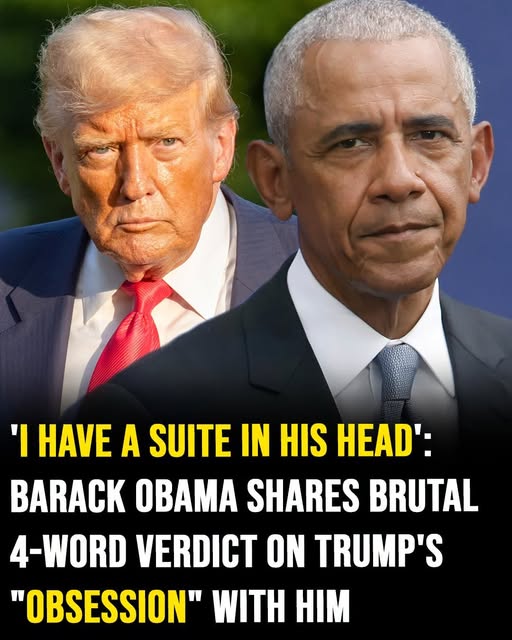
For years, the political rivalry between former U.S. presidents has remained one of the most closely watched dynamics in American public life. Criticism, countercriticism, speeches, interviews, and social media commentary have fueled endless debate among supporters and opponents alike. Yet when Barack Obama recently addressed Donald Trump’s long-running focus on him, many observers noticed something different. There was no angry outburst, no emotional confrontation, and no dramatic attempt to escalate the conflict. Instead, Obama responded with the same calm, measured tone that has long defined his public style, offering a critique that many felt carried more weight precisely because it was delivered without visible anger.
The exchange attracted attention not simply because of the individuals involved, but because it touched on a broader question that has followed both men for years: why does the relationship between the two former presidents continue to dominate so much political conversation? Even years after leaving office, Obama remains a frequent point of reference in Trump’s speeches, interviews, and public remarks. Supporters see this as a natural consequence of political disagreement and contrasting visions for the country. Critics, however, argue that the repeated focus reveals something deeper about the nature of modern political competition.
During the podcast appearance, Obama approached the topic with a mixture of humor and observation. Rather than launching into a detailed defense of his own presidency, he turned attention toward the recurring pattern itself. His comments suggested that the persistence of the criticism may say as much about the person delivering it as it does about the person receiving it. By framing the issue in those terms, Obama transformed years of attacks into a discussion about priorities, leadership, and where political energy is directed.
One of the moments that generated the most discussion came when Obama joked about occupying space inside Trump’s mind. Referring humorously to having a “room”—and then upgrading it to a “suite”—inside Trump’s head, he used humor to make a larger point. The joke landed because it reflected a perception shared by many observers who have watched the political relationship unfold over the years. Rather than responding point by point to specific accusations, Obama suggested that the repeated attention itself had become the story.
The remark quickly spread across social media, not because it was particularly harsh, but because it delivered criticism through wit rather than confrontation. Political audiences are accustomed to direct attacks and heated rhetoric. A quiet joke often attracts attention precisely because it feels unexpected. In this case, the humor served as a vehicle for a broader argument: that continued focus on past political opponents may reveal distraction rather than strength.
Obama then expanded on that idea by drawing a comparison to his own time in office. He reflected on the transition that followed the presidency of George W. Bush, explaining that his attention had been focused primarily on the challenges of governing rather than on the person who came before him. Whether dealing with economic recovery, healthcare reform, foreign policy, or other major issues facing the country, Obama suggested there was little time to devote to personal fixation on a predecessor.
That comparison formed the core of his argument.
Leadership, in his view, requires sustained attention to present responsibilities rather than constant engagement with past rivalries. The presidency presents countless immediate challenges demanding focus, judgment, and decision-making. When political energy becomes centered on former opponents, critics argue that it risks diverting attention away from the needs of the public.
For supporters of Obama, the comments reinforced an image of him as someone comfortable responding through reflection rather than outrage. For supporters of Trump, the remarks represented yet another chapter in a long-running political disagreement that has shaped national debate for more than a decade. Unsurprisingly, reactions varied dramatically depending on political perspective, with each side interpreting the exchange through its own lens.
What makes the relationship particularly significant is that it extends beyond personal disagreement. Obama and Trump have come to symbolize two very different approaches to politics, governance, communication, and public leadership. Discussions involving one frequently become discussions about the other. Their names often function as shorthand for broader debates about national identity, government priorities, cultural change, and the future direction of the country.
Because of that symbolism, even relatively brief comments can generate enormous public interest. A single podcast remark becomes headline news. A joke becomes a national conversation. Supporters and critics dissect every sentence, searching for hidden meaning, political strategy, or evidence supporting their existing views. In many ways, the public fascination reflects how deeply both figures remain embedded in the American political imagination.
The exchange also highlights the increasingly personal nature of modern political discourse. Political disagreements that once centered primarily on policy frequently become narratives driven by personality, rivalry, and public perception. Audiences are often drawn not only to debates about legislation or governance but also to the human dynamics between major political figures. As a result, personal observations sometimes receive as much attention as substantive policy discussions.
At the same time, Obama’s comments contained an argument extending beyond any individual rivalry. The broader message focused on the importance of priorities in leadership. Whether one agrees with his assessment or not, he suggested that public officials should remain focused on current challenges rather than becoming consumed by past political battles. The implication was that leadership ultimately involves directing attention toward solving problems rather than revisiting old conflicts.
That idea resonated with many listeners because it addressed a common frustration in modern politics. Citizens frequently express concern that political leaders spend too much time attacking opponents and too little time addressing practical issues affecting everyday life. Questions involving the economy, healthcare, education, public safety, and international affairs often compete with political theater for public attention. Obama’s remarks tapped into that broader concern by framing focus itself as a measure of effective leadership.
As expected, the comments immediately fueled another round of debate between supporters of both men. Some viewed Obama’s remarks as a clever and effective rebuttal to years of criticism. Others saw them as an unnecessary continuation of political rivalry. Still others focused less on the individuals involved and more on the larger question of how former presidents influence ongoing political discourse long after leaving office.
Regardless of where one stands politically, the exchange demonstrated the enduring influence both figures continue to wield. Years after sharing the national stage, they remain central characters in America’s political narrative. Their words still generate headlines. Their disagreements still shape conversations. Their contrasting visions continue influencing how millions of people understand the country’s past, present, and future.
In the end, Obama’s response stood out not because it was loud, but because it was restrained. Rather than matching criticism with anger, he responded with observation, humor, and a broader argument about leadership itself. Whether viewed as a sharp political rebuttal, a thoughtful reflection, or simply another chapter in a long-running rivalry, the remarks succeeded in doing one thing above all else: they reignited a national conversation about focus, priorities, and what voters expect from those who seek to lead.
And in that sense, the discussion became larger than either Obama or Trump. It became a debate about the nature of leadership itself—whether it is defined by looking backward at political opponents or forward toward the challenges that still demand attention.