The call arrived on a Thursday afternoon, just as Gloria was getting ready to leave for work at the library.
Her daughter-in-law sounded cheerful, polished, and perfectly composed—the kind of voice that always seemed pleasant but never quite sincere.
“We’d love for you to join us at the rehearsal dinner,” she said. “It’s going to be very relaxed and informal.”
Gloria understood immediately what that really meant.
It wasn’t an invitation to feel comfortable.
It was a reminder not to stand out.
After ending the call, she remained in her kitchen for a few moments, staring through the window above the sink. A faint handprint still marked one corner of the glass, left from a winter storm months earlier when she had stood there watching snow bend the birch trees in her yard. She had never bothered to wipe it away.
Her name was Gloria Sutherland Beck.
At sixty-three years old, she had spent most of her life allowing people to underestimate her.
Not because she lacked ambition.
Not because she lacked success.
But because she had never felt the need to advertise either.
For decades, even the people closest to her had only seen a small part of what she had built.
That included her son.
When her marriage ended, her son was only nine years old. Overnight, Gloria became a single mother responsible for holding an entire life together. Bills still arrived. Rent still needed to be paid. Groceries still had to appear in the kitchen. There was no time for self-pity and no one waiting to rescue her.
She went back to work full-time, managing bookkeeping accounts for small businesses around town. During the day she balanced financial records. At night she balanced something much harder: the responsibility of raising a child alone.
There were years her son barely remembers.
Years when dinner was whatever she could afford.
Years when every dollar had a purpose before it even reached her bank account.
Years when she quietly sacrificed her own comfort to make sure he never felt the full weight of their struggles.
He remembers a loving home.
She remembers the price of creating it.
While other people spent money chasing appearances, Gloria spent her time studying numbers. Numbers made sense to her. Numbers rewarded patience. Numbers didn’t care about status, popularity, or appearances.
Slowly, she began investing.
Carefully.
Quietly.
Methodically.
She purchased index funds long before many people around her understood them. Later, she bought her first rental property. Then another. When others panicked during economic downturns, Gloria looked for opportunities. She trusted discipline more than emotion and consistency more than luck.
Year after year, without attracting attention, she continued building.
Nobody applauded.
Nobody noticed.
And that was exactly how she preferred it.
By the time her son completed his MBA, Gloria had quietly accumulated a financial portfolio worth several million dollars.
Yet he had no idea.
He knew she was comfortable.
He knew she owned a few properties.
He knew she was careful with money.
What he didn’t know was how much patience, discipline, and long-term planning had transformed a modest income into real wealth over three decades.
Gloria never hid it out of secrecy.
She hid it out of principle.
She wanted her son to build his own future, not spend his life counting on someone else’s success.
She had watched too many families fall apart because children grew up believing an inheritance was a plan.
She wanted her son to understand the value of earning something for himself.
For many years, she believed he did.
Then he met the woman he would eventually marry.
His future wife came from a world very different from the one Gloria had known.
Her family lived in an affluent suburb outside Chicago. Her father owned a successful commercial real estate company. Her mother served on charity boards, attended fundraising galas, and moved through social circles where wealth wasn’t discussed because everyone already assumed it existed.
They owned a lake house.
A wine cellar.
Multiple properties.
Everything about them suggested comfort and status.
The first dinner Gloria shared with them revealed more than she expected.
She arrived wearing one of her favorite wool blazers—simple, elegant, and well made.
The bride’s mother glanced at it briefly before smiling.
“Oh, how practical.”
The words sounded complimentary.
The tone did not.
Gloria understood exactly what had happened.
She smiled politely and changed the subject.
People who cared deeply about appearances usually enjoyed talking about themselves.
That evening proved no different.
Throughout dinner, Gloria watched her son carefully.
At first she couldn’t identify what felt different.
Then she realized.
He was performing.
Every time his future father-in-law spoke, her son seemed eager to impress him.
Every joke received a laugh.
Every opinion received agreement.
Every story received admiration.
The confidence Gloria had always known in him seemed strangely absent.
It was as though he had become a guest in his own personality.
Driving home later that night, Gloria told herself not to overthink it.
Young people adapt.
Relationships change people.
Marriage creates new loyalties.
That was normal.
Or at least that was what she wanted to believe.
Months later, preparations for the wedding intensified.
Detailed schedules appeared.
Guest lists expanded.
Decisions were made about flowers, menus, lighting, and decorations.
One email from her future daughter-in-law ended with a cheerful note:
“Dress code is garden formal! Let me know if you need help figuring that out!”
Gloria stared at the message for several seconds.
Then laughed quietly to herself.
She knew exactly what garden formal meant.
And even if she didn’t, she knew how to learn.
During a work conference in the city, she visited a consignment boutique and discovered a beautiful dove-gray silk dress.
It fit perfectly.
The material was exquisite.
The tailoring was flawless.
The price tag read forty-five dollars.
Gloria bought it immediately.
The saleswoman explained it had come from an estate sale.
That made Gloria like it even more.
Some objects carried stories.
This dress clearly had one.
But the dress wasn’t what occupied most of her thoughts.
The real question involved a small envelope sitting inside her desk drawer.
Inside that envelope was something she had been protecting for twenty-five years.
A Series EE Savings Bond purchased shortly after her son was born.
Over the years she had given him several others during important milestones.
One at graduation.
One at university.
This was the last remaining bond.
The final piece.
The one she had intentionally saved for his wedding.
Before leaving for Wisconsin, she checked its value.
Nearly four thousand dollars.
Not life-changing money.
But meaningful.
Especially because of what it represented.
Twenty-five years of patience.
Twenty-five years of growth.
Twenty-five years of believing in her son’s future.
She placed the bond inside a carefully addressed envelope.
Then she wrote a note explaining its history.
Three separate drafts.
Several revisions.
Every word chosen carefully.
When she finally finished, she sealed the envelope and packed it for the trip.
She had no way of knowing that a simple gift would soon become the center of one of the most painful moments of her life.
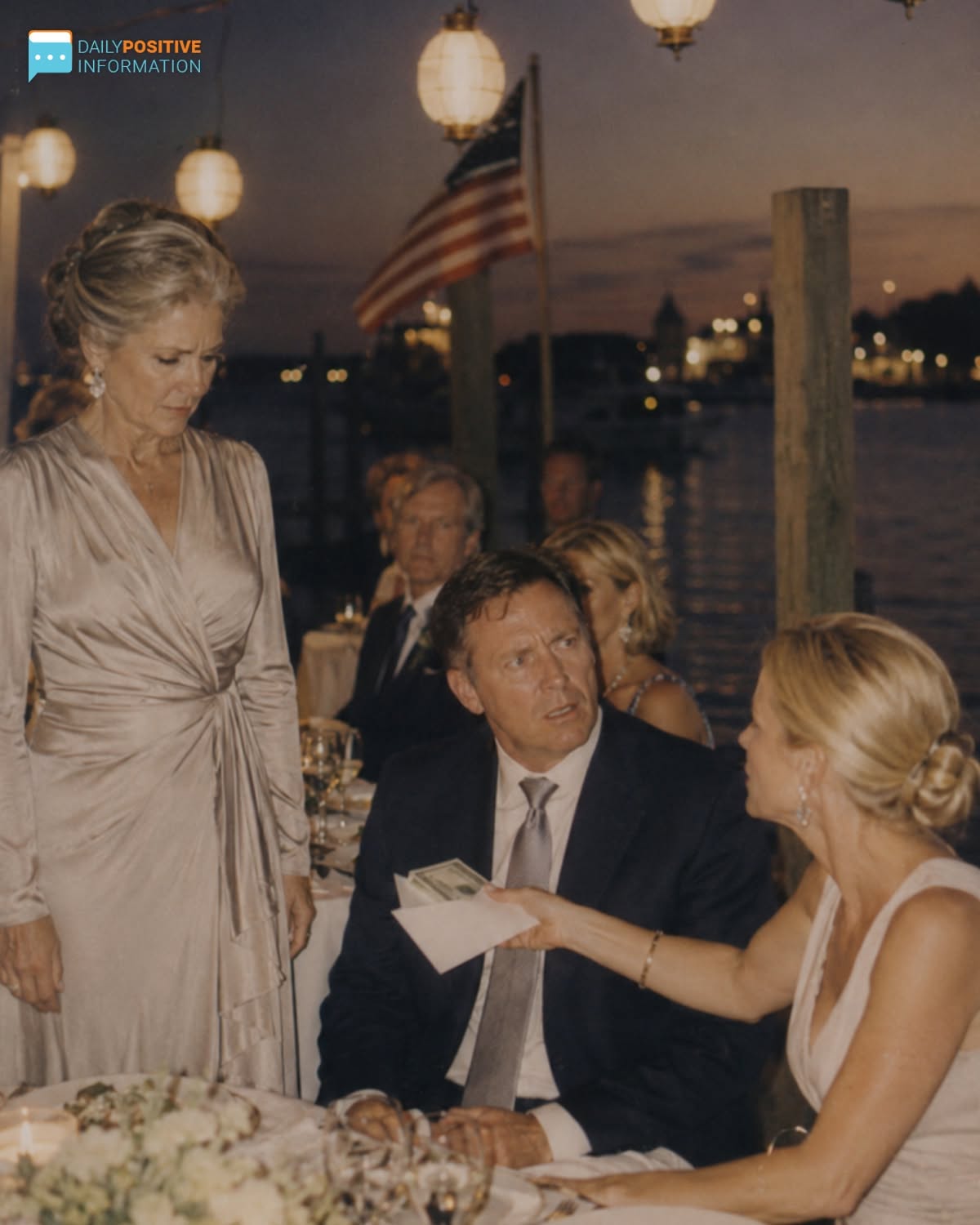
The rehearsal dinner was held inside a stunning lakeside boathouse overlooking the water.
Everything about the setting felt carefully designed to impress.
Soft lanterns hung from wooden beams.
White linen covered every table.
String lights reflected across the lake outside.
The atmosphere looked effortless, though Gloria suspected an enormous amount of effort had gone into creating it.
Guests arrived dressed in expensive suits and elegant dresses. Most of them already knew one another. Conversations flowed easily between families that shared similar backgrounds, lifestyles, and expectations.
Gloria did what she had always done in unfamiliar situations.
She observed.
She smiled.
She listened.
And she stayed gracious.
Her assigned seat was near the far end of the room, positioned between one of her son’s university friends and an elderly relative from the bride’s side of the family. Neither person knew much about her, which suited Gloria perfectly.
As dinner progressed, speeches began.
The bride’s father stood first.
He spoke confidently about success, achievement, family tradition, and the future.
He praised his daughter.
He praised the wedding.
He praised the opportunities awaiting the newlyweds.
At one point he briefly acknowledged Gloria.
A quick gesture.
A polite sentence.
A passing mention.
The audience applauded.
Then the speech moved on.
Gloria smiled.
She was used to being overlooked.
What she wasn’t prepared for was what happened next.
Apparently gift exchanges had become part of the rehearsal dinner tradition.
One by one, small presents were exchanged between family members.
Laughter filled the room.
Guests opened boxes.
Photographs were taken.
Then Gloria quietly reached for her envelope.
The final savings bond.
The gift she had protected for twenty-five years.
She handed it across the table.
Her future daughter-in-law smiled politely and opened it.
At first she seemed confused.
She removed the bond.
Read the first line of the note.
Then looked down again.
Several seconds passed.
The room remained attentive.
Waiting.
Finally she lifted the paper into the air.
“A savings bond?” she said.
The words echoed farther than she intended.
Several people looked over.
Her smile widened slightly.
“Is this actually from the nineties?”
A few guests laughed softly.
Not maliciously.
Just awkwardly.
But the damage was immediate.
Gloria felt every eye turning toward her.
Waiting for an explanation.
Waiting for context.
Waiting for someone to clarify.
Her son was sitting right beside his future wife.
Their eyes met.
For a moment Gloria expected him to speak.
To ask what it was worth.
To read the note.
To explain why she had kept it for so long.
To say something.
Anything.
Instead he smiled awkwardly and said the sentence that would replay in Gloria’s mind for months afterward.
“Mom, you could’ve just bought something from the registry.”
The room became strangely quiet.
No one realized how much those words hurt.
To everyone else, it sounded harmless.
Practical.
Reasonable.
But Gloria knew what he had really dismissed.
Not the bond.
The meaning behind it.
The years behind it.
The thought behind it.
The sacrifice behind it.
For twenty-five years she had protected that gift.
For twenty-five years she had imagined the moment she would finally hand it to him.
And in less than ten seconds, it had been reduced to a misunderstanding.
A cheap gift.
An outdated idea.
Something that should have been replaced by a kitchen appliance listed on a registry.
The bride folded the note.
The bond remained on the table.
Nobody asked what it was worth.
Nobody asked why Gloria had kept it all those years.
Nobody read the explanation.
For the first time that evening, Gloria felt completely invisible.
Not because strangers ignored her.
Because her own son had.
Slowly, she placed her napkin beside her plate.
Then she stood.
The movement attracted very little attention.
Which somehow made it worse.
“You’re right,” she said softly.
Her son looked up.
“What?”
Gloria managed a small smile.
“I’ll remember that next time.”
The words sounded polite.
But something inside her had changed.
Not dramatically.
Not suddenly.
More like the final crack appearing in a foundation that had been weakening for years.
She wished everyone a pleasant evening.
Thanked the people nearest her.
Then quietly walked out of the boathouse.
Outside, the lake was dark.
The water moved gently beneath the moonlight.
Inside, laughter continued.
Music continued.
Conversations continued.
Nobody came after her.
Nobody called her name.
Nobody noticed she was gone until much later.
Back in her cottage, Gloria sat alone on the edge of the bed.
The envelope rested beside her.
The savings bond still inside.
She stared at the wall for a very long time.
She didn’t cry.
She expected tears.
They never came.
What she felt instead was something colder.
Clarity.
For the first time, she stopped asking herself whether she was imagining things.
Stopped making excuses.
Stopped explaining away behavior that hurt.
The issue was never the bond.
The issue was what the bond revealed.
And as she sat alone in that quiet room, Gloria realized she would need to make some decisions when she got home.
Decisions that would change far more than anyone at that rehearsal dinner could possibly imagine.
The wedding took place the following afternoon beneath a white tent overlooking the lake.
The weather was perfect.
The sky was clear.
The water shimmered in the distance.
Everything looked exactly the way expensive weddings are supposed to look.
Guests smiled.
Photographers moved constantly.
Champagne glasses clinked together.
From the outside, it appeared flawless.
And Gloria attended every minute of it.
She wore the gray silk dress.
She smiled for photographs.
She congratulated relatives.
She hugged old friends.
She sat quietly in the second row and watched her son marry the woman he loved.
No one looking at her would have guessed what had happened the night before.
No one would have guessed how deeply a few careless words had wounded her.
When the ceremony ended, her son hugged her.
It was brief.
Polite.
Distracted.
His attention quickly shifted elsewhere.
There were guests to greet.
Pictures to take.
Speeches to hear.
A new family to impress.
Gloria smiled and let him go.
At the reception she danced once with one of his childhood friends.
Later she stood near the edge of the dance floor alone while an old song played—a song she had loved years earlier before her marriage ended.
For a moment she remembered a younger version of herself.
A woman with fewer worries.
A woman who believed life would unfold differently.
Then the song ended.
The lights dimmed.
The evening continued.
And eventually the weekend came to a close.
Sunday morning Gloria packed her suitcase and drove home alone.
The trip back felt longer than usual.
Hour after hour, highway stretched ahead of her.
She thought about the rehearsal dinner.
The savings bond.
The look on her son’s face.
The fact that he had never once asked what the gift meant.
The fact that he had chosen convenience over understanding.
Most of all, she thought about something she had avoided confronting for years.
The difference between being loved and being appreciated.
Those two things are not always the same.
By the time she pulled into her driveway, her decision had already been made.
She simply hadn’t spoken it aloud yet.
On Tuesday morning she called her financial advisor in Chicago.
They had worked together for more than a decade.
He answered cheerfully.
“Good morning, Gloria.”
“Good morning,” she replied.
“I need to make some changes.”
There was a brief pause.
“What kind of changes?”
Gloria looked out her office window.
The birch trees swayed gently in the wind.
“Estate planning.”
The advisor immediately became serious.
“Tell me what you’re thinking.”
And Gloria did.
For nearly an hour she explained exactly what she wanted.
She wanted her will reviewed.
She wanted beneficiary designations updated.
She wanted a family trust established.
She wanted every asset examined carefully.
Every property.
Every investment account.
Every retirement fund.
Everything.
The advisor listened quietly.
Finally he asked the obvious question.
“Do you want to move quickly?”
Gloria smiled.
“I already have.”
What followed were months of paperwork.
Legal meetings.
Financial reviews.
Signatures.
Documents.
Spreadsheets.
Lawyers.
Trust agreements.
Property transfers.
Gloria approached the process the same way she had approached every major decision in her life.
Calmly.
Methodically.
Without drama.
People often assume life-changing decisions happen in emotional moments.
Sometimes they do.
But more often they happen quietly.
Across desks.
Inside offices.
One signature at a time.
As she reviewed her finances, Gloria noticed something else.
Several expenses she had been paying for years without discussion.
Expenses her son barely realized existed.
She had been paying his car insurance.
That stopped.
She had been covering several streaming subscriptions attached to a family account.
Those ended too.
There was a backup credit line she had helped establish years earlier after he finished graduate school.
She removed herself from it.
None of these actions were revenge.
That wasn’t her goal.
The amounts involved were relatively small compared to her overall finances.
The point wasn’t punishment.
The point was awareness.
For years Gloria had quietly filled gaps.
Quietly supported.
Quietly protected.
Quietly carried responsibilities no one acknowledged.
Now she was asking herself a simple question:
Which of those responsibilities still belonged to her?
The answer surprised her.
Far fewer than she once believed.
October became November.
November became December.
Then one evening her son called.
The conversation began normally.
Work.
Weather.
Holiday plans.
Small talk.
Then Gloria casually mentioned she had been updating her estate plan.
Her son made a vague noise of acknowledgment.
The kind people make when they assume a subject doesn’t concern them.
Gloria noticed immediately.
And for the first time in years…
She didn’t explain.
She didn’t rescue the conversation.
She simply let the silence sit there.
Because something inside her had finally changed.
She was no longer interested in being understood automatically.
If people wanted to understand her now, they would have to make the effort themselves.
And sooner than either of them realized, her son was about to discover exactly how much he never knew about the woman who raised him.
Christmas arrived with cold winds and fresh snow covering the sidewalks outside Gloria’s apartment. A few months had passed since the wedding, and life appeared to have returned to normal—at least on the surface.
Her son and daughter-in-law had settled into a beautiful condominium in Chicago. The apartment was modern, bright, and carefully designed. Every piece of furniture seemed chosen for a reason. Every decoration looked as though it belonged in a magazine.
Gloria admired it honestly.
She had never been the kind of woman who refused to acknowledge beauty simply because it belonged to someone else.
Christmas morning passed pleasantly enough.
They exchanged gifts.
Shared breakfast.
Made conversation.
Laughed when appropriate.
Everything looked like a happy family gathering.
Yet beneath the smiles, Gloria felt something had changed permanently.
Not broken.
Changed.
There is a difference.
Her son gave her a gift certificate for a spa weekend.
Her daughter-in-law gave her an expensive scented candle.
Gloria thanked them warmly.
Then handed them a card.
“Your gift is coming separately,” she said.
Neither of them seemed particularly curious.
They assumed it was something practical.
Something ordinary.
A week later, a formal letter arrived.
Not a gift.
Not a package.
A letter from Gloria’s attorney.
The document informed her son that Gloria was actively restructuring her estate and reviewing all inheritance arrangements. It also stated that no previous assumptions regarding future distributions should be considered reliable until the process was complete.
The phone rang less than twenty-four hours later.
Gloria wasn’t surprised.
She answered calmly.
“Hello, sweetheart.”
“Mom… what is this?”
His voice carried confusion.
And something else.
Fear.
Gloria sat down at her kitchen table.
The same table where he had done homework as a child.
The same table where she had balanced bills late at night.
The same table where countless conversations had taken place over the years.
“It means exactly what it says.”
Silence.
Then:
“Are you upset about the wedding?”
Gloria stared out the window.
Snow drifted slowly past the glass.
“No.”
Another pause.
“Then why are you doing this?”
She took a deep breath.
Because now came the difficult part.
The truth.
“Because I finally realized something.”
“What?”
“For years I’ve been assuming people understood my value without me ever having to say it.”
Her son didn’t respond.
“So?”
“So they didn’t.”
The silence grew longer.
Then Gloria spoke the words she had been carrying since September.
“Do you know what that bond was worth?”
“No.”
“It matured to almost four thousand dollars.”
The line went completely quiet.
She could practically hear him processing the number.
“What?”
“Four thousand dollars.”
“Oh my God.”
His voice sounded genuinely stunned.
But Gloria wasn’t finished.
“That wasn’t the important part.”
“Then what was?”
“It was the last one.”
Silence.
She continued.
“I bought it when you were a baby.”
Nothing.
“I carried it for twenty-five years.”
Still nothing.
“I saved it specifically for your wedding.”
A long breath escaped from the other end of the line.
Then finally:
“Mom…”
The word sounded different.
Smaller.
Younger.
Like the voice of the little boy she used to tuck into bed.
“I know.”
For nearly two hours they talked.
Really talked.
Perhaps for the first time in years.
No distractions.
No performance.
No pretending.
Her son admitted things he had never said aloud.
He admitted he often felt inadequate around his wife’s family.
He admitted he spent enormous amounts of energy trying to fit into a world that never quite felt like his own.
He admitted that somewhere along the way he had started measuring himself through other people’s approval.
The confession surprised even him.
“I don’t know when it happened.”
Gloria listened quietly.
“I think I was trying so hard to belong that I stopped paying attention to who I actually was.”
The honesty in his voice hurt.
Because she believed him.
He wasn’t making excuses.
He was finally telling the truth.
“The person I feel most like myself with…” he said softly.
Then stopped.
Gloria waited.
“With you.”
Tears filled her eyes immediately.
“With me?”
“Yes.”
His voice cracked.
“With our Sunday phone calls.”
“With your kitchen table.”
“With the way things used to feel.”
For several seconds neither of them spoke.
The silence wasn’t uncomfortable.
It was healing.
Finally he asked:
“You still have the bond?”
Gloria looked toward the kitchen counter.
The envelope was still there.
Exactly where she had left it.
“Yes.”
Another pause.
“Why?”
She smiled sadly.
“Because I couldn’t leave it there.”
He laughed softly through tears.
Then he cried.
For the first time since he was a teenager.
Not dramatic sobs.
Just honest grief.
The kind that comes when someone finally sees their own mistakes clearly.
Gloria didn’t rush to comfort him.
Sometimes people need to sit with truth before they can grow from it.
When the conversation ended two hours later, neither of them had solved everything.
The estate plan remained unfinished.
The trust documents remained active.
The relationship with his wife remained complicated.
But something important had happened.
For the first time in a very long while, mother and son were speaking honestly.
And honesty, Gloria realized, was worth far more than any inheritance.
By the time spring arrived, her son would drive hundreds of miles alone just to sit once again at her kitchen table.
And there, between cups of coffee and an old savings bond, both of them would finally begin rebuilding what had almost been lost.
March arrived with the stubborn cold that always seemed to linger around Lake Superior. The snow had begun to melt in patches, but winter still refused to fully surrender.
On a gray Friday afternoon, Gloria heard a knock at her door.
When she opened it, her son was standing there alone.
No wife.
No holiday schedule.
No obligation.
Just him.
For a moment neither of them spoke.
Then he smiled.
A real smile.
The kind she hadn’t seen in years.
“Can I come in?”
Gloria stepped aside.
“Of course.”
The weekend unfolded in a way that felt strangely familiar.
They cooked together.
They drank coffee at the kitchen table.
They argued over crossword clues.
They took long walks along the shoreline where icy winds rolled in from the lake.
The conversations came naturally.
Without pressure.
Without performance.
Without anyone trying to impress anybody.
By Saturday evening Gloria realized something important.
The son she thought she had lost was still there.
Buried beneath expectations.
Buried beneath insecurity.
Buried beneath years of trying to fit into someone else’s idea of success.
But still there.
That night they sat at the kitchen table long after dinner.
The house was quiet.
Only the ticking clock and the occasional whistle of wind outside interrupted the silence.
Finally her son looked up.
“How much did I hurt you?”
The question lingered between them.
Gloria set down her coffee cup.
“A lot.”
He nodded slowly.
“I figured.”
“But not because of the money.”
“I know.”
“It was what it represented.”
He stared at the table.
“I understand that now.”
For a moment neither moved.
Then Gloria stood.
Walked into the next room.
And returned carrying a familiar envelope.
His eyes widened immediately.
The savings bond.
The same one.
Still perfectly preserved.
Still waiting.
She placed it carefully between them.
Neither reached for it.
Not yet.
For several moments they simply looked at it.
Twenty-five years.
A quarter century of patience sitting in the middle of the table.
His voice was barely above a whisper.
“You kept it.”
“I wasn’t ready to let it go.”
He nodded.
“I don’t think I deserved it.”
Gloria smiled softly.
“Not then.”
The honesty surprised him.
Then she continued.
“But people aren’t judged by their worst moment.”
His eyes filled with tears.
“Mom…”
“You made a mistake.”
He lowered his head.
“A big one.”
“Yes.”
The answer was immediate.
“But mistakes aren’t the same thing as character.”
For the first time all evening, he looked relieved.
Not forgiven.
Not absolved.
Simply understood.
And sometimes understanding is where healing begins.
“What happens now?” he asked.
Gloria leaned back in her chair.
“Now?”
He nodded.
“With the trust.”
“The estate.”
“The inheritance.”
Everything.
Gloria thought for a moment.
Then smiled.
“Now I keep doing exactly what I’ve always done.”
“What’s that?”
“Making careful decisions.”
He laughed softly.
The answer sounded exactly like her.
Then Gloria pushed the envelope across the table.
Slowly.
Deliberately.
Toward him.
His eyes widened.
“What are you doing?”
“It was always yours.”
He didn’t touch it.
“Even after everything?”
“Especially after everything.”
The room fell silent.
Finally he picked up the envelope.
His hands trembled.
Not because of the money.
Because he finally understood what it meant.
The bond had never been about four thousand dollars.
It had been about faith.
Patience.
Love.
A mother believing in her child long before anyone else knew who he would become.
Tears slipped down his face.
“I don’t know if I deserve you.”
Gloria laughed.
“That’s fortunate.”
He looked confused.
“Why?”
“Because being your mother was never something you had to earn.”
The tears came harder after that.
Neither of them tried to stop them.
The next morning she drove him to the train station.
The platform was nearly empty.
Cold wind swept across the tracks.
For a while they simply stood together.
Then the announcement for boarding echoed overhead.
His train had arrived.
He turned toward her.
And wrapped both arms around her.
Not the quick hug she had grown used to.
Not the polite embrace of adulthood.
A real hug.
The kind that says everything words cannot.
The kind that lasts long enough to matter.
When he finally stepped back, both of them were crying.
“I love you, Mom.”
“I know.”
“No.”
He shook his head.
“I really mean it.”
Gloria smiled.
“I know.”
He boarded the train.
Found a seat.
And waved through the window as it slowly pulled away.
Gloria remained on the platform until it disappeared completely.
Then she drove home.
Later that afternoon she stopped at a small diner for coffee.
Sitting by the window, she watched people move through the parking lot while sunlight reflected off melting snow.
She thought about the trust documents sitting in her filing cabinet.
The investment accounts.
The rental properties.
The savings bond.
The wedding.
The pain.
The apology.
The healing.
And she realized something.
The greatest thing she had built over thirty years wasn’t her wealth.
It wasn’t the real estate.
It wasn’t the investments.
It wasn’t the inheritance.
It was the fact that when everything had been tested, when pride and disappointment and misunderstanding had nearly pulled them apart, her son had still found his way back to her kitchen table.
Back to himself.
Back home.
And as Gloria finished her coffee and prepared to leave, she felt a peace that had been missing since that night at the boathouse.
The future was still uncertain.
The trust wasn’t finalized.
Relationships still needed work.
But for the first time in months, she wasn’t worried.
Because some things are worth more than money.
And now, finally, her son understood that too.
Spring slowly turned into summer, and with every passing month, the distance between Gloria and her son continued to shrink.
Not because either of them pretended the past hadn’t happened.
Not because difficult conversations were avoided.
But because they finally stopped hiding from them.
The trust documents continued moving through attorneys’ offices. Financial reviews continued. Beneficiary designations were updated. Meetings were held. Decisions were made.
Yet something surprising happened along the way.
The estate plan became less important.
Not because it no longer mattered.
Because it was no longer the center of the story.
For months Gloria had believed the wedding weekend represented a breaking point.
Now she realized it had been something else entirely.
A wake-up call.
A painful one.
But necessary.
Her son began calling more often.
Not out of guilt.
Gloria could tell the difference.
Guilt creates obligation.
Love creates effort.
This was effort.
The kind that arrives willingly.
Sometimes he called just to ask her opinion about something. Sometimes he wanted advice. Other times he simply wanted to hear her voice after a difficult day.
One evening he laughed and said something that made Gloria smile for hours afterward.
“You know, I spent years thinking successful people all looked like my father-in-law.”
“Oh?”
“Big houses. Expensive watches. Fancy vacations.”
“And now?”
He laughed.
“Now I think they look more like a woman who bought index funds in the nineties and never told anyone.”
Gloria nearly spilled her tea.
“That may be the nicest thing you’ve ever said to me.”
“It’s true.”
The respect in his voice sounded different now.
Not admiration.
Understanding.
The kind that only comes when someone finally sees the full picture.
Months later, his wife called unexpectedly.
That surprised Gloria even more.
Their relationship remained polite, but cautious.
Neither woman pretended otherwise.
Yet there was less tension than before.
Less performance.
Less judgment.
The younger woman sounded nervous.
“I wanted to apologize.”
Gloria remained silent.
Not to punish her.
Simply to listen.
“I handled that bond terribly.”
The admission came quickly.
“I thought it was some old piece of paper.”
Gloria smiled faintly.
“A lot of valuable things look ordinary.”
The line fell quiet.
Then her daughter-in-law laughed softly.
“I’ve learned that.”
For the first time, the conversation felt genuine.
No competition.
No hidden message.
No social performance.
Just honesty.
The apology didn’t erase the past.
Gloria never expected it to.
Some wounds heal.
They do not disappear.
But it was a beginning.
And beginnings matter.
That autumn, nearly a year after the wedding, Gloria received another invitation.
This one was different.
No instructions.
No dress code reminders.
No carefully crafted wording.
Just a simple message.
Dinner at our place. We’d love to have you.
Love,
Both of us.
Gloria read the message twice.
Then smiled.
The dinner itself was unremarkable.
And that was exactly why it mattered.
Nobody was performing.
Nobody was trying to impress anyone.
The food was simple.
The conversation was easy.
The evening felt real.
At one point, Gloria found herself standing on the condo balcony looking out over the city lights.
Her son stepped beside her.
For several moments they simply stood there.
Then he spoke.
“Do you ever wonder what would’ve happened if you hadn’t said anything?”
Gloria thought about it.
“Yes.”
“And?”
She looked toward the skyline.
“We would’ve kept drifting.”
The answer came immediately.
Because she knew it was true.
People rarely grow apart all at once.
It happens gradually.
One silence at a time.
One avoided conversation at a time.
One unspoken disappointment at a time.
Until eventually strangers are standing where family used to be.
Her son nodded.
“I almost became someone I didn’t recognize.”
“No.”
He looked at her.
“No?”
“You almost forgot who you were.”
The difference mattered.
And judging by the expression on his face, he understood why.
Years later, when Gloria looked back on the wedding, she no longer thought first about the embarrassment.
Or the bond.
Or the hurt.
She thought about the lesson.
A lesson that took sixty-three years to fully understand.
Love is not silence.
Love is not endless accommodation.
Love is not pretending everything is fine because conflict feels uncomfortable.
Real love tells the truth.
Kindly.
Honestly.
Even when the truth risks changing everything.
Especially then.
The savings bond eventually matured into a family story.
One retold during holidays.
One laughed about over dinner.
One that somehow grew more meaningful with time.
Because everyone finally understood what it had represented.
Not money.
Not inheritance.
Not financial planning.
It represented twenty-five years of faith.
A mother believing in her son before success, before degrees, before careers, before anyone else saw what he could become.
And in the end, that faith was rewarded.
Not through wealth.
Not through property.
Not through legal documents.
But through something far more valuable.
A son who found his way back.
A family willing to grow.
And a woman who finally learned that knowing your worth is not arrogance.
It is wisdom.
As Gloria often thought while watching the lake outside her window, the strongest things in life are rarely the loudest.
The strongest things are built quietly.
Day by day.
Year by year.
Choice by choice.
Until one day everyone else finally notices what was there all along.
And by then, if you’ve done it right, you no longer need their approval to know exactly what you’re worth.
Two years later, Gloria was standing in the same kitchen when her phone rang again.
This time it wasn’t her son.
It was her daughter-in-law.
And for the first time since they had met, Gloria smiled before answering.
“Hello, Emily.”
“Hi, Gloria.”
There was warmth in her voice now.
Real warmth.
Not politeness.
Not obligation.
Something genuine.
“I hope I’m not interrupting anything.”
“You’re not.”
A small laugh came through the phone.
“I wanted to ask you something.”
“Go ahead.”
There was a pause.
Then:
“Would you help me?”
Gloria waited.
“With what?”
Emily laughed again.
“The family finances.”
That surprised her.
Not because of the question.
Because of who was asking it.
Years earlier, Emily had measured value through appearances.
Now she sounded like someone searching for understanding instead.
“My father always handled everything,” Emily admitted.
“Investments. Retirement planning. Trusts. All of it.”
“And now?”
“Now I realize I never actually learned any of it.”
Gloria sat down slowly.
The irony wasn’t lost on her.
The woman who once laughed at a savings bond was now asking the woman who gave it for advice.
Life had a strange sense of humor.
“Of course I’ll help.”
The relief in Emily’s voice was immediate.
“Thank you.”
That conversation became another.
Then another.
Then many more.
Sometimes they discussed budgeting.
Sometimes investing.
Sometimes life.
Slowly, cautiously, they built something neither woman had expected.
Respect.
Not friendship.
Not yet.
But respect.
And respect is often where meaningful relationships begin.
A year later, Gloria’s son and Emily visited for Thanksgiving.
The house felt fuller than it had in decades.
Laughter drifted through the rooms.
The smell of food filled the kitchen.
At one point Gloria stood quietly in the doorway watching them argue over a recipe.
Neither noticed she was there.
Her son was laughing.
Emily was laughing.
For a moment Gloria simply watched.
Then she realized something.
This was what she had always wanted.
Not obedience.
Not admiration.
Not gratitude.
Just connection.
Real connection.
The kind built on honesty.
The kind that survives disappointment.
The kind that grows stronger after being tested.
That evening, after dinner, her son handed her a small wrapped package.
“What is this?”
“Open it.”
Inside was a simple wooden frame.
Nothing expensive.
Nothing flashy.
Just a photograph.
The picture had been taken years earlier.
A much younger Gloria sat at a kitchen table covered in bills and notebooks.
Beside her sat a teenage boy.
Her son.
Both of them were laughing about something neither could remember anymore.
At the bottom of the frame was a small engraved plate.
It read:
**The person who built everything.**
Gloria stared at the words.
Then at the photograph.
Then at her son.
He shrugged awkwardly.
“I should’ve said it sooner.”
The room grew very quiet.
Emily reached over and squeezed his hand.
Gloria felt tears gathering.
Not because of the gift.
Because of what it meant.
The boy she had raised.
The man she had worried about.
The son she thought she was losing.
Had found his way back.
Years after the wedding, people occasionally asked Gloria about estate
Years after the wedding, people occasionally asked Gloria about estate planning.
Some asked about investments.
Others asked about retirement.
A few wanted advice on building wealth.
Most expected her to talk about numbers.
Properties.
Accounts.
Returns.
Instead, Gloria usually told them something entirely different.
“Money is the easy part,” she would say.
And she meant it.
Because numbers follow rules.
People do not.
You can calculate compound interest.
You can forecast growth.
You can diversify investments.
But you cannot place a value on trust.
You cannot calculate regret.
And you certainly cannot predict the moment someone you love finally understands what you were trying to teach them all along.
By the time Gloria turned sixty-seven, the trust was complete.
Every document had been finalized.
Every account had been reviewed.
Every property had been placed exactly where she wanted it.
Her son knew the broad outline.
Not every detail.
Not every number.
Just enough.
And for the first time in her life, Gloria felt entirely comfortable with that.
One spring afternoon, her son joined her on the back porch overlooking the lake.
The water stretched endlessly toward the horizon.
A gentle breeze moved through the birch trees.
Neither spoke for several minutes.
Eventually he broke the silence.
“Can I ask you something?”
“Of course.”
“Why didn’t you tell me?”
Gloria looked at him.
“Tell you what?”
“How successful you were.”
She smiled.
“Because that wasn’t the lesson.”
He waited.
“The lesson wasn’t what I built.”
“What was it?”
Gloria looked toward the water.
“The lesson was how I built it.”
Her son nodded slowly.
The answer made sense.
Of course it did.
Everything important she had ever taught him had come through example.
Not speeches.
Not lectures.
Example.
Patience.
Discipline.
Consistency.
Those were the things she had spent a lifetime trying to pass on.
“Do you know something?” he asked.
“What?”
“I used to think wealthy people were the ones with the biggest houses.”
Gloria laughed.
“That’s a common mistake.”
“I know.”
He smiled.
“Now I think wealth is being able to look at your life without wishing you’d lived it differently.”
For a moment Gloria simply stared at him.
Then she smiled.
Because she recognized the thought immediately.
Not her words.
But her values.
The same values she had worried were disappearing years ago.
The same values that had nearly been lost beneath appearances and expectations.
They were still there.
Stronger than ever.
That evening, after her son left, Gloria walked through the quiet rooms of her house.
The kitchen.
The living room.
The office where so many decisions had been made.
She paused beside the filing cabinet that contained decades of records.
Inside were statements.
Contracts.
Property deeds.
Trust documents.
Evidence of thirty years of careful work.
Yet as she stood there, she realized none of those papers represented her greatest achievement.
Not even close.
Her greatest achievement wasn’t the money.
It wasn’t the investments.
It wasn’t the properties.
It wasn’t the inheritance.
It was raising a son who eventually found the courage to become himself.
A son willing to admit when he was wrong.
A son willing to grow.
A son willing to come back.
Many parents never receive that gift.
Gloria knew how fortunate she was.
Before going to bed, she opened the kitchen drawer where she kept a handful of personal keepsakes.
Photographs.
Letters.
Old birthday cards.
Near the back sat a faded envelope.
The envelope that had once held the savings bond.
She picked it up and smiled.
Years earlier it had become the symbol of disappointment.
Then reconciliation.
Then understanding.
Now it represented something else entirely.
Proof that relationships could survive difficult truths.
Proof that honesty was not the enemy of love.
Proof that people could change.
She returned the envelope to the drawer and turned off the light.
Outside, the lake reflected the moonlight.
Inside, the house was quiet.
Comfortably quiet.
The kind of quiet that comes when nothing important has been left unsaid.
And as Gloria headed upstairs, she felt something she had not felt on the night of the rehearsal dinner all those years ago.
Complete peace.
Not because life had been perfect.
Not because mistakes had never been made.
But because the people she loved finally understood one another.
In the end, the savings bond had never really been about money.
It had been about value.
And after all those years, everyone involved finally understood what Gloria had known from the beginning:
The most valuable things in life rarely announce themselves.
They grow quietly.
Patiently.
Year after year.
Until one day, their worth becomes impossible to ignore.
Several months later, Gloria received a letter she never expected.
It arrived in an ordinary envelope mixed in with bills, advertisements, and the usual stack of daily mail.
At first she almost ignored it.
Then she noticed the handwriting.
It belonged to Emily.
Not typed.
Not printed.
Handwritten.
Gloria sat down at the kitchen table before opening it.
The letter was longer than she expected.
Emily wrote about mistakes.
About assumptions.
About how easy it had been to judge people based on appearances.
She admitted that for years she had believed confidence came from wealth, status, and presentation. She had grown up in a world where value was often measured by visible success.
The savings bond had embarrassed her because she hadn’t understood it.
More importantly, she hadn’t understood the woman who gave it.
Halfway through the letter, Gloria stopped reading for a moment.
Her eyes had filled with tears.
Not because the apology was dramatic.
Because it was sincere.
The best apologies rarely sound perfect.
They sound honest.
Emily ended the letter with a sentence Gloria would never forget.
*”I spent years trying to understand how you built your wealth. Then I realized the more important question was how you built your character.”*
Gloria folded the letter carefully and placed it beside the old envelope from the savings bond.
Both represented lessons learned.
Both had arrived later than expected.
Yet somehow exactly on time.
As the years continued passing, life settled into a rhythm neither Gloria nor her son could have imagined during that painful wedding weekend.
Sunday phone calls became a tradition again.
Holiday visits felt natural.
There were fewer performances.
Fewer masks.
Less need to impress anyone.
One afternoon, nearly five years after the wedding, Gloria and her son sat on the porch watching the sun set over the lake.
The sky glowed orange and gold.
Neither spoke for several minutes.
Then her son broke the silence.
“Do you ever think about that night?”
Gloria smiled.
“The rehearsal dinner?”
He nodded.
“Yes.”
“Sometimes.”
“What do you think now?”
She considered the question carefully.
For years she would have answered differently.
Now the answer felt simple.
“I think it saved us.”
He looked surprised.
“Saved us?”
Gloria nodded.
“If that night never happened, we probably would’ve continued pretending.”
“Pretending what?”
“That everything was fine.”
Her son stared toward the lake.
Eventually he nodded.
Because he knew she was right.
Without that moment, the uncomfortable truths might never have surfaced.
The conversations might never have happened.
The growth might never have begun.
Painful moments often arrive disguised as endings.
Sometimes they’re beginnings.
As evening settled across the water, Gloria thought about all the things she had once worried about.
The inheritance.
The trust.
The properties.
The money.
Those things still existed.
But none of them felt as important anymore.
The trust would eventually pass on.
The assets would eventually change hands.
The numbers would eventually belong to someone else.
What mattered was what survived after the numbers disappeared.
Respect.
Character.
Love.
Those were the real inheritance.
Those were the things she had spent her entire life trying to build.
And now, looking at her son sitting beside her, she knew they had survived.
Perhaps not perfectly.
But successfully.
The sun finally disappeared beyond the horizon.
The lake darkened.
Lights began appearing in distant homes along the shoreline.
Her son stood.
“So,” he said.
“So?”
“Who’s making dinner?”
Gloria laughed.
“There he is.”
“Who?”
“The twelve-year-old who used to ask that exact question every evening.”
He grinned.
“Some things never change.”
“No,” Gloria said softly.
“Some things don’t.”
And as they walked back toward the house together, Gloria realized that the story she once thought was about a savings bond, a wedding, and an inheritance had never really been about any of those things.
It was about a mother learning her own worth.
A son finding his way back to himself.
And a family discovering that honesty, even when painful, is often the strongest foundation love can stand on.
For the first time in a very long time, nothing important remained unsaid.
And that, more than the properties, the investments, or the millions she had quietly built, was the richest feeling Gloria had ever known.