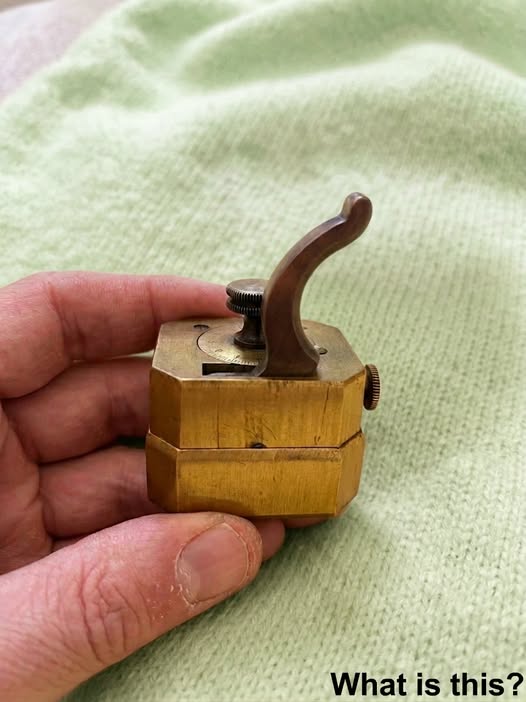
At first glance, it seemed like nothing more than an unusual antique. Small enough to fit comfortably in the palm of a hand, crafted from metal, and covered in the subtle wear of age, it appeared to be the kind of object someone might discover in an old drawer, at a flea market, or tucked away among forgotten belongings. Its design was intriguing, and the more closely I examined it, the more curious I became. Yet something about it felt slightly unsettling. Every movement of its mechanism revealed another detail I hadn’t noticed before, and each discovery only deepened the mystery.
Initially, I considered several possibilities. Perhaps it was an old lighter. Maybe a mechanical gadget from a bygone era. It could have been a pocket tool, a novelty item, or some forgotten household device whose purpose had been lost to time. But none of those explanations seemed quite right. The construction was too deliberate, the mechanism too precise, and the overall design suggested a function far more specific than simple entertainment or convenience.
As I continued inspecting it, I rotated the object in my hand and noticed something I had overlooked.
Tiny blades.
Carefully aligned.
Hidden so discreetly that they were almost invisible unless viewed from the proper angle.
The moment light reflected off the metal edges, a wave of unease passed through me. Suddenly, the object felt very different. It was no longer an interesting curiosity. It was a tool designed for a purpose that involved the human body.
Determined to understand what I was holding, I began researching its design and history.
What I eventually discovered was both fascinating and unsettling.
The object was an antique medical scarificator, an instrument once commonly used during the practice of bloodletting. Hidden inside its compact housing was a spring-loaded mechanism designed to release several tiny blades simultaneously. When activated, the blades would emerge for only a fraction of a second, creating a series of shallow, controlled cuts across the skin.
Today, the idea may sound shocking, but for centuries many physicians believed bloodletting was a legitimate medical treatment. According to prevailing theories of the time, illness often resulted from imbalances within the body. Removing blood was thought to restore health and correct those imbalances. As a result, patients underwent these procedures for a remarkable range of conditions.
Headaches.
Fevers.
Infections.
Inflammation.
Digestive problems.
Even emotional distress.
Many ailments that modern medicine now understands very differently were once treated through bloodletting.
Patients placed their trust in the physicians performing these procedures because they represented the best medical knowledge available at the time. Doctors genuinely believed they were helping people. The treatments were not intended as cruelty but as attempts at healing based on the scientific understanding of the era.
Looking at the scarificator today, however, it is impossible not to reflect on how much medicine has evolved.
The device itself is surprisingly sophisticated. Its mechanism demonstrates careful engineering and craftsmanship. Every component was designed with precision, allowing the instrument to perform exactly as intended. Yet despite its ingenuity, the treatment it delivered was often ineffective and, in many cases, potentially harmful.
That contrast is what makes the object so compelling.
It represents both human innovation and human error.
It is evidence of a time when confidence often exceeded understanding, when even educated professionals could be convinced they were helping while unknowingly causing harm.
Holding the scarificator in my hand created a strange emotional reaction. Part of me admired the craftsmanship and historical significance of the device. Another part felt uneasy imagining the countless patients who had sat still while trusting it would cure their suffering.
For them, this instrument represented hope.
Hope that pain would ease.
Hope that illness would disappear.
Hope that a trusted physician knew the answer.
Many likely endured the procedure believing recovery was just around the corner.
Today, the scarificator serves a different purpose.
It is no longer a medical instrument.
It is a reminder.
A reminder of how science advances through trial, observation, correction, and sometimes painful mistakes. It demonstrates that certainty can be misleading and that even widely accepted beliefs must remain open to challenge and evidence.
The object also highlights the importance of humility in medicine. Every generation tends to believe it understands the world more completely than the one before it. Yet history repeatedly shows that knowledge evolves, theories change, and practices once considered unquestionable may eventually be abandoned.
What began as a harmless-looking antique turned out to be far more significant than I ever expected. It was not merely an old tool gathering dust from another era. It was a silent witness to centuries of medical history, carrying stories of suffering, trust, hope, and the relentless human search for healing.
Since discovering its true purpose, I find myself looking differently at historical objects. What appears ordinary on the surface may conceal an extraordinary story beneath. Sometimes the smallest artifacts reveal the most about how people once lived, what they feared, and what they believed.
And every time I see that scarificator now, I am reminded that progress often comes from questioning certainty—and that even the most confident answers can one day become history.