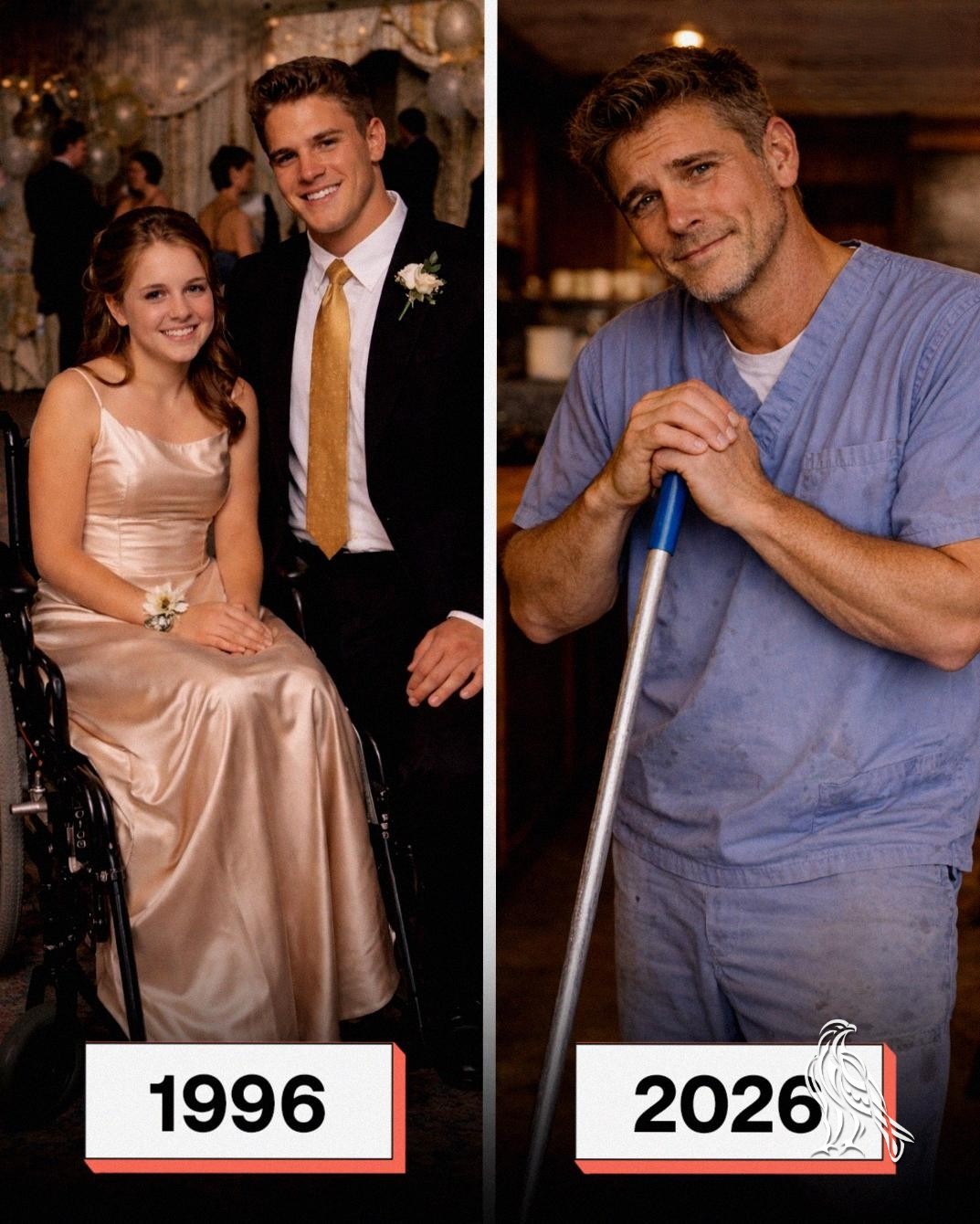
The night that was supposed to humiliate her became the night that quietly shaped the rest of her life.
At seventeen, Leah believed the worst thing that could happen to a person was being seen at their weakest. She learned that lesson the hard way beneath the harsh lights of a high school gymnasium decorated with silver streamers and cheap paper stars for prom night.
Until then, her senior year had unfolded normally enough.
Then came the accident.
One rainy afternoon just three weeks before prom, Leah’s car hydroplaned on a curve outside town. The crash shattered her left leg, fractured two ribs, and left her temporarily dependent on a wheelchair while the rest of her classmates prepared for graduation parties and photographs she no longer wanted to attend.
By prom week, she had already decided she wasn’t going.
The thought of rolling into a gym full of pitying stares felt unbearable.
But her mother insisted gently.
“You’ve already lost enough this year,” she said quietly. “Don’t let the accident take this too.”
So Leah went.
And regretted it almost immediately.
The second she entered the gymnasium, she felt it:
the glances,
the awkward smiles,
the way conversations shifted when people noticed the wheelchair.
Nobody said anything cruel outright.
That almost made it worse.
People became too careful around her, which only highlighted how different she suddenly felt. Friends danced while Leah sat near the refreshment table pretending she was comfortable watching from the sidelines.
At one point, she overheard someone whisper:
“Poor thing.”
That sentence nearly sent her home.
Then Marcus crossed the room.
Marcus Reed wasn’t the kind of boy teachers predicted would become meaningful later in life. Quiet, broad-shouldered, permanently wearing worn denim jackets, he spent more time helping his father repair engines than worrying about popularity.
Yet somehow, he moved through the crowded dance floor with complete certainty.
Straight toward her.
Leah immediately braced herself for sympathy.
Instead, Marcus leaned casually against the table beside her and said:
“You look like you hate every person in this gym.”
Despite herself, she laughed.
“That obvious?”
“Only to anyone with eyes.”
For the first time all evening, someone spoke to her normally.
Not delicately.
Not carefully.
Just honestly.
They talked for nearly twenty minutes while music pounded around them. Marcus told ridiculous stories about nearly failing chemistry. Leah forgot to feel embarrassed for the first time since the accident.
Then came the moment she remembered for the next thirty years.
Marcus glanced toward the dance floor and asked:
“Would you like to dance?”
Leah stared at him, stunned.
“You can’t dance with a wheelchair.”
“Sure you can,” he shrugged. “You just do it differently.”
The gym suddenly felt silent even though the music never stopped.
People noticed.
Some stared openly.
But Marcus didn’t seem remotely aware of the audience around them. He simply rolled her gently onto the dance floor and swayed beside her beneath spinning lights while classmates watched in confused silence.
It wasn’t charity.
That’s what mattered most.
He wasn’t performing kindness for attention.
He genuinely wanted her there.
And in that moment, something fractured inside Leah — not painfully, but permanently.
Because until then, she hadn’t realized how quickly hardship had convinced her she deserved to disappear.
Marcus gave her something back that night:
visibility.
After graduation, life pulled them in different directions.
Leah went into architecture after years of struggling through inaccessible buildings, elevators, and spaces clearly never designed with disabled people in mind. The frustration fueled her career. Eventually, she became known for designing inclusive public spaces focused on accessibility and dignity.
Every ramp,
every widened doorway,
every redesigned community center
carried traces of that night beneath the prom lights.
Because she never forgot how it felt to be quietly pushed aside.
Marcus, meanwhile, stayed local. Life hit him differently. Years of construction work damaged his back permanently. A failed marriage and financial struggles followed. By his fifties, he looked older than his age — worn down but still carrying the same calm steadiness she remembered.
They didn’t see each other again for over three decades.
Then one spilled coffee changed everything.
Leah was standing inside a crowded café reviewing blueprints when someone bumped her shoulder hard enough to send coffee splashing across the table.
“Oh hell,” a familiar voice muttered instantly.
She froze.
Nobody else still sounded exactly like seventeen-year-old Marcus Reed.
When she looked up, time seemed to collapse strangely between them.
Older now.
Grayer.
Softer around the edges.
But unmistakably him.
For several seconds, neither of them spoke.
Then Marcus smiled slowly.
“Well,” he said quietly, “you still look like you’re judging the room.”
Leah burst into laughter so suddenly people turned to stare.
Coffee turned into dinner.
Dinner became hours of conversation.
And gradually, both admitted something neither fully understood until then:
Neither of them had ever forgotten prom night.
Marcus confessed that asking her to dance terrified him because he knew everyone was watching.
“I just hated seeing you sitting there alone,” he admitted.
Leah looked down quietly before answering.
“You changed my life that night.”
He blinked in surprise.
But it was true.
That single act of ordinary kindness had quietly shaped the woman she became.
Over the next few years, they built something gentler than romance usually looks in movies. No dramatic declarations. No perfect fairy tale.
Just two people carrying different scars finally finding a place where neither needed to hide them.
Together, they eventually opened a community center focused on accessibility programs and support services for people recovering from life-changing injuries.
At the grand opening, families filled the building Leah helped design herself.
Wheelchairs moved easily through every doorway.
Children laughed inside therapy rooms painted bright yellow.
Nobody looked out of place.
Near the end of the evening, music began playing softly through the center’s speakers.
Marcus approached her slowly with the same quiet expression he wore thirty years earlier.
“Would you like to dance?” he asked.
Leah smiled instantly.
This time, there was no gymnasium crowd staring at them.
No humiliation waiting nearby.
No fear of being seen.
Only two people finally understanding what that first dance had really meant.
Not rescue.
Not pity.
An invitation.
Back then, neither of them was ready to fully live inside that moment.
Now they were.