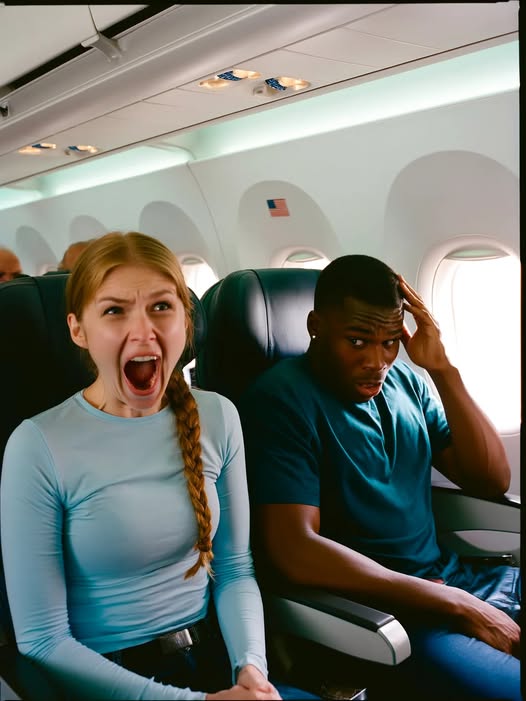
Marcus Cole sat quietly in seat 14B on the overnight flight from Chicago to London, looking like the kind of passenger nobody would remember after landing. Dressed in a faded hoodie and worn sneakers, he blended into the cabin effortlessly — just another exhausted traveler trying to survive a long international flight. To everyone around him, he appeared ordinary. But hidden beneath that calm, unremarkable exterior was a man who had once flown some of the most advanced aircraft in the United States Air Force before leaving that life behind to raise his daughter.
Years earlier, Marcus had traded combat missions and military prestige for school pickups, grocery runs, and bedtime stories. He didn’t leave aviation because he stopped loving the sky. He left because he loved being a father more.
The flight had settled into the quiet stillness that only happens halfway across the Atlantic. Most passengers were asleep beneath dim cabin lights while engines hummed steadily through the darkness outside.
Then the intercom chimed.
At first, it sounded routine. But the moment the lead flight attendant began speaking, Marcus noticed something hidden beneath her professional tone — fear.
“We are asking if there are any passengers with military aviation experience onboard…”
Marcus felt an old instinct wake up immediately.
Without saying a word, he calmly unbuckled his seatbelt and stood. As he stepped into the aisle, a businessman nearby looked him up and down skeptically.
The man scoffed quietly.
“They need a pilot,” he muttered sarcastically, “not some guy dressed like he’s backpacking across Europe.”
Marcus ignored him completely.
He had long ago stopped needing strangers to recognize who he was.
When Marcus reached the front galley, the seriousness of the situation became obvious instantly. The captain had suffered a severe medical emergency and was completely incapacitated. Inside the cockpit, the young first officer — Elias — was struggling to control an escalating systems failure while trying to keep the aircraft stable.
A major hydraulic leak had compromised the plane’s flight controls, and warning alarms were multiplying faster than they could react.
The second Marcus stepped into the cockpit, years of buried muscle memory came flooding back.
The smell of electronics, recycled air, and overheated systems felt strangely familiar.
Elias looked at Marcus uncertainly at first. No uniform. No rank insignia. Just a calm man with steady eyes.
But then Marcus spoke.
The language changed immediately.
Short, precise aviation terminology. Calm instructions. Technical shorthand only someone deeply trained would know instinctively.
Within seconds, Elias realized exactly who he was dealing with.
Marcus didn’t try to overpower him or take control dramatically. Instead, he stabilized the situation simply by being calm.
And suddenly the young officer could breathe again.
The situation was bad.
The aircraft was steadily losing hydraulic pressure, meaning the controls would soon become dangerously difficult to operate manually. Marcus knew immediately they would never safely reach London.
They needed the closest runway possible.
Fast.
Together, they rerouted toward Keflavik Airport in Iceland.
Outside the cockpit windows stretched the freezing emptiness of the North Atlantic — one of the most unforgiving places on Earth for an aircraft in distress.
As the plane descended, the controls became heavier with every passing minute. Without full hydraulic assistance, even simple turns demanded enormous physical force.
Marcus finally took hold of the controls himself.
His hands wrapped around the yoke with the familiarity of someone who had done this thousands of times before.
The years disappeared.
The combat pilot inside him returned instantly.
But he wasn’t fighting for medals or recognition anymore.
He was fighting because his daughter was waiting for him at home.
And because every passenger behind him had somebody waiting too.
The final descent into Iceland was brutal.
Powerful coastal winds slammed against the aircraft, pushing the damaged jet sideways as Marcus fought to keep it aligned with the runway lights ahead. The controls resisted every movement. The plane groaned violently under the strain.
Back in the cabin, terrified passengers sat frozen in brace positions while the aircraft shuddered around them.
Then came the landing.
It wasn’t smooth.
It wasn’t graceful.
It was survival.
The wheels slammed against the runway with bone-rattling force. The aircraft shook violently as Marcus and Elias wrestled the crippled jet back under control. Tires screamed against the pavement while reverse thrust roared through the engines.
For several terrifying seconds, it looked like the plane might skid off the runway entirely.
Then finally…
It slowed.
Stopped.
And silence filled the cockpit.
Outside, emergency vehicles surrounded the aircraft in flashing blue and red lights.
Marcus leaned back in his seat, exhausted. His hands slowly released their death grip on the controls while adrenaline drained from his body all at once.
He checked on Elias first.
The younger pilot looked stunned.
Marcus simply nodded at him with quiet professional respect before standing up and leaving the cockpit without waiting for praise.
Inside the terminal, emotions exploded everywhere. Some passengers cried openly. Others laughed hysterically from relief. Families hugged each other as reality settled in.
Eventually, the businessman who mocked Marcus earlier found him standing quietly near a window.
The man looked deeply ashamed.
He began stumbling through an apology, clearly overwhelmed by guilt.
Marcus stopped him gently with a small nod.
He wasn’t angry.
People underestimate quiet men all the time.
What mattered was that everyone survived.
While airline staff scrambled to organize hotels and reporters started hunting for the “mystery passenger” who helped save the flight, Marcus sat alone near the terminal window overlooking the icy runway.
Then he made the only phone call that truly mattered.
His daughter answered sleepily, confused by the late hour.
Marcus never mentioned the emergency.
He never talked about the damaged aircraft, the dying hydraulics, or the hundreds of lives that nearly ended over the Atlantic Ocean.
He simply smiled softly and said:
“Hey, kiddo. My flight got delayed a little… but I’m okay. I’ll still make it home.”
Years earlier, when Marcus walked away from military aviation, he made himself one promise:
Always come home.
That night, every skill he had ever learned was used for one purpose — keeping that promise alive.
Eventually, Marcus boarded another flight and disappeared back into the crowd of ordinary travelers.
No interviews.
No speeches.
No medals.
Just a father quietly going home to make breakfast for his daughter.
Because some people don’t carry greatness to impress the world.
They carry it quietly, waiting for the moment someone needs them most.