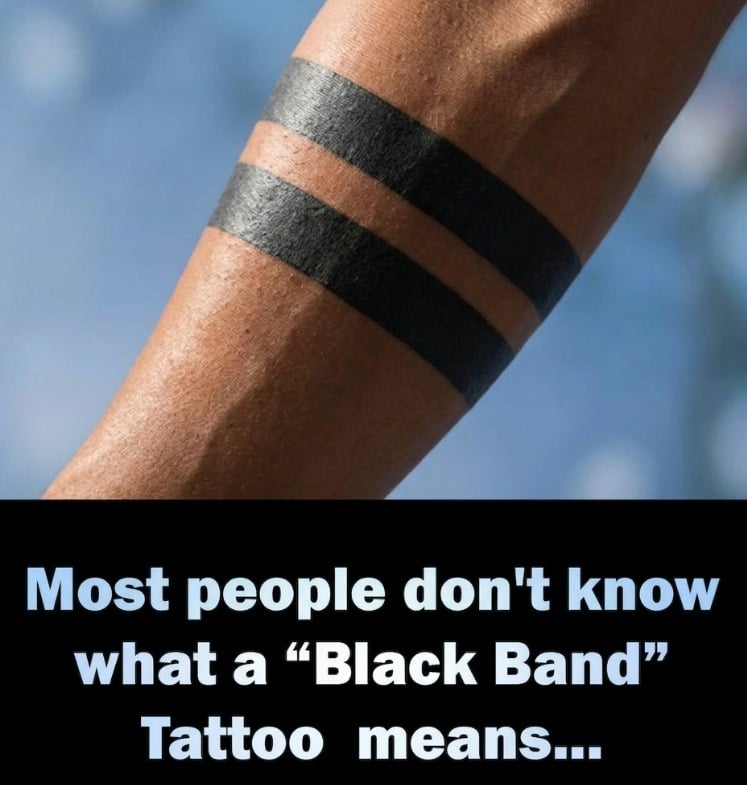
Black band tattoos rarely beg for attention. They don’t need elaborate designs, bright colors, or complicated symbolism to stand out. Instead, they sit quietly on the skin—simple, dark, and almost impossible to fully explain unless the person wearing them chooses to speak. That mystery is part of what gives them such emotional weight.
At first glance, they look minimalistic. Just solid black rings wrapping around an arm, wrist, leg, or finger. But behind that simplicity, the meaning can become incredibly personal.
For many people, a black band tattoo represents mourning.
Much like the black armbands people once wore after losing loved ones, the tattoo becomes a permanent memorial carried directly on the body. The unbroken circle often symbolizes a bond that death couldn’t fully erase. Some people choose a single band after losing a parent, partner, sibling, or child—someone whose absence permanently divided life into “before” and “after.”
What makes these tattoos especially powerful is their quietness.
There are no names required.
No dates.
No explanations.
The grief exists privately beneath the ink, visible but deeply personal. To outsiders, it may appear purely decorative. To the person wearing it, it can represent a loss too painful to summarize aloud.
But mourning is only one interpretation.
For others, black bands symbolize survival.
A turning point.
A chapter of life they fought desperately to escape.
Some people get them after overcoming addiction, trauma, illness, depression, or periods of personal destruction. The solid line becomes a marker separating the person they once were from the person they became afterward. In that sense, the tattoo almost functions like a scar transformed into something intentional—proof that even painful experiences can become part of rebuilding yourself.
Others see the bands as symbols of strength and discipline. The clean, uninterrupted shape can represent stability, endurance, or control over chaos. Some people intentionally choose multiple bands, each one tied to a specific life stage, achievement, or hardship survived.
And sometimes, the meaning is much simpler.
Not every black band tattoo carries tragedy or emotional depth. For many people, the appeal lies purely in the aesthetic itself. The design feels timeless, balanced, and bold without needing excessive detail. Unlike trendy tattoos that may fade stylistically over time, black bands often remain visually strong for decades because of their simplicity.
That’s part of why these tattoos continue attracting people across completely different backgrounds and cultures.
They leave room for interpretation.
Minimal enough to hide deeply personal meaning.
Strong enough to stand on appearance alone.
And perhaps that’s the most important thing about black band tattoos: their true meaning almost never belongs to the public. People may speculate when they see them, attaching assumptions about grief, rebellion, spirituality, or toughness. But the reality beneath the ink belongs entirely to the individual wearing it.
Sometimes it marks heartbreak.
Sometimes healing.
Sometimes both at once.
And sometimes, the silence surrounding the tattoo says far more than words ever could.