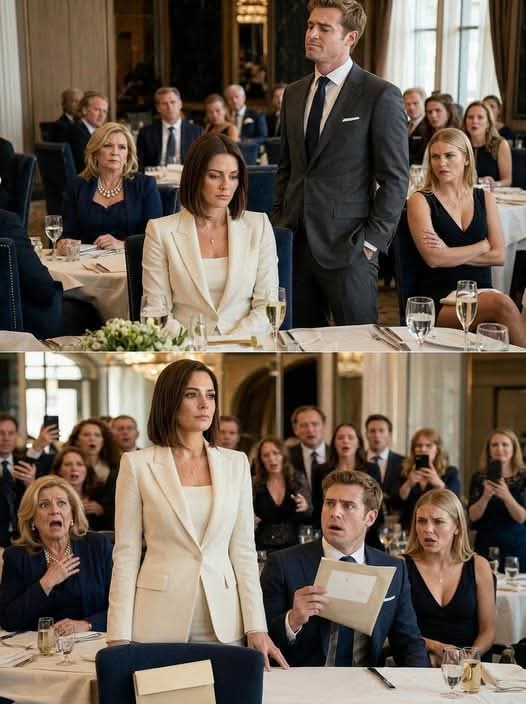
The moment my fiancé told me to stop calling him my future husband, something inside me quietly stopped breathing. Around us, dinner continued normally enough — crystal glasses clinking softly, polished silverware scraping against porcelain, and my future mother-in-law’s sharp laughter echoing across the dining room. To anyone else, it probably looked elegant and sophisticated. But inside me, something trusting suddenly shut down completely.
It started with something harmless.
I reached across the table and moved olives from Adrien’s plate while casually joking that my future husband had always hated them.
That was it.
An ordinary sentence.
A loving sentence.
Yet Adrien’s entire expression shifted instantly. His fingers rested lightly against the stem of his wine glass before he looked at me with that carefully practiced elegance he used whenever he wanted to seem charming, untouchable, and superior all at once.
“Don’t call me your future husband,” he said softly. “Not yet.”
His voice remained calm, which somehow made the words feel even colder.
Across the table, his sister Camille smiled faintly, the kind of smile designed to punish someone without openly appearing cruel. Their mother, Vivienne, barely reacted outwardly at all. She simply stared at my engagement ring with obvious disapproval, as though she regretted allowing me to wear it in the first place.
Adrien repeated himself moments later for emphasis.
“We’re only engaged,” he reminded me in front of everyone. “There’s no need to rush into making things sound permanent.”
Then he added that calling him my husband made him feel trapped, like I was trying to force permanence too quickly.
Vivienne sighed dramatically and added that men “needed room to breathe.”
Camille laughed and remarked that commitment must feel especially overwhelming when someone married “above themselves.”
The insult arrived wrapped in elegance sharp enough to slice skin.
Heat climbed painfully into my throat, but years spent navigating corporate boardrooms had trained me well. I knew how to remain composed while people underestimated me. So I sat there quietly with my hands folded neatly in my lap while Adrien placed a patronizing hand over my wrist — the same way someone might soothe an emotional child — and gently reminded me that he loved me.
But later that night, long after we returned to my penthouse apartment, his words kept replaying inside my head.
He loved me.
Did he?
Or did he love what I gave him?
Because suddenly I saw things clearly for the first time.
He loved me when my father’s venture capital firm secured bridge financing for his collapsing company.
He loved me when I introduced him to investors he never could have reached on his own.
He loved me when my surname opened doors his ambition alone couldn’t unlock.
And maybe worst of all, he only seemed to love me when being close to me benefited him financially or socially.
That night, while Adrien slept peacefully in my bed, I sat alone in my office staring at the files connected to our wedding.
Guest lists.
Vendor contracts.
Hotel reservations.
Private event schedules.
Security details.
Financial authorizations.
Every single thing tied to my name.
And one by one, I quietly removed myself from all of it.
I canceled authorizations.
Withdrew approvals.
Pulled deposits.
Voided contracts.
Then before sunrise, I made a series of phone calls that erased the future Adrien thought he already owned.
Two days later, he still believed I was simply upset.
He sent flowers with a note asking me to “be reasonable.”
Then came the texts.
“Don’t embarrass me.”
“My mother thinks you owe Camille an apology.”
“We’ll have lunch Friday. Appearances matter.”
Appearances.
That word told me everything.
The lunch was arranged at Bellamy House — an old private club draped in oil paintings, polished wood, and generational wealth. The kind of place where powerful people never openly gossiped, but remembered every scandal forever. Adrien invited investors, relatives, business associates, and even a society magazine editor planning to feature our engagement publicly.
What Adrien failed to understand was that Bellamy House carried my family’s history too.
My grandmother helped fund its early years.
Her portrait still hung proudly inside the garden room.
People there might have tolerated Adrien.
But they respected me.
That Friday, I dressed carefully in ivory silk while my assistant Noelle handed me a final folder confirming every canceled wedding contract.
All the deposits traced back to my accounts.
Every signature belonged to me.
Without my authorization, Adrien’s dream wedding no longer existed.
And by then, another truth had surfaced too.
Investigators reviewing Adrien’s business discovered falsified financial statements, inflated contracts, and fabricated projections. One investor agreement had never actually been signed. Another major client withdrew months earlier. Worst of all, Adrien improperly leveraged my father’s firm during negotiations to create the illusion of security.
Suddenly everything made sense.
Adrien didn’t want marriage because he loved me.
He wanted protection before his empire collapsed.
At Bellamy House, staff moved quietly around me preparing the room exactly as instructed.
Seating cards disappeared.
Reservations shifted.
Menus changed.
And on Adrien’s chair, I placed a cream-colored envelope sealed with black wax.
Inside were four items:
The official termination of our engagement.
Legal cancellations of all wedding arrangements tied to my name.
The foreclosure notice connected to his company’s defaulted loan.
And finally, a photograph.
Adrien kissing Camille’s best friend Tessa outside a hotel elevator.
I received the picture anonymously weeks earlier but ignored it because love has a dangerous habit of blinding people to obvious truths.
Then guests began arriving.
Vivienne swept into the room draped in pearls and superiority, immediately demanding to know why I sat at the head table instead of her son.
The staff answered politely.
“Not today.”
Camille initially laughed like the entire thing was a misunderstanding.
Then Adrien walked into the room.
And saw me seated beneath my grandmother’s portrait.
Then he noticed the envelope waiting on his chair.
His confidence vanished instantly.
He approached slowly, staring at the envelope like it might explode.
Because men like Adrien fear paper trails more than confrontation.
Paper creates proof.
Proof destroys performance.
“Are you making a scene?” he hissed quietly.
I smiled faintly.
“A scene only matters if the audience deserves entertainment.”
Camille grabbed the envelope first.
The second she scanned the contents, all color drained from her face.
Adrien ripped the papers away from her hands and immediately understood everything.
The engagement was over.
The wedding was gone.
And as he reached the photograph of himself kissing Tessa, silence spread across the room like smoke.
Tessa looked horrified.
Vivienne demanded explanations.
One investor physically leaned back from the table in disgust.
Still, Adrien tried regaining control.
“Couples survive mistakes like this,” he insisted weakly.
“Yes,” I answered calmly. “Businesses usually don’t.”
That was when real fear finally appeared on his face.
I informed him quietly that his business loan was now officially in default, his board had been notified, and auditors were already investigating the inconsistencies inside his financial records.
Vivienne attempted fighting back until I casually mentioned jewelry purchases connected suspiciously to company funds.
Then every phone at the table began vibrating simultaneously.
News of our breakup had already spread publicly.
Not the affair photograph.
Not yet.
Just enough information to let society begin asking dangerous questions.
Adrien lowered his voice desperately.
“We should handle this privately.”
I looked at him carefully.
Privacy had never mattered much to him when humiliating me publicly over one harmless sentence at dinner.
So I reminded him softly:
“I simply followed your instructions.”
He frowned.
“You told me not to call you my future husband anymore.”
Then I removed the engagement ring from my finger and placed it gently onto his untouched dinner plate.
The collapse afterward happened fast.
Adrien’s board forced him to step down within hours.
Financial investigators moved in quickly.
Vivienne began quietly selling jewelry to manage mounting debts.
Camille’s event-planning business imploded after screenshots of cruel messages mocking clients leaked online.
Six months later, I purchased the garden room at Bellamy House and renamed it after my grandmother.
Opening night glowed with candlelight and soft music.
Instead of a white wedding dress, I wore black silk.
And for the first time in years, I finally felt entirely like myself — without pressure, expectation, or someone else trying to shrink me into a more convenient version.
Nobody mentioned Adrien that evening.
But somewhere out there, I imagine he’s still trying to explain himself to people who no longer believe a single word he says.
And when someone called my name across the room that night, I turned toward them feeling whole again.
Not because someone finally chose me.
But because, at last, I had chosen myself.