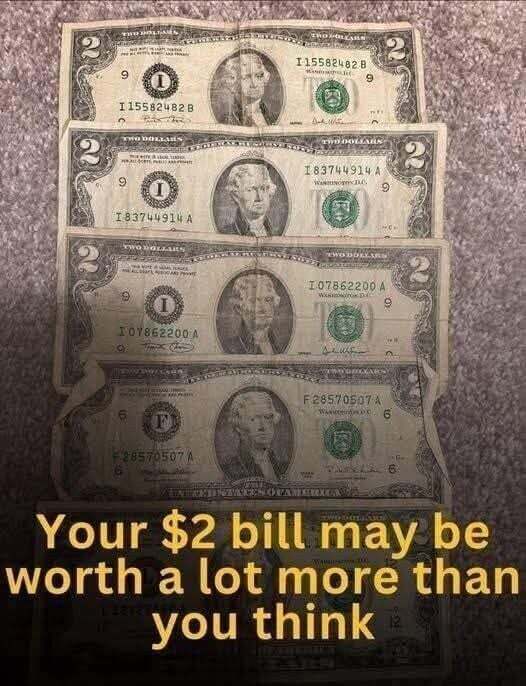
The $2 bill has always carried a strange reputation. Some people treat it like a curiosity. Others avoid it entirely, whispering old superstitions about bad luck, gambling losses, or cursed money. For decades, cashiers tucked them aside, customers refused them, and many Americans grew up believing the unusual note was either fake, unlucky, or no longer printed at all. Yet hidden beneath that mystery is a surprising reality: the humble $2 bill may be one of the most misunderstood pieces of currency still circulating today.
And in some cases, it could be worth far more than two dollars.
Part of the fascination comes from how rarely people encounter one in everyday life. Most Americans can go years without seeing a $2 bill pass through their hands, which naturally makes it feel rare or special. That scarcity created myths over time. Some believed banks had stopped producing them decades ago. Others assumed they were collector’s items automatically worth large sums. In truth, the U.S. Treasury still prints $2 bills today, though in much smaller quantities than more common denominations.
Because they appear so infrequently, many people save them instead of spending them.
Ironically, that habit helps keep them uncommon in circulation and strengthens the illusion that they are disappearing entirely. A person might receive one as change, tuck it into a drawer “just in case,” and forget about it for years. Families often pass them down in birthday cards, holiday envelopes, or keepsake boxes, giving the bill an almost sentimental status compared to ordinary cash.
But occasionally, those forgotten notes turn out to be genuinely valuable.
Collectors pay close attention to certain details that can dramatically increase a $2 bill’s worth. The series year is one of the first things experts examine. Older bills, especially those printed in the late 1800s or early 1900s, can command impressive prices depending on rarity and condition. Even more modern notes sometimes attract serious collector interest if they feature unusual characteristics.
Serial numbers are one of the biggest factors.
A bill with repeating digits, extremely low numbers, palindromes, or sequential patterns — often called “fancy serial numbers” — can become surprisingly desirable. Something as simple as a serial number like 00000021 or 77777777 may transform an ordinary bill into a collector’s target. Certain printing errors also create value. Misaligned cuts, ink mistakes, duplicated serial numbers, or unusual seals can send prices soaring among currency enthusiasts.
Condition matters just as much.
A crisp, uncirculated $2 bill stored carefully for years is far more valuable than one folded repeatedly inside a wallet. Collectors often search for notes without creases, tears, stains, or fading. Some pristine examples, especially older issues, have sold for hundreds or even thousands of dollars at auctions.
That possibility is what keeps treasure hunters constantly checking old envelopes, inherited collections, and forgotten drawers.
Stories regularly surface online about people discovering valuable currency hidden among ordinary possessions. A dusty family scrapbook, an untouched coat pocket, or an old birthday card suddenly becomes exciting once someone realizes the bill inside may be worth much more than face value. While most $2 bills remain worth exactly two dollars, the small chance of uncovering a rare one fuels endless curiosity.
The bill’s odd cultural history only adds to its mystique.
At different points in American history, the $2 bill became associated with everything from gambling and political bribery to bad omens and strange luck. Some businesses even refused to accept them because employees believed they were counterfeit. Yet for others, the bills became symbols of prosperity or uniqueness. Certain people intentionally carry them as good-luck charms precisely because they stand out.
That contradiction is part of why the $2 bill continues fascinating people generations after its introduction.
It exists in a strange space between ordinary money and collectible artifact. Most people ignore it. Some fear it. Others quietly hunt for it hoping to uncover hidden value. And unlike many old myths, this one occasionally contains a grain of truth.
So before spending the next $2 bill you find, it may be worth pausing for a closer look.
Check the year. Examine the serial number. Look for printing errors or unusual features. Notice the condition. Chances are it’s simply an uncommon piece of everyday currency. But every so often, the crumpled note sitting forgotten in a drawer turns out to be something far more valuable — a small, overlooked fortune hiding in plain sight.