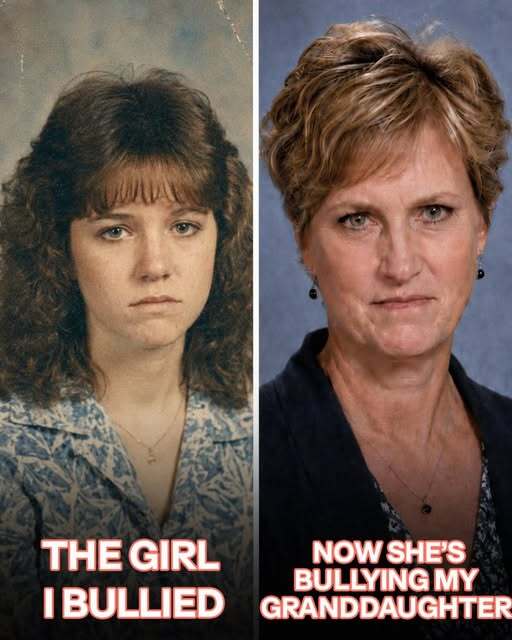
My granddaughter came home with a note that shattered the life I’d spent forty years trying to outrun. One sentence. Ten words. And suddenly, the girl I once destroyed was back in front of me — this time holding power over my family. What happens when the bully and the victim meet again, with a child caught in the middle?
The note was folded so tightly in Sophie’s trembling hands that the paper had nearly torn at the edges. She stood in my kitchen doorway after school, her backpack hanging from one shoulder, eyes swollen from crying she had clearly tried to hide during the bus ride home. At first, I assumed it was another ordinary childhood disaster — a failed spelling test, a fight with a friend, some playground cruelty children recover from in days. But then she handed me the note.
“Bad behavior runs in families.”
No signature. No explanation. Just those words written in sharp blue ink across the bottom of her homework sheet.
I felt something cold move through my chest the moment I saw the handwriting. Memory is strange that way. Forty years can disappear in an instant because of the shape of certain letters. Carol always pressed too hard with her pen. Even in high school, her writing looked angry.
Sophie sat at the kitchen table while I stared at the paper far too long.
“Grandma,” she whispered carefully, “did I do something wrong?”
That question hurt more than the note itself.
Because children always assume cruelty is deserved.
And suddenly I was seventeen again, watching Carol Walker stand alone near the cafeteria windows while people laughed at a rumor I had started simply because I was bored and wanted attention. I remembered the nicknames. The mocking. The way I convinced myself it wasn’t bullying because I never touched her. As if humiliation somehow became harmless when delivered with a smile instead of a fist.
Back then, Carol was painfully shy. She wore oversized sweaters regardless of the weather and carried books against her chest like armor. Teachers adored her because she was brilliant, which made girls like me resent her even more. I knew exactly how to turn a room against someone. High school rewards that kind of talent more often than adults like admitting.
I told myself for years that teenagers are cruel by nature. That everyone eventually grows up. That the past belonged in the past.
But the truth was uglier: I never apologized because apologizing would have required admitting I enjoyed hurting her.
Sophie interrupted my thoughts quietly.
“Mrs. Walker doesn’t like me.”
The room went silent.
Walker.
Of course.
I should have known the moment the school announced her name at the beginning of the year. But Carol Walker is not an uncommon name, and denial is a powerful thing. I convinced myself it couldn’t possibly be her. That life wasn’t dramatic enough for that kind of punishment.
Yet suddenly every interaction Sophie had mentioned over the past two months replayed differently in my mind. The unusually harsh comments on assignments. The detentions for tiny mistakes. The way Sophie had stopped raising her hand in class because, according to her, “the teacher always sounds annoyed when I answer.”
At the time, I blamed normal school adjustment problems.
Now I wasn’t sure.
That night I barely slept. I kept remembering one particular afternoon during senior year. Carol had been selected to give a speech at an academic banquet, and I spread a rumor that she’d only won because her father donated money to the school. By the end of the week, students were whispering about her in hallways. Someone scribbled “teacher’s pet” across her locker. She cried in the bathroom during lunch while I sat with my friends pretending not to notice.
I never touched her.
But I built the room that trapped her inside.
The next morning, I called the school requesting a meeting.
The secretary’s voice was cheerful when she scheduled it. Ordinary. Unaware that two old ghosts were about to sit across from each other pretending to be civilized adults.
When Carol entered the conference room later that afternoon, I recognized her instantly despite the decades between us. Her hair was shorter now, streaked lightly with gray, and there were fine lines around her eyes that hadn’t been there before. But her posture was the same — cautious, guarded, like someone accustomed to expecting attacks from directions other people never notice.
For one brief second, shock crossed her face too.
Then professionalism buried it.
“Mrs. Bennett,” she said evenly, taking her seat. “How can I help you?”
Not Helen. Not even a flicker of recognition in her voice.
That hurt more than anger would have.
I looked down at the note in my hands.
“You wrote this to my granddaughter.”
It wasn’t a question.
Carol’s expression barely changed. “Sophie has had several behavioral issues in class.”
“She’s nine.”
“And children learn behavior somewhere.”
There it was.
Not denial. Not apology. A blade sharpened over forty years.
Part of me wanted to get defensive immediately. To insist Sophie was innocent. To demand professionalism. But another part of me understood something terrible: Carol wasn’t speaking to Sophie when she wrote those words.
She was speaking to me.
The meeting deteriorated quickly after that. Carol remained calm while I became emotional, which somehow made me feel guiltier. Every sentence she spoke carried years beneath it.
“You don’t remember everything you did,” she said quietly at one point.
And she was right.
That was the worst part.
Bullies often remember their cruelty as isolated incidents because they experience it as performance. Victims remember it as climate. Constant. Unavoidable. A world rearranged around humiliation.
I left the school shaken in ways I couldn’t explain to my daughter later that evening.
“She can’t take this out on Sophie,” my daughter snapped angrily after hearing the story. “We should report her.”
But I sat there staring at the note again, unable to escape the uncomfortable truth that none of this had started with Carol.
It started with me.
Over the next week, Sophie became quieter. She started pretending to be sick in the mornings. One evening I overheard her asking her mother if mean people stay mean forever.
Children hear more than adults realize.
That question finally forced me to make a decision.
The school board meeting happened on a Thursday night in a crowded gymnasium that smelled faintly of floor polish and old basketballs. Parents expected an ordinary discussion about classroom conduct. They had no idea they were about to witness forty years of buried shame dragged into fluorescent light.
Carol sat rigidly near the front row while administrators shuffled papers nervously beside her.
When my name was called, my legs nearly failed me walking toward the podium.
I stood there knowing there was no version of this where I emerged as the hero.
I spoke anyway.
I told them who I had been in high school. Not the polished version people soften with phrases like “kids make mistakes.” The truth. I described the rumors I spread. The humiliation I orchestrated. The pleasure I took in belonging to the powerful side of cruelty. I admitted that I had spent decades minimizing behavior that helped shape another human being’s life.
The gym grew painfully quiet.
I watched students’ faces shift as I described the kind of cruelty that leaves no bruises, only echoes. I watched teachers glance toward Carol, realizing the woman they respected carried wounds none of them had ever seen. Some parents looked uncomfortable. Others looked angry. A few looked ashamed in the way people do when they recognize themselves somewhere inside a story.
My confession didn’t redeem me.
It simply named what I had spent a lifetime disguising as “youth” and “mistakes.”
Then I said the only thing that mattered.
“My granddaughter should not inherit guilt for my sins. And Carol should not have to carry this pain alone anymore.”
Carol never looked at me during the speech.
But when I stepped away from the microphone, Sophie quietly left her seat beside my daughter and walked across the gym toward her teacher.
Every adult in the room froze.
Sophie wrapped her small arms around Carol’s waist and whispered something none of us could hear. Carol’s face broke instantly. Not dramatically. Not like a movie scene. Just one exhausted crack in a wall held upright for too many years.
It was not forgiveness.
It was something smaller and perhaps more important: a refusal to continue the inheritance of cruelty.
Later, long after parents and teachers filtered out of the building, Carol and I sat alone in the empty gym while janitors cleaned nearby hallways. The silence between us felt heavier than any argument could have.
“I hated you,” she admitted finally, eyes fixed on the basketball court. “For a very long time.”
“I know.”
“No,” she said quietly. “You really don’t.”
And again, she was right.
We talked for nearly an hour. Not like friends. Not even like enemies. More like survivors describing the same fire from opposite sides. She told me about panic attacks in college whenever groups of girls laughed nearby. About years spent believing kindness always concealed mockery. About how becoming a teacher sometimes felt like reclaiming territory stolen from her as a child.
I apologized then. Truly apologized. Not to erase consequences or demand absolution, but because the truth deserved to exist plainly between us at least once before we died.
Carol listened.
She didn’t forgive me.
I didn’t ask her to.
Some damage remains damage forever.
But when we finally stood to leave, something had shifted slightly. Not healed. Not repaired. Just acknowledged.
And sometimes acknowledgment is the first honest thing two broken people can offer each other.
That day, I didn’t break the chain of harm completely.
But for the first time in forty years, I stepped out of it.