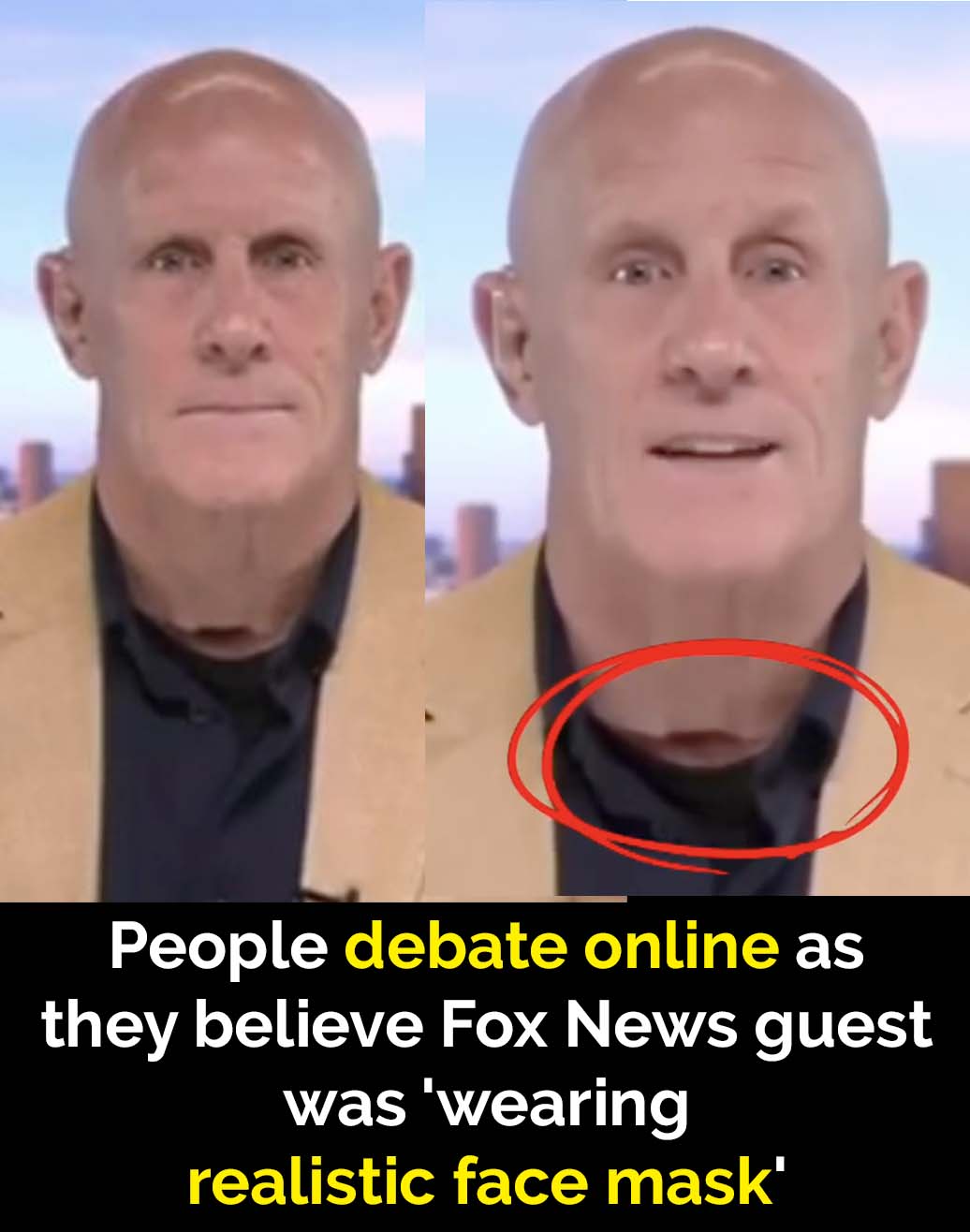
A single frozen television frame was all it took to send the internet spiraling into another reality-bending frenzy. One moment, viewers were casually watching a routine Fox News discussion about rising tensions with Iran. The next, social media feeds exploded with screenshots, zoomed-in stills, and wild claims that seemed pulled straight from a science-fiction thriller. People paused the video repeatedly, staring obsessively at Vice Admiral Robert Harward’s neck. And there, just above the collar of his dark jacket, many swore they saw it:
The edge of a human mask.
Within hours, the clip had escaped television entirely and transformed into online mythology. Grainy reposts spread across Reddit, X, TikTok, and conspiracy forums at lightning speed. Users slowed the footage frame by frame, drawing bright red circles around shadows near Harward’s collar while insisting the strange line could only mean one thing: the man appearing on television was not actually Robert Harward at all.
The theory sounded absurd.
Which, of course, only made it spread faster.
Soon the internet was overflowing with speculation. Some claimed the retired Navy SEAL had been replaced by an actor wearing advanced silicone prosthetics. Others suggested intelligence agencies were testing hyper-realistic disguises publicly to measure whether audiences would notice. More extreme theories insisted the clip “proved” powerful institutions routinely place imposters on live television while the public remains too distracted to realize it.
And somehow, millions of people began genuinely debating whether a decorated military officer had appeared on national television disguised as someone else.
The strange thing was that the screenshot did look unsettling at first glance.
The image quality was poor. The lighting uneven. Harward wore layered dark clothing beneath intense studio lights that created harsh shadows along his neck and jawline. In still frames, especially compressed and reposted repeatedly online, the crease near his collar appeared oddly artificial — almost like peeling latex or the edge of prosthetic material lifting slightly from skin.
The human brain is built to search for patterns, especially unsettling ones.
Once viewers were told “this looks like a mask,” many could no longer unsee it.
That’s how internet hysteria works now. Suspicion spreads faster than context. A blurry visual anomaly becomes “evidence” long before experts have time to explain it. By the end of the day, people who had never heard of Robert Harward were analyzing screenshots of his neck like forensic investigators examining classified footage.
Reddit threads grew massive within hours. Users compared the clip to spy movies, deepfake technology, and old conspiracy theories about politicians being replaced publicly. Amateur analysts slowed videos down obsessively, claiming certain head movements looked “unnatural.” Others insisted tiny lighting shifts proved the skin texture was fake. Every pixel became open to interpretation.
And interpretation online almost always drifts toward paranoia.
But while conspiracy theories multiplied rapidly, others pushed back just as aggressively.
Lighting professionals, television producers, photographers, and video editors began explaining how easily strange visual distortions appear on camera — especially during live broadcasts compressed heavily for online reposting. Harsh studio uplighting can carve bizarre shapes into skin folds and clothing seams. Dark collars create sharp contrast against flesh tones. Compression artifacts distort shadows further each time a clip is downloaded, reposted, and screen-recorded again.
In other words: the “mask line” likely wasn’t a mask at all.
Just bad lighting colliding with low-quality internet footage and a public increasingly conditioned to distrust what it sees.
Several professionals demonstrated how ordinary neck folds and clothing creases can appear deeply unnatural once videos lose resolution. Some recreated nearly identical “mask effects” using nothing more than directional lighting and layered jackets. Yet by then, facts had become almost irrelevant.
Because the internet was no longer discussing Robert Harward specifically.
It was discussing reality itself.
That’s what made the moment feel so unsettling to many people. The theories were ridiculous on the surface, yet they tapped directly into a deeper cultural anxiety now shaping modern life: the fear that nothing seen through a screen can be trusted anymore. Deepfakes exist. AI-generated videos improve constantly. Edited clips travel faster than verified information. Public trust in institutions continues collapsing. Against that backdrop, even a harmless visual glitch can suddenly feel sinister.
The retired admiral became less important than the collective paranoia projected onto him.
And perhaps that is the most revealing part of the entire story.
Years ago, a strange television frame would have remained exactly that — strange. Maybe briefly amusing. Easily forgotten. Today, it becomes an international debate within minutes because millions of people now exist inside an ecosystem built to reward suspicion. Algorithms push emotionally charged content harder than rational explanations. Outrage spreads farther than expertise. Mystery becomes entertainment.
A crease in someone’s collar becomes proof of hidden realities because people increasingly expect deception everywhere they look.
Ironically, Vice Admiral Harward himself never appeared particularly rattled by the chaos. While the internet dissected his neck frame by frame, he remained exactly what available evidence suggests he always was: a retired military officer appearing on television beneath difficult studio lighting.
No hidden identity.
No silicone disguise.
No secret operation unfolding live on cable news.
Just a visual quirk amplified into cultural hysteria by a digital world permanently primed for conspiracy.
And yet, for a few surreal days online, millions of people stared at one blurry television screenshot and genuinely wondered whether human faces themselves could still be trusted.