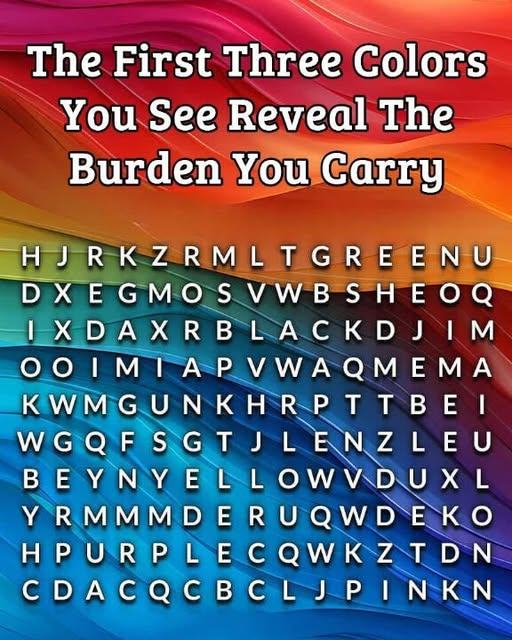
It’s not just our eyes that see color. Somewhere deeper is where they settle. A hue might land like a memory, a change in mood, or even a silent alarm before we’ve even had a chance to express how we’re feeling. The notion that “the first three colors you notice reveal the weight you’re carrying” continues to circulate online in part because of this. It can be helpful as a symbolic reflection tool, but it is neither a scientific evaluation nor a replacement for actual mental health care. It slows you down just enough for self-reflection.
The idea is simple. You are either asked to quickly identify the first three colors you see around you, or you are shown an image that is full of color. They are not chosen at random by your brain. What we see is filtered by attention. We are drawn to things that seem familiar, noticeable, reassuring, or pressing. You’re not merely taking in your surroundings at that moment. They are being interpreted by you. The concept of a “burden” enters the image through that interpretive prism.
In this context, a load need not be as severe as trauma. It might be the stress you’ve become accustomed to. the pressure you bear without discussing it. The bitterness you’ve kept hidden for years. You are not intended to be diagnosed or labeled by this activity. It is a reflection of who you are. You might start to see emotional patterns you’ve been missing if you approach it carefully and don’t treat it as fortune telling.
The way the brain interprets color is the reason it feels so intimate. Color perception is more than just visual. It’s interpretative. The brain associates color with learned associations, memories, and emotions. Imagine how warm sunset light may calm your body, or how a stark white hospital hallway can make your chest tense. Your system reacts even when you’re not conscious of it. There is a biological component to that reaction. Experience plays a role.
Another factor is culture. In one culture, a color that is consoling could represent loss in another. White is associated with cleanliness, marriage, and purity in many Western countries. White is strongly connected to funerals and grief in a number of Asian traditions. In one context, red might be a warning or a symbol of danger, but in Chinese culture, it is associated with prosperity, joy, and good fortune. Therefore, when someone says that “black means grief” or “red means passion,” they are utilizing common abbreviations rather than fundamental principles.
Nevertheless, these common meanings were not spontaneous. Over time, humans have attached emotional signals to color because it helps us interpret the world quickly. It is essential to marketers. Filmmakers and designers intentionally exploit it. The same is true when we dress according to our desire to blend in or stand out. Color communicates directly with the nervous system, skipping the rational mind.
What is the purpose of this “first three colors” exercise, then? It encapsulates your natural reaction. That split second before you edit yourself into a more rational answer. It allows you to see your quick response. Furthermore, the initial response is frequently more honest than the one that results from careful consideration.
These are a few popular symbolic interpretations. as ideas for contemplation rather than as unchangeable facts.
Intensity is represented by red. It may indicate boldness, passion, love, and drive. It may also indicate stress, rage, impatience, and a sense of urgency. Emotional heat could be the weight you’re carrying if red is the first hue you notice. a feeling that slowing down is unsafe and that everything is important right now. It can occasionally be a reflection of someone who has been trying too hard to keep themselves together.
Depth is reflected in blue. It may imply composure, dependability, devotion, and emotional intelligence. It can also relate to duty, melancholy, and the burden of being the one who maintains order. Your burden can be silent pressure if blue is the most noticeable color. helping others, controlling feelings, and maintaining composure when you need help yourself.
Brightness can be found in yellow, but there is also tension behind it. It represents optimism, inventiveness, hope, and curiosity. Additionally, it may be associated with anxiety, mental hyperactivity, and the need to maintain a positive attitude. You may have to perform happiness if yellow appears first. feeling obligated to maintain a positive attitude despite being exhausted or in pain.
Black is the color of protection. It can convey control, elegance, strength, and boundaries. It may also be a reflection of emotional shielding, fear, grief, or secrecy. If black is among the first colors you see, you may be holding something heavy in silence. Or you’ve constructed walls so sturdy that being vulnerable feels dangerous.
White indicates control and clarity. It can stand for peace, renewal, and simplicity. It can also point to perfectionism, emotional distance, and the urge to keep everything orderly. If white appears quickly, your burden may involve maintaining composure. Doing everything “right” while feeling unsettled when life becomes unpredictable.
Green connects to growth and healing. It can represent renewal, balance, and resilience. It can also reflect envy, comparison, and the discomfort of change. If green stands out, your burden may involve transition. Recovering, rebuilding, or trying to evolve while your surroundings resist it.
Purple is often associated with transformation. It can reflect intuition, wisdom, imagination, and emotional depth. It can also signal loneliness, feeling misunderstood, or carrying questions without clear answers. If purple catches your eye, your burden may be emotional complexity. Living in deep thought, holding layered feelings without an easy outlet.
Orange represents stimulation and momentum. It signals enthusiasm, ambition, boldness, and vitality. It can also point to exhaustion, overload, and the sense that you always have to show up at full volume. If orange appears early, your burden may involve constant performance. Always producing, always energizing others, never fully resting.
Gray sits in the middle. It can represent steadiness, neutrality, and maturity. It can also reflect emotional fatigue, numbness, and indecision. If gray shows up quickly, your burden may feel like fog. Moving through life without strong feeling, or feeling suspended between paths.
None of these interpretations are final judgments. They’re entry points. What matters most is your reaction. Does a meaning feel uncomfortably accurate? Does it sound familiar? Does it annoy you because it hits close to something you’d rather not face?
If you want this exercise to be genuinely useful, stay grounded with it. Don’t treat it as destiny. Treat it as reflection.
Choose your three colors quickly. Don’t analyze. Then write one honest sentence about each. What does it remind you of? What emotion does it carry? What might it represent in your life right now? If you journal, take it further. Ask yourself what weight you’ve been calling normal. If you’re in therapy, it can open conversation. If you create art, express it visually. Even if you don’t, it can still help you put language to feelings your body already recognizes.
Colors won’t fix what you’re carrying. But they can help you see it. And sometimes, seeing it clearly is the first step toward finally setting it down.