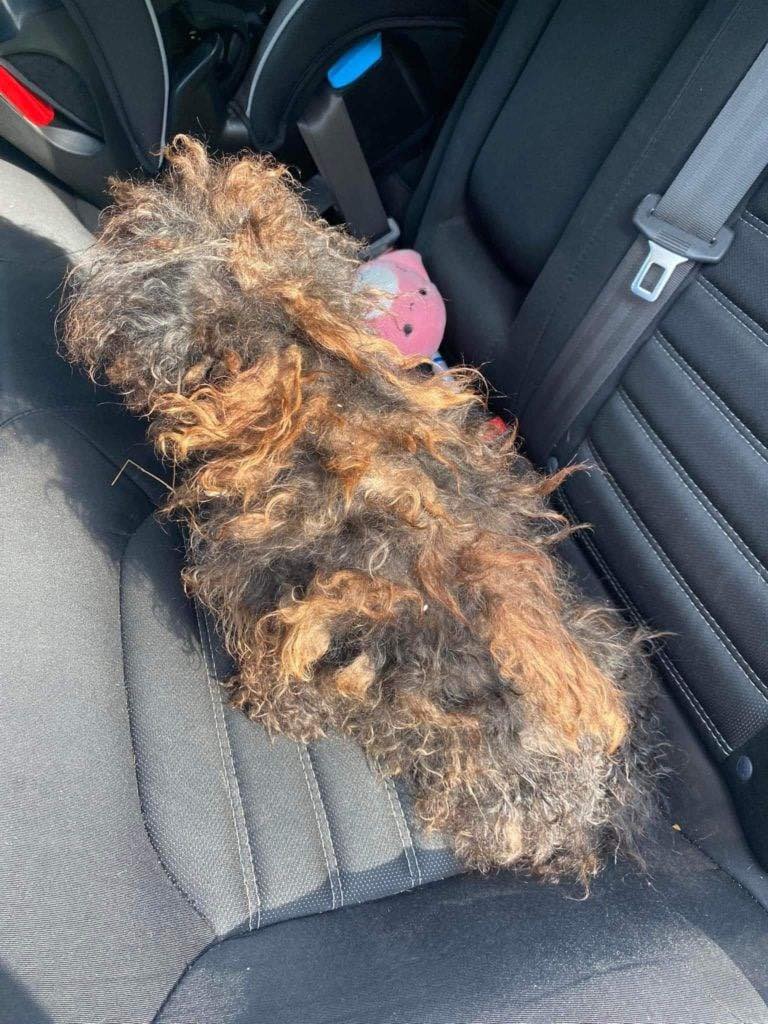
It was hardly identifiable as a real, breathing creature, hunched by the side of a desolate Missouri road. Her body was deteriorating and vanishing in the open, a terrible reflection of a life characterized by neglect and desertion. Every step she took sent waves of pain through her skeleton, exhausted body, and every movement she tried was a torturous struggle. She was more of a neglected pile of matted, filthy fur than a dog; she was a quiet victim of a society that had abandoned her. She had been abandoned to suffer silently and slowly, blending into the gravel and dust until she was no longer discernible from the abandoned rubble of the road.
It wasn’t until the rescuers at Mac’s Mission had finally removed the suffocating exoskeleton of wreckage that had imprisoned her for so long that she was given the name Pear. When she was first seen, she was little more than a terrifying apparition on the highway shoulder, a trailing shadow that most cars would have thought was rubbish. The heavy, overgrown knots of hair had completely imprisoned her, limiting her movement and tugging at her sensitive, wounded skin with every painful shift of her weight. To look at her was to see the complete erasing of a soul. She waited for an end that felt much closer than any chance of a beginning, existing in a state of suspended animation.
The Mac’s Mission team came without hesitation. They approached the quivering pile of fur with a deep, practiced care, knowing that time was running out. The procedure of rescue was an act of emancipation rather than just a physical one. They painstakingly worked through knots that had turned into a prison of the dog’s own fur as their clippers started to hum, the sound steady and rhythmic against the still afternoon. She regained a small portion of her life with every heavy mat that dropped to the floor. They exposed raw, brittle skin, atrophied muscle from lack of usage, and a spirit buried beneath layers of neglect.
There was a tangible sense of relief with each cut of the blades—a hushed, shocked recognition that a living human was at last being recognized for who she really was. When the last mat was taken off, Pear appeared in front of them as a small, shattered puppy. Her loss of one eye was a painful, lasting record of her survival, and she had scars that would never completely heal. Even though she was shaking and exhausted from years of exposure and famine, she was clearly and indisputably herself as she stood in the gentle light.
Raw, desperate needs characterized the immediate aftermath of her rescue. A behavioral echo of the long, hollow days she had experienced, Pear ate with a feverish intensity, devouring her food as if she were afraid it may disappear into thin air. When she was done eating, she fell into a heavy, deep sleep that was almost a complete surrender of her senses. It seemed as though her body had finally let go of the weight of the past after being freed from the never-ending, hypervigilant condition of survival. The spectacular “after” photos—the change from a matted ball of garbage to a dog that could stand on her own four feet—were all that the average person could see on the internet. However, the mission personnel was aware that the real miracle was something much deeper and more subtle.
When her fur was cut or her thirst was finally satisfied, the true metamorphosis did not take place. A dog that had been abandoned by society made the miraculous decision to carefully and hesitantly lean into a human hand in the silent, dusty corner of the recovery room. She made a decision in that one moment that went against all she had ever done. Instead of bearing the crushing burden of her own previous pain, she opted to trust the touch of kindness. She bridged the gap between her life of misery and a future of compassion by reaching out and putting her frail head on the warmth of a palm.
Pear became more than just a rescued animal in that conscious decision to trust; she became full. She showed an incredible level of resilience. She accepted the attention, letting herself be soothed, drugged, and hugged, even though she had every right to be afraid of the hands that sought for her. She demonstrated that the spark of life does not readily go out, even after the most traumatic events. Her tale served as a beacon for the endeavor, serving as a potent reminder that every abandoned soul is worth the effort, perseverance, and clippers needed to find the life concealed behind the debris.
Pear’s journey from that desolate roadside in Missouri to a secure life was proof of the effectiveness of persistent intervention. There are innumerable other souls out there, floating on the shoulders of our roadways like lost shadows, just waiting for someone to notice that beneath the matting, there is still a heartbeat. Pear serves as a reminder that, as long as someone is ready to reach out, we are never really lost past the point of reclamation. She is a genuine, breathing example of the value of kindness in a society that sometimes places convenience first. Pear no longer fears the dark and is no longer constrained by the ruins of her past as she sleeps in the comfort of her own house. She is a survivor in the purest meaning of the word, and she serves as a potent, timeless reminder that the most broken among us can find their way back to themselves if we choose to reach out for one another.