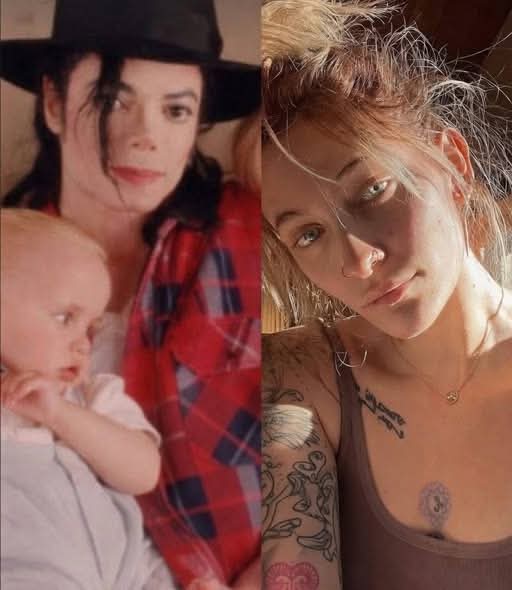
From the moment she was born, Paris Jackson lived inside a reality unlike almost anyone else’s. Before she understood what fame even meant, cameras already followed her movements, strangers already recognized her face, and the world already viewed her less as a child than as an extension of her father’s mythology.
For years, people mostly saw her hidden.
Covered by masks and veils during public appearances beside Michael Jackson, Paris became part of one of the most intensely protected celebrity families in modern history. Those images remain burned into public memory: children shielded from cameras while their father tried desperately to preserve some fragment of privacy inside a life consumed by global obsession.
But hiding a child from the world does not protect them from the weight surrounding it.
If anything, it often makes the collision harsher once exposure finally arrives.
After Michael Jackson’s death in 2009, Paris’s life transformed overnight in a way few people fully understood at the time. The veil disappeared, but so did the structure protecting her from public scrutiny. Suddenly the grieving daughter standing tearfully at her father’s memorial became visible to the entire world all at once. Millions watched her heartbreak in real time before she was emotionally old enough to process it privately herself.
That moment changed everything.
For many people, Paris Jackson became permanently frozen as “Michael Jackson’s daughter,” a symbolic extension of loss and celebrity tragedy rather than an individual person. Growing up under that kind of projection can distort identity itself. Every phase of adolescence — rebellion, confusion, experimentation, emotional collapse, self-discovery — unfolds publicly under relentless comparison to a parent whose cultural legacy borders on mythological.
And Paris has spent years trying to separate herself from that gravitational pull without denying where she came from.
That struggle appears everywhere across her life now: in her music, her interviews, her tattoos, her fashion, and the brutal honesty she increasingly brings to conversations about trauma and mental health. Unlike many celebrity children who avoid discussing painful personal experiences publicly, Paris has chosen a different path. She has spoken openly about addiction, assault, depression, self-harm, and suicidal thoughts — not with polished celebrity distance, but with a rawness that often unsettles audiences expecting glamour instead of vulnerability.
To some people, those confessions seemed shocking.
To others, they felt heartbreakingly inevitable.
Because growing up under extreme fame rarely leaves children untouched psychologically, especially when grief, media pressure, and identity crises collide so early. Paris’s willingness to speak openly about those experiences reflects something larger than celebrity confession culture. It feels more like an attempt to reclaim ownership over a narrative the public started writing for her before she could even speak for herself.
Her tattoos tell part of that story visually.
Spread across her body are symbols, phrases, tributes, spiritual imagery, and deeply personal references that function less like decoration and more like emotional cartography. Many people interpret tattoos as rebellion automatically, especially on celebrity women. But in Paris Jackson’s case, they often feel closer to survival markers — physical reminders that pain was endured rather than hidden.
Each piece of ink transforms invisible experiences into something visible and self-controlled.
That distinction matters.
Trauma often leaves people feeling powerless over their own bodies and identities. Tattoos, for some survivors, become acts of reclamation: permanent decisions made freely on skin that once carried suffering imposed by others. Paris has hinted at that emotional connection repeatedly over the years, framing her body art not as random impulsiveness but as personal storytelling.
At the same time, she continues carrying the impossible emotional inheritance attached to her father’s death.
Publicly, Paris has occasionally expressed skepticism about aspects of the official narrative surrounding Michael Jackson’s passing. Those comments have fueled endless speculation online because anything connected to Michael Jackson inevitably becomes magnified into cultural obsession. But beneath the conspiracy debates and headlines exists something more human: a daughter still trying to emotionally process losing one of the most famous people in the world while growing up inside the storm left behind afterward.
Grief becomes extraordinarily complicated when the person lost belongs not only to you, but to millions of strangers simultaneously.
Paris has had to navigate mourning while also carrying the burden of her father’s cultural legacy, controversies, worshippers, critics, and unresolved public mythology. Every statement she makes about him becomes analyzed globally. Every expression of doubt becomes headline material. In many ways, she inherited not only his fame, but the impossibility of ever escaping public interpretation completely.
Yet despite all that, she keeps building something distinctly her own.
Through music especially, Paris seems increasingly focused on creating identity outside pure celebrity inheritance. Her artistic style leans introspective, alternative, emotionally textured — far removed from direct imitation of her father’s sound or stage persona. That distance feels intentional. She honors where she comes from without attempting to become a replica of it.
And perhaps that is the most remarkable part of her story.
Not the scandals.
Not the tattoos.
Not the headlines about trauma.
But the fact that someone raised beneath one of the most overwhelming spotlights in entertainment history is still attempting, publicly and imperfectly, to become an authentic human being separate from the mythology surrounding her.
That process looks messy because real self-discovery usually is messy.
Especially when millions of strangers believe they already know who you are.
Paris Jackson’s life often gets framed through tragedy and inherited fame, but there is another thread running through it too: resistance. Resistance against becoming trapped forever inside childhood grief. Resistance against public ownership of her identity. Resistance against silence surrounding pain.
And maybe that is why so many people connect with her now.
Not because she appears flawless.
But because she doesn’t.
She looks like someone still healing in public while refusing to disappear.
Someone turning scars into symbols instead of secrets.
Someone trying, piece by piece, to step out from beneath a legendary shadow and finally become fully visible on her own terms.