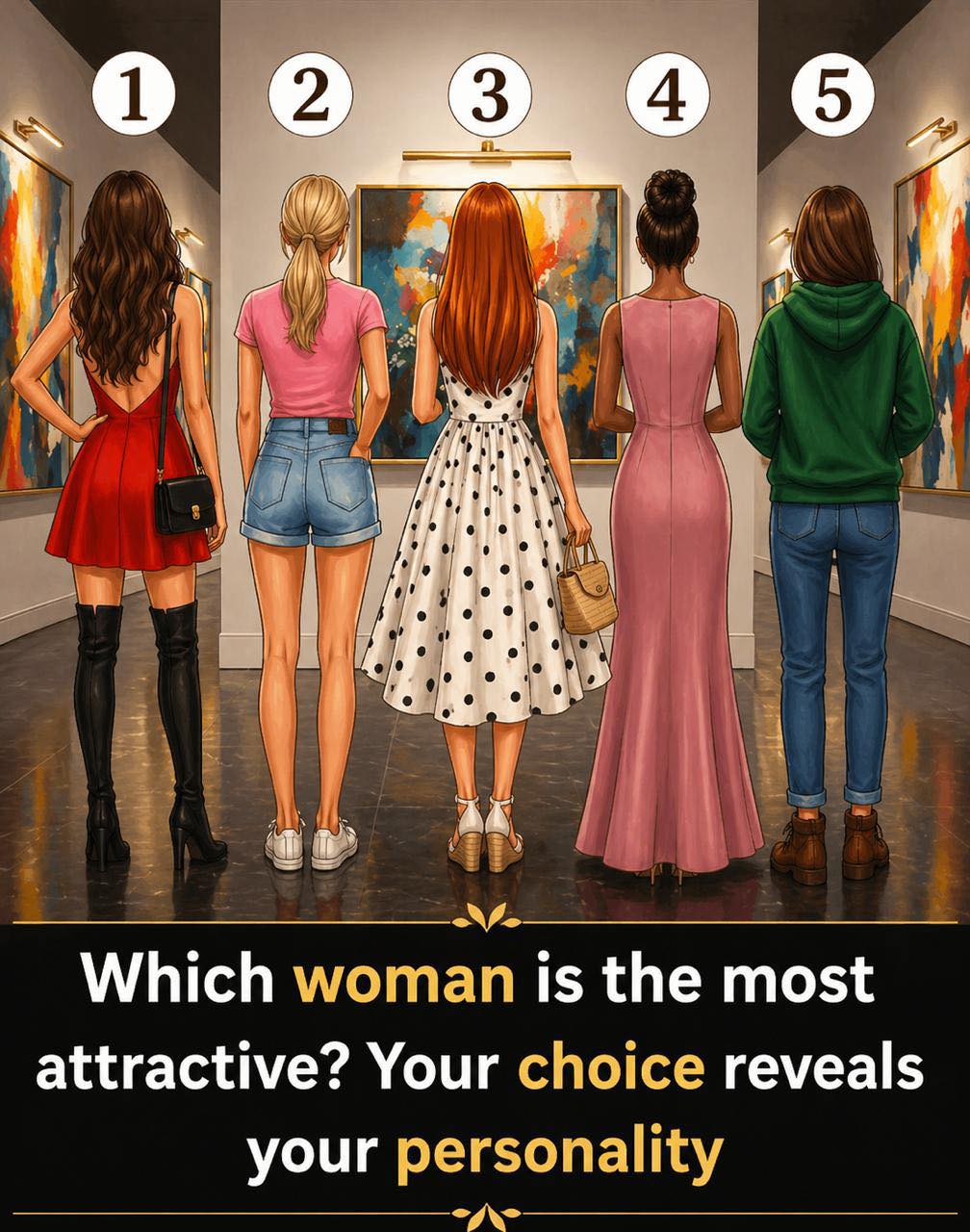
At first glance, it looks like nothing more than a playful personality test hanging quietly inside an imaginary art gallery. Five women. Five different energies. One simple question: which one attracts you the most? Most people answer instinctively, believing they are choosing based on appearance, style, or mood. But the strange thing about these choices is how personal they can begin to feel once you stop and examine them closely.
Because often, the person who catches your attention is not simply someone you admire.
They represent something inside you.
The moment your eyes settle on one woman longer than the others, your subconscious is already speaking. Not logically. Emotionally. Quietly. The choice may reveal the kind of comfort you crave, the qualities you feel disconnected from, or the emotional energy your nervous system currently recognizes as familiar and safe. That is why these exercises resonate with so many people even when they know the psychology behind them is symbolic rather than scientific.
It feels less like choosing another person and more like encountering a hidden part of yourself.
Some people are immediately drawn toward confidence and boldness. The woman who stands tall, unafraid of attention, feels magnetic because deep down they are exhausted from shrinking themselves to make others comfortable. Her energy represents courage they wish they possessed more openly. Choosing her may reflect a longing to become louder, freer, more unapologetic in their own life.
Others find themselves pulled toward softness and simplicity. Not because simplicity is boring, but because their inner world has become emotionally exhausted. When life feels overwhelming, chaotic, or emotionally performative, the heart often begins craving peace more than excitement. A calm, grounded presence can suddenly feel deeply attractive because it represents rest — the kind that goes beyond sleep and reaches the soul itself.
Then there are those who choose elegance or mystery.
Elegance often appeals to people searching for stability, structure, or emotional safety. Grace can feel comforting when life feels unpredictable. It symbolizes control, composure, and the ability to move through pain without falling apart publicly. Mystery, on the other hand, tends to attract people carrying unanswered questions within themselves. They are often introspective, emotionally layered, or quietly searching for meaning they cannot fully explain. The mysterious woman reflects uncertainty, depth, and the hidden corners of identity many people spend years trying to understand.
Strength creates another powerful reaction.
Some are drawn toward the woman who appears resilient, intense, or emotionally untouchable because they admire what they themselves desperately need. Maybe they have spent too long feeling vulnerable, overlooked, or emotionally dependent on others. Strength becomes attractive not only romantically, but psychologically — a symbol of survival, self-protection, and control.
What makes these tests emotionally compelling is not whether the interpretations are objectively true. It is the honesty they quietly invite. They ask people to pause long enough to notice what emotionally pulls them without overexplaining it away. And often, what we are drawn toward reveals more about our emotional hunger than our conscious preferences.
Your choice becomes a kind of confession.
Not necessarily about who you are permanently, but about who you are right now.
That distinction matters.
A person recovering from heartbreak may choose softness because they crave safety after emotional chaos. The same person, years later, may suddenly feel drawn toward boldness because healing restored their confidence. Someone overwhelmed by responsibility may gravitate toward mystery and freedom. Another person navigating loneliness may feel emotionally attached to warmth and gentleness.
The choices evolve because people evolve.
That is why revisiting these kinds of images months or years later can feel strangely revealing. The woman who once seemed invisible may suddenly become the one you cannot stop looking at. Not because the image changed, but because you did.
And perhaps that is the real purpose behind exercises like this.
Not predicting personality with perfect accuracy.
Not defining people through simplistic labels.
But creating a quiet moment of self-reflection in a world where many people rarely stop long enough to ask themselves what they actually need emotionally.
The power of the image is not in being scientifically correct.
It is in helping people notice themselves more honestly.
Sometimes attraction is not about desire at all.
Sometimes it is recognition.
A recognition of longing.
Of exhaustion.
Of healing.
Of loneliness.
Of hope.
Of the version of yourself still waiting quietly beneath survival mode.
And maybe the most important part is this:
There is no “wrong” choice.
Every answer simply reflects where your heart is standing right now. And as life changes you — through loss, love, confidence, grief, growth, failure, healing, and time — your answer may change too.
That is not inconsistency.
That is proof you are still becoming someone new.