The water above Vaavu Atoll looked impossibly calm that morning.
Tourists saw what the Maldives always promises the world: endless blue stretching toward the horizon, sunlight flickering across gentle waves, paradise so beautiful it almost appears unreal. Beneath that surface, however, lay a labyrinth of darkness — underwater caves twisting through volcanic rock, narrow passages where light disappears quickly and even experienced divers can lose direction in seconds.
That was where the six lives became trapped between mystery and tragedy.
The group descending that day was not reckless. They were experienced, educated, and deeply familiar with the ocean’s risks. Among them were Italian divers with years of technical training, researchers passionate about marine environments, and professionals accustomed to difficult underwater conditions. At the center of the group was renowned marine biologist Monica Montefalcone, respected for her scientific work and extensive diving expertise. Alongside her were colleagues, students, and veteran diving captain Gianluca Benedetti, a man trusted to guide others safely through dangerous underwater terrain.
Nothing about the dive initially appeared unusual.
The team entered the cave system beneath the postcard-perfect waters of the Maldives expecting a challenging but manageable expedition. These kinds of dives require extraordinary preparation: oxygen calculations, decompression planning, backup equipment, strict communication procedures, and constant awareness that one mistake at depth can become fatal almost instantly. Divers who enter underwater caves understand a terrifying truth — unlike open water, there is no direct path to the surface. If panic, darkness, or equipment failure strikes, escape becomes a race against both time and oxygen.
Then the group vanished.
Hours passed without contact. Concern slowly transformed into alarm as support crews realized the divers had not resurfaced. Rescue teams launched searches through the cave system, descending into narrowing corridors where visibility dropped and underwater currents complicated movement. The deeper rescuers searched, the stranger and more frightening the situation became.
The first and only body recovered initially was that of Gianluca Benedetti.
He was found floating near an empty oxygen tank, separated from the others and unable to explain what had happened. Instead of answers, his death created more questions. Had he tried to help someone else? Had the group become disoriented in darkness? Did an equipment malfunction trigger panic? Or had something unexpected happened so suddenly that even experienced divers could not react in time?
Above the surface, families waited through agonizing silence.
For Monica Montefalcone’s husband, the nightmare felt impossible to accept. He knew her experience better than anyone. She was not careless. She understood underwater systems, decompression risks, cave navigation, and emergency procedures at an elite level. To him, the only explanation that made emotional sense was catastrophic failure — some sudden event affecting everyone at once deep inside the cave.
As days passed without recovery, hope and horror intertwined painfully.
Then the tragedy deepened further.
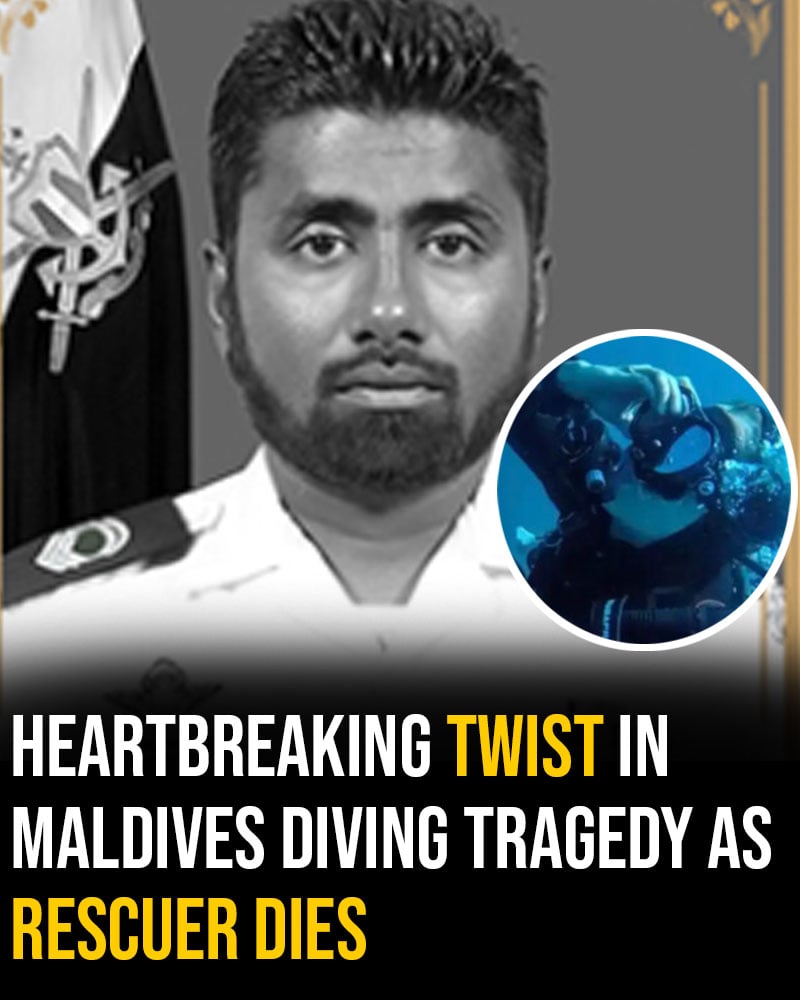
When Sergeant Major Mohammed Mahdi descended as part of the recovery effort, he carried more than diving equipment into the darkness. He carried the desperate hopes of six grieving families and an entire rescue operation determined to bring answers home. Cave recovery dives are among the most dangerous missions in the world. Rescuers enter unstable, low-visibility environments already associated with fatalities, often pushing their own physical limits while navigating emotional pressure and extreme underwater conditions.
Mahdi never returned safely either.
He later died from decompression sickness, transforming an already devastating incident into a national tragedy for the Maldives. What began as a missing-divers investigation now carried the weight of a rescuer’s sacrifice as well. Across the islands, mourning spread beyond the victims’ families to rescue crews, officials, and local communities shaken by the scale of the disaster.
And still, the ocean refused to explain itself.
Investigators began reconstructing possibilities from fragments: equipment logs, dive plans, recovered gear, witness accounts, oxygen usage estimates, and the geography of the cave itself. Technical diving experts speculated about several scenarios. A malfunctioning tank could have triggered panic at depth. Poor visibility may have separated the divers inside the maze-like tunnels. A single emergency could have created a deadly chain reaction as divers attempted to assist one another while oxygen supplies dwindled.
At depths beyond 200 feet, even small mistakes become magnified catastrophically.
Nitrogen narcosis can cloud judgment. Equipment failures become harder to solve under pressure. Disorientation inside caves can erase a diver’s sense of direction completely. Every breath becomes part of a countdown. And unlike surface emergencies, underwater disasters unfold in terrifying silence.
Yet amid all the uncertainty, one fragile hope continues haunting the investigation.
Somewhere inside the cave system, investigators believe a missing GoPro camera may still exist.
Perhaps attached to equipment.
Perhaps resting on the cave floor.
Perhaps still holding footage from the final moments before everything went wrong.
That possibility has become emotionally overwhelming for the families left behind. The camera, if recovered intact, could answer questions no witness survived to explain. It might reveal whether the divers stayed calm, whether equipment failed, whether they attempted rescue procedures, or whether some unseen environmental hazard suddenly trapped them. More than evidence, the footage could become the final voice of people swallowed by silence beneath the sea.
For now, however, the cave keeps its secrets.
The image haunting many involved in the tragedy is not one of panic, but darkness — six experienced divers moving through ancient underwater rock formations, lights cutting briefly through black water before vanishing entirely. The Maldives above remained bright, beautiful, and untouched by visible disaster while, far below, something irreversible unfolded in silence.
The ocean has always carried this contradiction.
It inspires awe, wonder, exploration, and peace.
But it also reminds humanity how small and fragile we remain inside environments we still do not fully control.
Somewhere beneath the waters of Vaavu Atoll, answers may still be waiting in the dark.