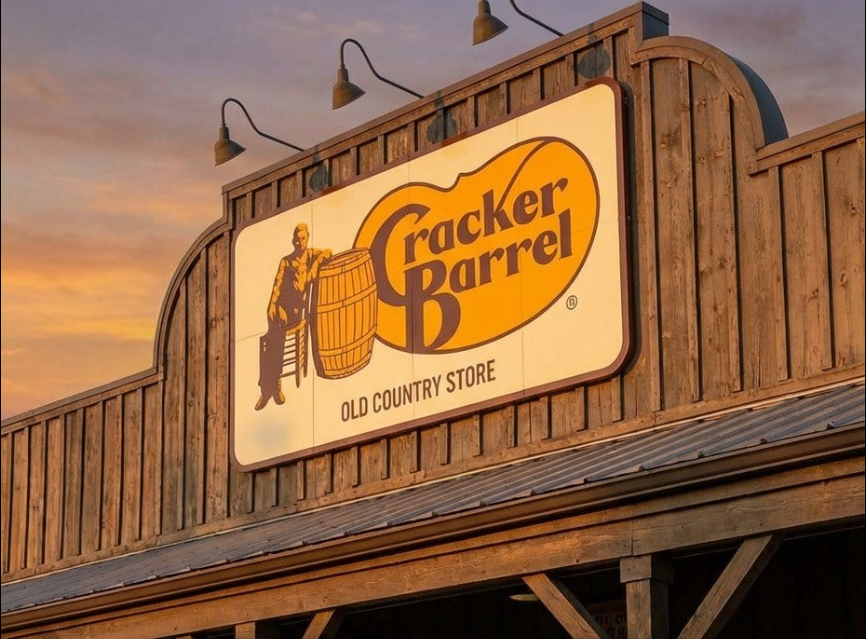
For millions of Americans, Cracker Barrel Old Country Store was never just a restaurant.
It was ritual.
A place woven into road trips, Sunday mornings, family vacations, holiday travel, and ordinary moments people quietly carried for decades. Long before social media debates and corporate redesigns, families associated Cracker Barrel with something emotionally dependable: the sound of rocking chairs creaking on the front porch, shelves crowded with old-fashioned candy and country-store trinkets, the smell of biscuits and gravy drifting through dining rooms filled with warm lighting and familiar routines.
People did not simply eat there.
They returned there.
Again and again.
That emotional connection is exactly why the backlash hit so hard when changes began appearing across the company’s branding and restaurants. A refreshed logo. Updated dining room layouts. Cleaner, more modern design touches replacing some of the heavily nostalgic clutter longtime customers associated with the brand’s identity.
To corporate leadership, the updates were part of a survival strategy.
To many loyal customers, they felt personal.
Online outrage spread quickly as visitors complained the chain was “losing its soul” or abandoning the old-country charm that made it unique in the first place. Social media filled with side-by-side comparisons of logos, interiors, and menu presentations, with some customers insisting the company was trying to become “too modern” at the expense of the comforting atmosphere people actually loved.
What outsiders sometimes missed, however, was that the company’s challenge was far more complicated than aesthetics alone.
Restaurants today operate inside an intensely competitive landscape shaped by changing consumer expectations, labor costs, digital ordering systems, younger demographics, and shifting travel habits. For brands built around nostalgia, that creates an especially difficult balancing act: evolve too slowly and risk irrelevance, evolve too aggressively and risk alienating the very customers who kept the brand alive for generations.
Cracker Barrel found itself trapped directly inside that tension.
Executives reportedly understood that younger diners often preferred brighter spaces, updated branding, streamlined experiences, and modernized restaurant layouts. But they also underestimated how emotionally attached longtime guests had become to even the smallest visual details — the worn textures, antique signage, dimmer lighting, crowded décor, and old-fashioned atmosphere that made Cracker Barrel feel emotionally distinct from other chain restaurants.
Because nostalgia is rarely rational.
It is emotional memory disguised as design preference.
People were not simply reacting to logos or wall decorations.
They were reacting to the fear that a familiar emotional experience was disappearing.
And once companies accidentally disrupt emotional comfort tied to memory, backlash becomes far more intense than ordinary branding criticism.
Eventually, the company appeared to recognize that reality.
As complaints mounted, leadership quietly adjusted course. Familiar design elements began returning or remaining more prominent in remodeled stores while modernization efforts continued more subtly behind the scenes. The goal shifted from reinvention toward careful preservation with strategic updates hidden beneath the surface rather than aggressively visible to customers.
At the same time, another controversy unexpectedly pulled attention toward the company’s internal culture.
Reports and discussions surrounding employee travel guidance — including suggestions that workers dine at Cracker Barrel locations during business travel — triggered criticism and confusion online. Some interpreted the policies as overly controlling or performative, especially during a period when the company already faced accusations of prioritizing corporate image over authenticity.
The company later clarified that these recommendations were guidelines rather than strict mandates, while also emphasizing transparency around reimbursement policies and internal expectations.
That clarification mattered because the broader controversy was no longer only about décor or branding.
It had become a referendum on trust.
Customers wanted reassurance that the company still understood why people loved it in the first place. Employees wanted clarity about culture and expectations behind the scenes. And executives faced the uncomfortable realization that once a brand becomes emotionally symbolic, every decision — logos, furniture, policies, messaging — begins carrying cultural weight far beyond business strategy alone.
In many ways, Cracker Barrel’s struggle reflects something larger happening across American culture.
Institutions built on nostalgia now face a difficult question:
How do you evolve without erasing the emotional experiences people came for?
Because iconic brands are not only selling products.
They are selling familiarity.
Memory.
Comfort.
A feeling people hope will remain unchanged even while the world around them changes constantly.
And perhaps that is the deeper lesson behind the backlash.
People can accept updates.
They can accept modernization.
What they struggle to accept is the feeling that something emotionally grounding is quietly disappearing beneath the language of “refreshing the brand.”
In the end, Cracker Barrel’s challenge is not simply preserving old décor.
It is preserving trust.
Because once a place becomes tied to family memories, road trips, and emotional comfort, changing it too carelessly does not feel like renovation to customers.
It feels like losing part of home.