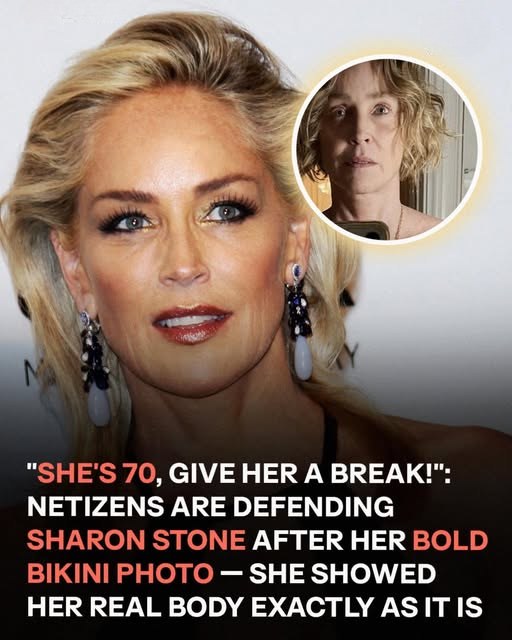
It wasn’t just the image itself that caused Sharon Stone’s recent bikini photo to become viral online; it was also the lack of a performance. Stone’s tweet felt remarkably straightforward at a time when celebrity photos are frequently filtered, expertly lit, substantially edited, or accompanied by thoughtfully designed messaging about empowerment. There was no overt attempt to hide the everyday realities of aging, no dramatic framing, and no attempt to transform the occasion into a manifesto. She just reposted the picture and moved on, letting people respond in any way they saw fit.
The reaction was so emotionally revealing in part because of its simplicity.
Stone was seen in the photo next to a brightly illuminated outdoor pool. She was wearing a geometric purple-and-green bikini with tie-side bottoms, circular sunglasses covering her face, blonde hair that was loosely pinned back, and a handful of leaves that were carelessly gathered in one hand. The scene seemed intimate and unplanned, more like a typical afternoon interrupted long enough for someone to snap a photo than a marketing photo session.
“Summer’s around the corner!” was her caption, which nicely complemented the tone. Happy Friday, my dear ones. Nothing protective. Nothing symbolic. She didn’t explain why she posted it, didn’t anticipate criticism, and didn’t use words that would have made the image seem daring or innovative. And maybe that’s precisely why it sparked such a quick conversation.
Because even though the post was lighthearted, the response revealed how culturally charged aging still becomes when women are clearly at ease with their own bodies.
A large portion of the admiration was focused on genuineness rather than traditional glamour. The photograph was frequently referred to as “natural” by followers, who praised Stone’s lack of harsh filtering, surgical perfection, or computer reshaping. Many responses expressed both appreciation for her appearance and weariness with the norms of modern beauty. Not only were people praising her appearance, but they were also reacting to the image’s apparent rejection.
In that discussion, Stone, at 68, has a particularly prominent cultural position. She has spent decades working in a field that frequently views female aging as something to handle covertly rather than publicly. Hollywood has always punished outward manifestations of aging while rewarding women for maintaining the appearance of timelessness. Even if the individual posting the photos never frames it that way, merely showing up in public without an apology might become unexpectedly political in that setting.
Stone didn’t either.
That distinction is important.
She didn’t seem to want the picture to serve as a message about aging, body image, or beauty standards. However, because public presence for older women still entails societal tension, audiences unavoidably read it through those lenses. The image became significant because of the responses it elicited, not because of anything remarkable about it.
Some remarks openly praised her self-assurance. In contrast to celebrity culture’s fixation with aesthetic perfection, others applauded the image for feeling “real.” Supporters characterized her as self-assured, carefree, and completely at ease—qualities that many viewers found more captivating than polished glamour.
As expected, criticism also surfaced.
A few readers questioned whether women “of a certain age” should display themselves in such an open manner at all, reiterating a well-known social expectation that as women age, their visibility, sensuality, and physical self-expression in public areas inevitably diminish. These responses were noteworthy because they showed how enduring such presumptions are, not because they dominated the discussion.
The criticism was swiftly met with resistance. In addition to praising Stone’s appearance, many rejected the idea that growing older should necessitate hiding. Some reactions were amusing, some direct, and some incredibly encouraging. However, taken as a whole, they represented an increasing dissatisfaction with the notion that confidence becomes unsuitable beyond a certain age.
The image itself “does” very nothing, which is amazing. In no spectacular way is it controversial. Exaggerated posing, dramatic sexuality, and overt attempts to shock are all absent. If anything, the picture’s strength stems from how commonplace it seems. Stone appears at ease, unguarded, and completely indifferent to the opinions of the internet.
People may have reacted most strongly to that lack of concern.
Because audiences tend to accept prominent people’ confidence more readily when it is associated with youth. That relationship is often complicated by aging, particularly for women whose public image has traditionally been linked to sexuality or attractiveness. Stone’s career has been a part of that cultural context for a long time. She has been viewed not just as an actress but also as a visual symbol since the early years of movies like Total Recall and subsequently Basic Instinct, onto whom viewers projected ideals about glamor, seduction, confidence, and power.
That type of public identity may eventually become constrictive. As if public memory anticipates permanence without change, audiences start comparing aged celebrities to frozen versions of themselves from decades ago. Unconsciously, every new image is compared to past times, generating unachievable standards based more on nostalgia than on truth.
That phenomena is precisely highlighted in the old photos that go with the recent post. From Stone’s appearances at the Cannes Film Festival in the early 1990s to his sleek red carpet moments in later decades, one aspect of his public life has remained remarkably consistent: the sense of self-possession that underlies everything, not the hairstyle, clothes, or even the particular aesthetic.
She wears a black cropped top and has her hair brushed sharply back in one early Cannes photo from the Total Recall promotional era. She embodies the acute visual assurance that characterized much of the early 1990s celebrity culture. A more stylized elegance is captured in another poolside Cannes portrait, which strikes a balance between sophistication and the carefully chosen visual language of the time’s film festivals. Subsequent appearances show changes in style, such as shorter hairstyles, more elegant shapes, and more subdued expressions of elegance, yet the fundamental quality is astonishingly consistent.
This continuity is important because it reframes aging as evolution rather than disappearance.
The younger Stone that people recall is not erased by the latest swimsuit shot. Rather, it coexists with them. The woman near the pool is just moving on from her old self, not competing with it. However, public culture frequently finds it difficult to accept such notion. Women are still often seen as either “aging gracefully” in accordance with social norms or “trying too hard” by continuing to be obviously expressive, fashionable, or physically self-assured.
The entire structure is subtly disregarded in Stone’s piece.
She doesn’t request permission to be seen.
She doesn’t express regret for getting older.
She also doesn’t actively promote her confidence.
She just shows up.
And it’s that simplicity that turns the photograph from commonplace celebrity fodder into something that people keep talking about. The responses reflect more about the unsolved unease that many civilizations still have with aging, visibility, and femininity than they do about the portrait itself.
The graphic symbolized liberation from unachievable expectations for supporters. It questioned preconceived notions about how older women are “supposed” to behave in public, according to critics. Additionally, Stone might have seen it as nothing more than a lighthearted summer photo that was posted without much deeper meaning.
However, cultural meaning frequently develops apart from purpose.
Ultimately, the bikini, the pool, and even the subsequent online controversy are not what most remember about the picture. It’s the simplicity. the absence of self-awareness. the reluctance to present common visibility as something that needs explanation.
Sharon Stone doesn’t seem to be questioning whether she is still permitted to occupy visual space at the age of 68.
She just does.