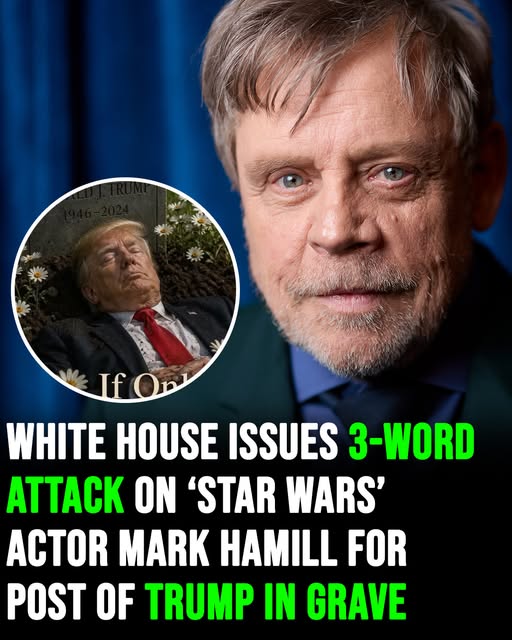
At one of the most politically charged times in recent memory, the Mark Hamill controversy erupted, turning what could have been written off as edgy internet satire into a national debate about speech, celebrity influence, and the emotional climate of American politics. A daring social media message from a Hollywood star could have made a few irate headlines in a previous era before swiftly vanishing beneath the never-ending churn of internet indignation. However, this particular time was unique. Reports of an alleged assassination attempt related to the White House Correspondents’ Dinner had already created a tense, suspicious, and worn-out environment around Washington. In light of this, Hamill’s now-deleted AI-generated picture of Donald Trump in a grave did not come out of thin air. It arrived in a country already teeming with discord and terror.
The timing, according to Hamill’s detractors, turned the image from thought-provoking satire into something more sinister and perilous. The White House reacted almost immediately, using the incident as proof of a larger culture of growing political animosity, according to officials. The actor’s message was presented by administration voices as part of a rhetorical atmosphere that they claimed encourages violence in the actual world rather than as a harmless speech. During a time of increased national tension, some officials and supporters called Hamill a “radical left sick individual” and accused him of normalizing ugly imagery against political opponents.
The rapidity of the pushback demonstrated how brittle the line between perceived incitement and political speech has become in the modern day. Context frequently collapses instantaneously in today’s digital environment. In a matter of seconds, images are shared, reposted, cropped, and reframed, losing any subtlety or purpose. What is perceived as satire by one audience may be seen as support, inspiration, or danger by another. This clash between perception and intention was exemplified by Hamill’s image.
Instead of easing public attention, the actor’s final removal of the post just made it more intense. Hamill made an effort to carefully balance damage control and clarification in a follow-up remark. While acknowledging that the picture could have been “inappropriate,” he stressed that he wanted Trump “the opposite of dead.” The difficult balancing act that many public personalities now have to do online was mirrored in the phrase. A total apology runs the danger of upsetting supporters who stand up for controversial political speech, while ignoring issues can strengthen charges of carelessness.
The removal was seen by Hamill’s detractors as evidence that the post went too far. On the other hand, supporters contended that the response itself demonstrated an increasing readiness to police political satire differently based on the subject. Many noted that aggressive words and unpleasant imagery have permeated American political culture on both sides of the ideological spectrum. Instead of seeing Hamill’s essay as a singular moral issue, they saw it as a part of a wider ecosystem of inflated internet conversation.
However, one photograph was not the only factor in the debate. Additionally, it was a reflection of Hamill’s lengthy and well-known antipathy to Trump. The actor has grown to be one of the most vocal opponents of the former president in the entertainment business over the years. He frequently presented himself as an aggressive political voice rather than an impartial celebrity observer through social media criticism, interviews, and public appearances. His internet presence transcended his persona as the adored Luke Skywalker from Star Wars and became more closely linked to direct confrontation and political activism.
After the photo went viral, he became a particularly prominent target due to his lengthy history of criticism. Conservative pundits swiftly presented the dispute as proof of the hypocrisy they perceive in celebrity political culture, claiming that performers who advocate for civility and tolerance frequently use language that they would denounce if it were employed by ideological rivals. In order to paint Hamill as emotionally distant from regular Americans and obsessed by partisan animosity, others also brought up past statements in which he allegedly hinted that he had thought about fleeing the country following the 2024 election results.
However, Hamill’s supporters contended that the outcry over his article disregarded the larger context of American political speech, which has grown more dramatic and combative over the previous ten years. They pointed out that apocalyptic rhetoric, violent metaphors, and exaggerated images are frequently used by political figures, influencers, commentators, and online personalities across the spectrum to motivate supporters or elicit emotional responses. They contended that in that context, Hamill’s article evolved from a singular incident to a symptom of a broader national issue.
The episode also brought to light the complex role artificial intelligence currently plays in contemporary political expression. AI-generated images sits in an odd and precarious space between parody, art, false information, and emotional manipulation. Such graphics frequently elicit visceral responses that language alone would not be able to since they might seem incredibly genuine while still being imaginary. Because audiences respond differently to visual media than to written criticism, the AI-generated grave image in Hamill’s case had symbolic force. When faced with graphic visual symbols, even individuals who frequently hear severe political language may react more forcefully.
This fact brings up challenging issues regarding accountability in the digital era. Public personalities have a huge global following, and their posts can go viral in a matter of minutes. Critics contend that celebrities with large fan bases should be cautious, especially when there is political unrest or violence. Proponents argue that enforcing ambiguous guidelines on “dangerous rhetoric” runs the risk of suppressing acceptable satire, criticism, and artistic expression. When political passions are already running high, the debate becomes very complex.
The emotional atmosphere that this debate entered was what made it so explosive. National anxiety was already elevated by the supposed assassination-related concerns encircling Washington. Symbolic gestures are amplified at times of communal anxiety. When a joke is criticized, it can rapidly turn into allegations of authoritarianism, censorship, or hypocrisy, and it can suddenly feel menacing. indignation feeds indignation, and each response heightens the subsequent one, creating a vicious cycle.
A growing number of political observers caution that American culture is currently in a state of perpetual emotional escalation. Emotional immediacy, conflict, and intensity are rewarded on social media sites. Seldom do moderate reactions become viral. Algorithmic amplification makes it difficult for Nuance to survive. Celebrity political opinion frequently serves more as symbolic tribal signaling in that system than as careful persuasion. Public personalities take on the role of avatars for larger ideological conflicts that go well beyond the particular phrases or visuals used.
Hamill’s predicament highlights how challenging it is now for celebrities to distinguish between their political and entertainment identities. He will always be connected to heroic fictional stories about opposing oppression and dictatorship for millions of fans. The way audiences understand his political actions is unavoidably influenced by that symbolic relationship. Critics may perceive self-righteous grandstanding masquerading as moral courage, while supporters may perceive principled resistance.
The White House’s response, meanwhile, demonstrated yet another distinctive feature of contemporary politics: the quick weaponization of cultural disputes for more expansive political message. Officials weren’t just critical of the picture. They linked celebrity discourse to worries about public safety and national stability, framing it as proof of a larger moral and political problem. By doing this, the administration turned a single actor’s social media message into a more extensive debate concerning media culture and political radicalism.
In the end, the controversy around Hamill’s removed photo was never really about a single post. It came to represent a far broader issue: a country that struggles to distinguish between satire and agitation, comedy and hate, criticism and dehumanization. Even a single image can become a national flashpoint in a time when politics increasingly intersects with entertainment, celebrity culture, internet outrage, and ideological identity.
America’s political conflicts are no longer limited to campaigns, speeches, or laws, as the dispute has revealed. These days, they are present in every aspect of cultural life, including social media, sports, humor, movies, television, and music. These days, celebrities are more than just performers. Politicians are no longer merely employees of the government. Everyone works in the same enormous digital arena where performance, fury, and identity are always at odds.
Furthermore, incidents like the Hamill debate are unlikely to go away in that setting. In a nation where politics has turned into an ongoing cultural conflict and where every picture, joke, or remark has the capacity to start a firestorm much beyond its initial aim, they are starting to become the new normal.