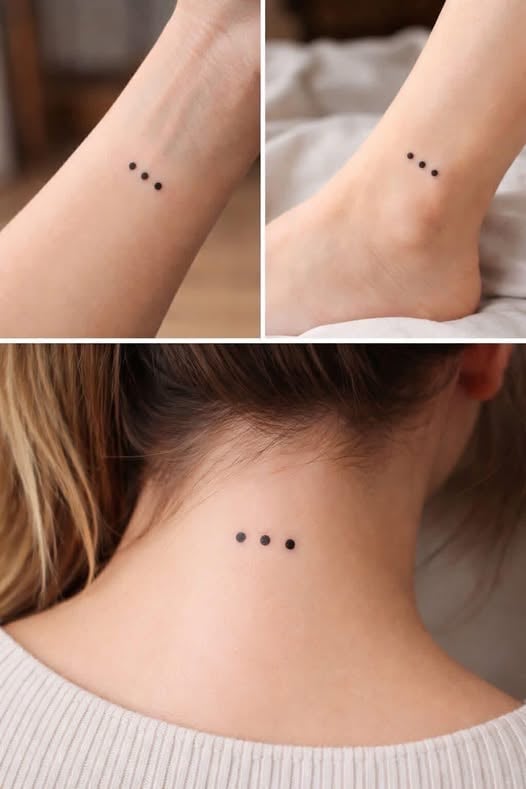
The three-dot tattoo looks almost insignificant at first glance. Tiny. Minimal. Easy to miss unless someone is looking closely. Yet for decades, those three small marks have carried meanings powerful enough to shape reputations, signal danger, inspire loyalty, or permanently alter how a person is treated by the world around them.
To some people, it is nothing more than ink.
To others, it is a warning.
And in certain environments — especially prisons, gangs, and criminal networks — those three dots can function almost like a silent language understood without words.
Placed between the thumb and forefinger, near the knuckles, or along the hand, the tattoo often appears deceptively simple. But simplicity is part of what gives it power. Unlike large dramatic tattoos meant to attract attention, the three-dot symbol communicates quietly. It is designed less for the general public and more for those who already recognize what it may represent.
One of the most widely recognized interpretations connects the tattoo to the idea of the “Three Wise Monkeys” — see no evil, hear no evil, speak no evil. In ordinary culture, that phrase often symbolizes wisdom, restraint, or avoiding negativity.
Inside prison culture and criminal circles, however, the meaning becomes much darker and far more serious.
There, the phrase often transforms into a code of silence.
Do not talk to police.
Do not betray others.
Do not become an informant.
Do not break under pressure.
In that context, the tattoo acts almost like an oath permanently written into the skin. It signals loyalty to a specific code where silence is valued above honesty and survival often depends on trust within dangerous environments.
For many incarcerated individuals, symbols like these become deeply important because prison culture revolves heavily around reputation and identity. A tattoo may communicate history, alliances, time served, or personal philosophy without requiring explanation. In places where vulnerability can be dangerous, visible symbols become tools of survival.
The three dots therefore often represent much more than decoration.
They represent belonging.
Or at least the appearance of belonging.
Yet the tattoo’s meaning shifts dramatically depending on geography, culture, and personal background.
In parts of Latin America and within some gang-related environments, the three dots are associated with the phrase “Mi Vida Loca” — Spanish for “My Crazy Life.” The phrase reflects a lifestyle connected to chaos, danger, rebellion, poverty, crime, or survival on society’s margins.
For some individuals, the tattoo becomes a declaration that life itself has already become unstable or violent.
A person carrying the symbol may be communicating that they grew up surrounded by hardship, lived through criminal environments, or accepted a life where risk and uncertainty feel permanent.
Sometimes the tattoo represents pride.
Other times resignation.
And in many cases, both at once.
Inside prisons, additional dots can carry even more specific meanings. Some people use them to symbolize years served, time lost, loyalty to a particular group, or significant life experiences connected to incarceration. In those situations, the body itself slowly becomes a living archive recording parts of a person’s history through symbols outsiders may never fully understand.
That hidden language is part of what makes tattoos inside criminal culture so psychologically powerful.
They are not only personal expression.
They are communication.
Signals.
Warnings.
Memories.
Declarations of identity.
At the same time, the three-dot tattoo also demonstrates how dangerous assumptions can become.
Not every person wearing the symbol belongs to a gang or criminal organization. Some people receive the tattoo without fully understanding its associations. Others adopt it for personal reasons unrelated to crime entirely — spirituality, minimalism, friendship, emotional symbolism, or even simple aesthetics.
But once certain symbols become linked to criminal culture publicly, perception often overrides personal intention.
That reality creates serious consequences.
Employers may react differently.
Police may become suspicious.
Strangers may make assumptions.
Rival groups may misinterpret the symbol.
Even crossing international borders can suddenly become more complicated depending on how authorities interpret visible tattoos.
A tiny mark can therefore shape opportunities, relationships, and safety in ways many people never anticipate beforehand.
This is especially true because tattoos connected to gangs or prison culture often carry reputational weight far beyond the tattoo itself. Law enforcement agencies in many countries actively study tattoo symbolism because certain markings may indicate affiliation, criminal background, or involvement in organized groups.
As a result, people carrying these tattoos sometimes face scrutiny even years after leaving those environments behind.
And that introduces one of the deepest emotional truths surrounding prison and gang tattoos:
Many people can physically leave dangerous environments long before those environments stop shaping how the world sees them.
The tattoo remains visible even after someone changes their life completely.
For former gang members or formerly incarcerated individuals trying to rebuild stable futures, visible symbols from the past can become painful reminders of identities they no longer want attached to them. Some attempt expensive tattoo removals. Others cover old markings with larger artwork. Some simply learn to live with the consequences permanently.
Because ink is easier to place onto skin than remove from identity.
The fascination surrounding symbols like the three-dot tattoo also reveals something broader about human psychology.
People have always searched for ways to communicate belonging, loyalty, suffering, rebellion, and identity through visible markings. From ancient tribal tattoos to military insignias, humans repeatedly transform the body into a canvas carrying social meaning.
The three dots are part of that tradition.
What makes them unsettling is not their appearance, but the worlds they are often connected to — prisons, violence, survival, silence, betrayal, and lives shaped by instability.
Yet even within those darker associations, the symbol still carries human complexity.
Behind every tattoo exists a story.
Sometimes it is a story of crime.
Sometimes poverty.
Sometimes protection.
Sometimes regret.
Sometimes survival.
And sometimes all of those things at once.
That complexity is important because symbols alone rarely tell the full truth about a person. Two individuals may carry identical tattoos while living entirely different lives emotionally, morally, and personally.
Still, society reacts strongly to visible symbols because humans instinctively search for meaning in outward appearance. Tattoos become interpreted as clues about character, history, or danger even when reality is far more complicated underneath.
Ultimately, the three-dot tattoo endures because it represents more than one fixed idea.
It can symbolize silence.
Loyalty.
Chaos.
Defiance.
Prison.
Brotherhood.
Regret.
Identity.
Or survival.
Sometimes it opens doors within dangerous worlds.
Sometimes it closes doors everywhere else.
And perhaps that is what makes those three tiny dots so haunting.
Not their size.
But the enormous weight of experience, consequence, and human history they can silently carry inside such a small amount of ink.