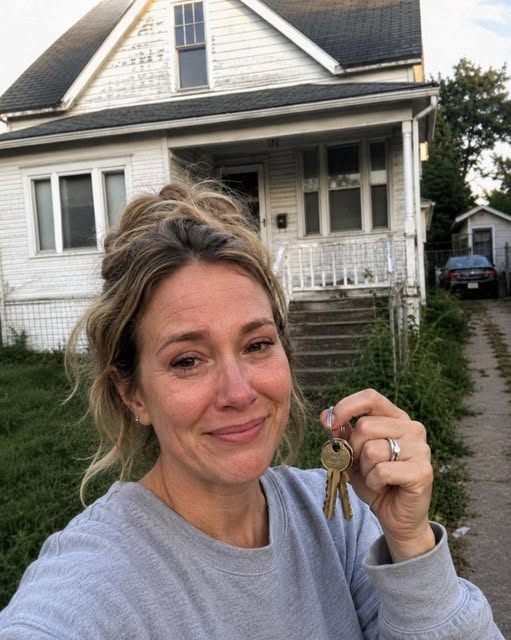
At thirty-one years old, Astrid believed she understood her life with complete certainty. Some people inherit family recipes, businesses, or treasured traditions. Astrid inherited something very different: a foreclosure. A single humiliating collapse that silently shaped nearly every decision she made afterward. Every bill paid early, every unnecessary expense avoided, every late-night check of her savings account traced back to one rainy morning when strangers carried her family’s belongings onto the curb while neighbors watched quietly from behind their windows.
For years, she carried one simple explanation for that pain:
Her father had failed them.
That explanation mattered because simple stories are easier to survive emotionally. If her father had truly been irresponsible, careless, or weak, then the world still made sense. Bad things happened because people made bad choices. Stability could be protected through discipline and control.
So Astrid built her entire adulthood around never becoming him.
That is what makes her return to the old house feel so emotionally powerful. She isn’t simply buying back property. She is trying to reclaim control over the wound that shaped her identity. Owning the house again feels symbolic — almost like correcting history itself. Somewhere deep inside, she believes reclaiming the house might finally heal the humiliation and loss that never truly left her.
But the story slowly reveals something many people spend years avoiding:
Sometimes the most painful discovery is not learning your parents failed you.
It is learning they suffered in ways you never understood.
The first sign that reality is more complicated appears through her mother’s fear. The moment Catherine nervously asks Astrid whether she has “found it,” the house changes instantly. It no longer feels like a place filled only with memories. It becomes a place hiding something unfinished.
The hidden wall behind the pantry stops feeling like architecture and starts feeling symbolic — a physical barrier protecting emotional truths buried for decades.
And when Astrid finally tears through it with a hammer, she is doing far more than breaking drywall.
She is dismantling twenty years of certainty.
What she discovers inside is devastating precisely because it is not dramatic.
There are no criminal secrets.
No shocking betrayals.
Only paperwork.
Letters.
Checks.
IOUs.
Quiet records documenting sacrifice month after month.
The hidden room becomes an archive of emotional exhaustion — proof that her father had spent years fighting a battle nobody else fully saw.
That detail changes everything.
Because many families are not destroyed by the absence of love.
They are destroyed when love becomes tangled inside silence, pride, guilt, and obligation until the people trying hardest to protect everyone slowly destroy themselves.
Astrid grew up believing her father ruined the family through irresponsibility.
Instead, she discovers he ruined himself trying to save his brother.
That realization completely reshapes her understanding of the past.
Every unpaid bill suddenly carries hidden context.
Every exhausted silence at the dinner table feels different.
Every tense moment inside the house now contains pressure she had simply been too young to understand.
And perhaps the most heartbreaking discovery of all is that her father knew exactly how his children were beginning to see him.
“Asher’s things are gone. Astrid won’t look me in the eye anymore.”
That line hurts more deeply than the financial collapse itself because it reveals awareness. He saw the disappointment growing inside his daughter. He recognized the distance forming between them.
And still, he said nothing.
Not because he didn’t care.
But because he believed silence would somehow protect everyone from even greater pain.
That misunderstanding lies at the emotional center of the entire story.
Again and again, people confuse silence with kindness.
The father hides the debt to protect the family.
The mother hides the truth to preserve peace.
Uncle Tom accepts the secrecy because it protects him from accountability.
And the result becomes generational damage.
Astrid spends twenty years shaping her personality around resentment toward a man who was actually sacrificing himself in deeply flawed but painfully human ways. Her discipline, control, and obsession with stability are not simply ambition.
They are grief transformed into survival.
The hidden room therefore threatens more than memory.
It threatens her identity.
Because if her father was not truly the selfish failure she imagined, then who has she spent her entire life protecting herself from?
That question explains why her first reaction is anger rather than relief.
Human beings rarely surrender survival narratives easily — even painful ones. Hatred can become emotionally useful. It creates order, direction, and certainty. Removing it leaves confusion behind.
One of the story’s greatest strengths is that it refuses to suddenly transform her father into a perfect man after the truth is revealed.
Astrid says it herself:
“He was stubborn, proud, and terrible at asking for help.”
That complexity matters deeply because real healing rarely comes from discovering someone was flawless.
It comes from discovering they were human.
Her father’s greatest flaw was not indifference.
It was martyrdom wrapped in secrecy.
He kept trying to save everyone privately until there was nothing left of himself to save. He believed he could absorb the damage alone, never realizing that silence itself had become another form of harm.
Meanwhile, Uncle Tom represents another painfully familiar family dynamic: the person quietly protected by everyone else’s fear of conflict.
He survives because others choose comfort over truth.
His easy jokes at family gatherings, his nostalgic stories about the house, his casual presence — all of it becomes unbearable once Astrid understands the full reality. Another man carried the moral blame for destruction they both helped create.
And yet even Tom is not written as a monster.
He is weak.
Ashamed.
Emotionally avoidant.
But recognizable.
The story understands that family damage often grows less from cruelty than from repeated failures of courage.
The dinner confrontation becomes powerful because it finally destroys the family’s central pattern: silence.
For years, everyone participated in an unspoken agreement to protect emotional stability by avoiding uncomfortable truths. Astrid breaks that pattern completely. Reading the letters aloud transforms private suffering into shared acknowledgment.
The hidden room stops functioning as a burial place for secrets and becomes something else entirely:
A witness.
“You all want a villain.”
Tom’s line exposes something deeply human. Families often desperately search for one person to blame because it simplifies pain. One person becomes “the problem,” allowing everyone else to avoid examining the larger system of fear, dependence, denial, and silence surrounding them.
But Astrid’s response reveals the story’s deeper emotional truth:
“I wanted a father I could understand.”
Not a hero.
Not a villain.
A person.
That distinction changes everything.
Children often create emotionally manageable versions of their parents because complexity feels harder to carry than certainty. Especially after loss, memories harden into fixed narratives. A dead parent cannot explain themselves. The surviving child simply builds the version that hurts least or makes the most sense.
Astrid’s deepest grief is therefore not truly about the house.
It is about misunderstanding her father for twenty years.
It is about loving him incorrectly.
Believing his silence meant failure instead of shame, sacrifice, fear, and love tangled together.
That is why the final letter feels so devastating.
“You always noticed when something was wrong. I am sorry I let you believe the wrong thing was me.”
That sentence carries enormous emotional weight because it reveals how fully her father understood what had happened. He knew the story his daughter had inherited about him.
And he also knew he helped create it.
The final act of completely tearing down the hidden wall becomes deeply symbolic. Astrid doesn’t simply uncover the room.
She refuses to hide it again.
That decision becomes the story’s true emotional resolution.
Families hide painful things constantly:
Debt.
Addiction.
Failure.
Mental illness.
Resentment.
Affairs.
And often, the secrecy surrounding those wounds becomes even more destructive than the original pain itself. Children inherit fear without explanation. Anxiety without history. Emotional tension without understanding where it began.
Astrid finally interrupts that cycle.
By permanently opening the hidden room, she rejects the family tradition of concealment. She chooses honesty over comfort. Truth over emotional convenience.
And the final image — sunlight finally entering the room after twenty years of darkness — feels emotionally earned rather than symbolic for symbolism’s sake.
Because the room was never really about money.
It was about memory trapped in silence.
Opening it finally allows grief to become honest.
Her father does not get the house back.
But he receives something almost more important:
The restoration of his humanity.
His children finally see him completely — not as the careless failure they once imagined, nor as a flawless martyr, but as a frightened, loving, deeply imperfect man whose disastrous decisions grew from loyalty, shame, and desperation.
And for Astrid, that understanding changes everything she thought she had rebuilt.
She believed she was reclaiming a house ruined by her father’s failure.
Instead, she uncovered the hidden cost of his love.
By morning, the wall is gone.
The trophies are visible again.
The letters remain out in the open.
And for the first time since the foreclosure, the house no longer carries only loss.
Now, it carries truth too.