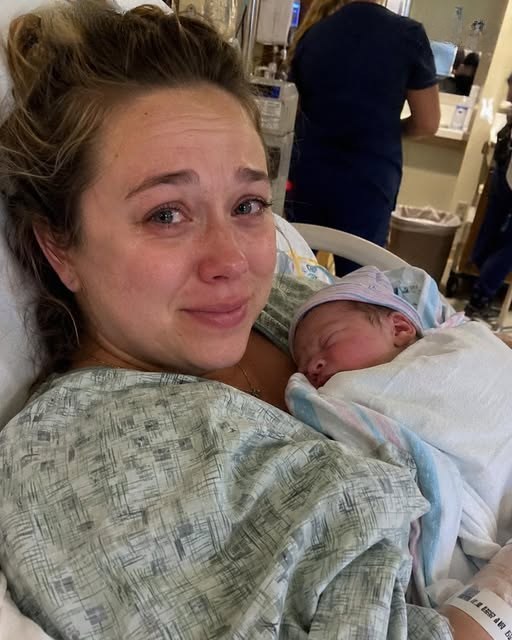
I carried my sister’s baby for nine months because she couldn’t.
Not in the casual, symbolic way people sometimes say it to sound supportive, but in the real, physical way that changes your body, your routines, your sleep, your emotions — your entire life. Every kick felt like a promise we were sharing together. Every doctor’s appointment felt like another step toward something we had created out of grief, love, and desperation.
My sister Carol had always wanted to become a mother.
Not in a vague “maybe someday” kind of way.
She wanted it with the intensity of someone reaching for air underwater.
As a child, she carried dolls around like they were real babies. As a teenager, she kept babysitting long after her friends lost interest because she genuinely loved caring for children. As an adult, every pregnancy announcement made her emotional, even when it belonged to someone else.
Then doctors finally gave her devastating news:
She could not safely carry a child herself.
That truth shattered something inside her.
Not just her plans for the future — something deeper.
Slowly, she began disappearing from life piece by piece. Family dinners were skipped. Messages stayed unanswered. Conversations became shorter. The laughter that once filled every room around her slowly vanished into silence.
Then one night, she showed up unexpectedly at my front door.
Her eyes were red from crying. Her hands trembled. And before she even spoke, I could already feel the weight of what she was about to ask.
“I need to ask you something,” she whispered while gripping my hands tightly, like she was afraid I might disappear.
Then she said it:
“Would you carry a baby for me?”
The question should have shocked me more than it did.
But when I looked at her, I didn’t see entitlement or selfishness.
I saw grief.
The kind so heavy it had nowhere left to go.
“I’ll do it,” I told her before I fully understood the magnitude of what I was agreeing to. “But Paul has to be involved in this too.”
That night, my husband didn’t immediately say yes.
But he didn’t say no either.
Instead, he quietly took my hand and said, “If we do this, we do it properly. Legal agreements. Doctors. Everything.”
At the time, I thought those precautions meant we were protecting everyone involved.
I didn’t realize yet that sometimes protection begins with warnings people fail to recognize until much later.
When I officially agreed to become Carol’s surrogate, she broke down crying so hard she could barely breathe.
“You’re giving me my whole life back,” she whispered into my shoulder.
I remember laughing softly because the sentence felt too enormous for something that hadn’t even begun yet.
I had no idea how literally she meant it.
At first, the pregnancy unfolded the way everyone hoped it would.
Appointments.
Ultrasounds.
Heartbeat recordings.
Tiny milestones slowly turning into something real.
Carol attended every appointment. In the beginning, she seemed grateful, emotional, and careful not to overstep. But as the months passed, something inside her gradually changed.
She stopped acting like someone participating in the experience.
And started acting like someone who needed complete ownership of it.
She painted the nursery before I was halfway through the pregnancy. She chose names, blankets, colors, decorations. She constantly referred to the baby as though he already fully belonged to her.
“Our son,” she would whisper while resting her hands on my stomach.
One afternoon, my daughter reached out excitedly to feel the baby kick.
Carol gently moved her hand away.
“My baby,” she corrected softly with a smile that somehow didn’t feel warm at all.
Paul noticed the change before I did.
At first he only watched her quietly.
Then with concern.
Then with something heavier — something neither of us fully understood yet but that clearly unsettled him.
One evening, he finally said it aloud.
“She’s not okay,” he told me quietly. “This has become more than excitement.”
I dismissed it immediately.
Not because I didn’t hear him.
Because I didn’t want to believe love and desperation could twist into something frightening so quickly.
“She’s waited her entire life for this,” I insisted. “She’s just emotional.”
But even while saying it, something inside me already sounded uncertain.
Then labor came early.
Sudden.
Violent.
The kind of pain that leaves no emotional space for anything except survival.
The hospital room filled quickly with nurses, machines, instructions, and urgent voices. Carol stood beside me gripping my hand too tightly while her husband Rob paced anxiously nearby. Paul wiped sweat from my forehead with shaking hands.
And through all of it, Carol kept whispering the same sentence:
“My boy is almost here.”
Not the baby.
Not your son.
Mine.
When he was finally born, the room shifted into that strange sacred silence that follows life entering the world.
Then came his cry.
Sharp.
Tiny.
Alive.
For one brief moment, the nurse placed him against my chest.
Warm.
Fragile.
Real in a way nothing else had prepared me for.
I remember turning my head slightly to find Paul’s face.
But he wasn’t looking at me.
He was staring at Carol.
She was crying too — but not gently.
Not joyfully.
It looked more like someone emotionally unraveling.
Then she whispered:
“That’s my son.”
And suddenly, the atmosphere in the room changed completely.
The nurse carried the baby away briefly for routine cleaning and examination.
But Carol watched them with panic, as though someone was taking him away from her physically.
The moment the door closed behind the nurse, Paul leaned toward me urgently.
“Don’t give him to her yet,” he whispered.
I stared at him, exhausted and confused.
“What are you talking about?”
Then he handed me his phone.
And everything shattered.
Messages between him and Rob.
Conversations I had never seen before.
Words that no longer matched the version of Carol I thought I understood.
She thinks Anna is going to keep the baby.
She’s saying the baby is the only reason she still wants to live.
She isn’t coping well anymore.
I reread the messages over and over while something cold settled deep in my stomach.
“This isn’t her,” I whispered automatically, desperately. “She knows I would never keep him from her.”
Paul shook his head slowly.
“She’s not thinking clearly anymore. This has been building for months.”
Before I could process anything else, the hospital room door opened again.
Carol walked back inside.
But something about her felt completely different now.
She smiled too quickly.
Too sharply.
And the second she saw my face, the smile disappeared.
“What’s happening?” she asked quietly.
Paul stood up.
“We need to talk about the baby.”
The word “talk” seemed to crack something open inside her instantly.
“You don’t talk about him,” she snapped, her voice trembling. “You give him to me. That’s what’s supposed to happen.”
And in that moment, I realized something terrifying.
This wasn’t only fear anymore.
It was possession.
And beneath that possession was something even more fragile:
A complete emotional collapse waiting to happen.
I looked at my sister’s shaking hands, her uneven breathing, her desperate eyes — and suddenly understood that nothing about this situation would ever be simple again.
My newborn son — my nephew — the child I had carried for nine months — was down the hallway completely unaware that his first hours of life had already become the center of emotional chaos.
Then Carol looked directly at me and whispered:
“You promised me.”
And in that moment, I did something I never imagined I would do to my own sister.
I said no.
Not forever.
But for now.
“I can’t hand him over yet,” I told her while crying myself. “Not until you get help.”
The silence afterward felt unbearable.
Then she broke completely.
Not dramatically.
Not loudly.
She simply collapsed inward emotionally, like something inside her had finally shattered under years of grief and pressure.
Standing there beside my husband while my sister fell apart in front of me, I realized something painful about love:
Sometimes love stops looking like giving people what they want.
Sometimes love means refusing them.
Even when they hate you for it.
What followed afterward wasn’t a clean ending.
It was a long process.
Doctors.
Evaluations.
Legal delays.
Custody discussions.
Days stretching endlessly while reality slowly forced itself into all our lives.
Carol was eventually admitted for psychiatric treatment.
At first, my mother called my decision betrayal.
Then she read the messages.
And suddenly, her anger turned into heartbreak too.
Nothing healed quickly.
Time simply created enough distance for reality to settle where denial once lived.
For weeks, Carol cried constantly for the baby.
Then eventually she began asking about him.
And later — slowly, painfully — she started asking about me too.
Not just the child.
Me.
That was the moment I understood recovery doesn’t always mean returning to who someone used to be.
Sometimes recovery means rebuilding a person from pieces nobody realized were fragile until they broke apart completely.
Several months later, I brought the baby to visit her in a supervised room filled with cautious silence.
The second she saw him, she froze.
I expected her to reach for him instinctively.
She didn’t.
She simply cried.
Then, in a voice so quiet it barely sounded like her own, she whispered:
“Thank you for keeping him safe.”
I sat across from her holding him carefully in my arms, still carrying the emotional weight of everything that had brought us to that room.
And for the first time since she knocked on my door asking me to carry her dream for her, I finally understood the truth.
I hadn’t only been carrying a baby for nine months.
I had been carrying a breaking point nobody saw coming.