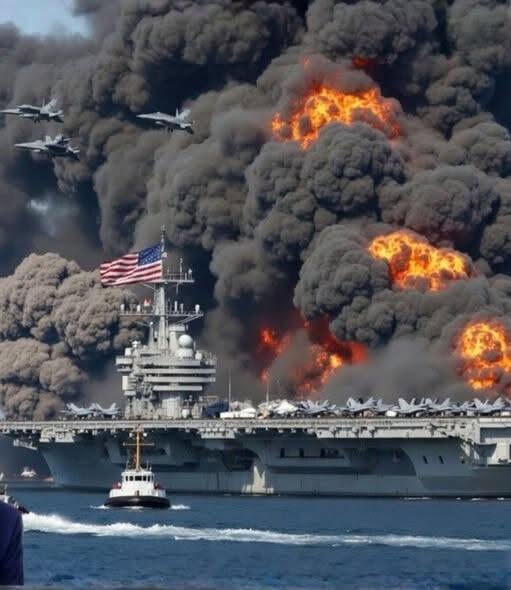
A single rumor can be like a match thrown into a dry forest in the high-stakes drama of contemporary geopolitics. A viral story of a devastating military assault on a heavily guarded navy ship is currently scorching the internet. Moving through social media feeds like a heat-seeking missile, the stories are comprehensive, cinematic, and becoming more and more ubiquitous. However, there is a shocking reality hidden behind the dramatic headlines and the hurried reposts. As of right now, the notion that such an incident has occurred is not supported by any reliable, verified proof from any official government agency, ministry of defense, or international military alliance. We are seeing a classic instance of “information laundering,” in which conjecture is repeated so frequently that it starts to resemble reality.
The triumph of urgency over accuracy is a basic dilemma in the digital age, which is highlighted by this phenomenon. Global security agencies, including the Pentagon, NATO, and several national defense ministries, follow stringent procedures that put verification ahead of expediency. The procedure of disclosing information when a military asset is involved aims to minimize unintentional escalations that can result in actual conflict, in addition to keeping the public informed. Although an audience used to quick satisfaction may find this delay annoying, it is an essential precaution. However, anonymous accounts, unreliable commentators, and algorithmic amplification are filling the void in the absence of an official “yes” or “no.” The end effect is a warped reality in which a claim appears to become more true the louder it is yelled.
Organizations like the Pew Research Center have thoroughly researched the mechanisms of this disinformation. Military action-related breaking news events are particularly susceptible to “rumor spiraling.” People’s minds frequently fill in the holes with guesses when they are anxious for updates on delicate geopolitical issues. Speculative fiction thrives when there is a high level of public curiosity and little early facts. Sensational material is frequently amplified by social media algorithms that promote high engagement, thus giving unreliable sources a voice. The false narrative has already gone around the world 10 times by the time an official spokesman can take the podium to explain the issue, impacting everything from international financial markets to diplomatic tensions.
The ramifications of drawing these conclusions too quickly are anything but scholarly. Misinformation is a dynamic force in the field of international affairs. Accepting a military attack report too soon can lead to hasty diplomatic reactions, influence investment behavior in erratic markets, and cause unwarranted fear among the general public. False narratives in delicate security circumstances can hamper real-world diplomatic efforts and potentially contribute to the escalation of hostilities, as organizations like the United Nations and UNESCO have frequently warned. Even if the “attack” was nothing more than a virtual ghost, there is tremendous pressure to retaliate if a country believes its vessel has been targeted due to viral misinformation.
The only way to stop this pandemonium is through verification. The legitimacy of reputable defense analysts and research organizations, including the Stockholm International Peace Research Institute (SIPRI) and the International Institute for Strategic Studies (IISS), is based on a straightforward principle: analysis must come after facts, not before them. These professionals are aware of the extreme complexity of contemporary combat, which includes advanced missile defense systems, cyber operations, and stealth technologies. In addition to being careless, speculating on the nature of a claimed attack in the absence of raw data might lead to a dangerous misconception about the true capabilities of contemporary military equipment. Any “expert” judgment on a viral rumor is only educated guessing in the absence of verified operational facts, assessed national security ramifications, and collaboration with allied states.
In the 24-hour news cycle, patience has become one of the most neglected virtues. History gives us a long history of “first reports” that, once the fog of battle cleared, proved to be spectacularly wrong. When new information becomes available, initial narratives are often updated. It is not a sign of being “behind the curve” to take the time to wait for a verified press release or a corroborated story from a respectable international news source; rather, it is a sign of being a responsible and knowledgeable member of the information ecosystem. Everyone has the authority to publish in this world, but it is also everyone’s duty to confirm.
Instead than following anonymous social media threads, the public will need to keep an eye on established communication routes going forward. Official pronouncements from defense agencies, confirmed reporting from traditional media outlets with firsthand experience, and formal confirmation from multinational alliances are important markers of reality in these circumstances. The rumors of a vessel attack stay in the realm of fiction until these indicators appear. Information has become more accessible in the digital era, but truth has not. Evidence, cross-checking, and the labor-intensive work of military intelligence and professional media are still necessary to find the truth.
“Information responsibility” is the larger picture here. Every person who decides against clicking the “share” button on an unsubstantiated allegation is acting in a stable manner. Readers help create a more truthful and stable global conversation by refraining from spreading rumors. This is especially important when it comes to national security issues, since the stakes are measured in real lives rather than “likes” or “shares.” The only way to preserve faith in our institutions and our common reality is to choose accuracy over presumptions. In a world where it is harder than ever to distinguish between a breaking news report and a digital fiction, informed skepticism is now more than simply a skill. The most effective weapon we have while we wait for the facts to become clear is the capacity to wait. Accuracy wins the history books, but urgency may win the first hour.