The storm didn’t show up as most people anticipate.
There was no distant thunder sounding like a warning bell, nor was there a steady buildup of clouds that would have given the town time to get ready. Shop doors opening, school bags swinging, someone watering hanging baskets outside a café window—S-town seemed commonplace one moment, but the sky changed its mind the next.
It turned green.
Not in a symbolic sense. Not in a poetic sense. It took on a sick, strange hue that caused people to stop in their tracks and glance up in bewilderment rather than terror, as though the weather had momentarily ceased acting like the weather.
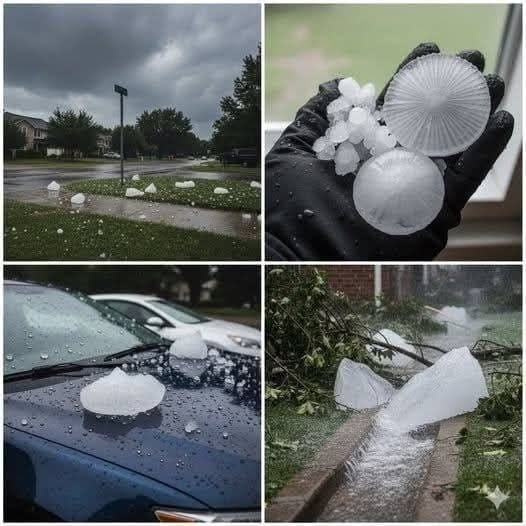
The first hailstone then struck a windshield so forcefully that the motorist inside flinched and cursed out, believing something had fallen from a roof. There was a second impact. Ten more after that. Subsequently, the boom became so loud that it was impossible to discern individual blows.
It turned into a roar.
From above came a continuous, disorganized drumbeat.
The town ceased to exist as a town in ninety seconds.
In the confusion, cars stopped at odd angles, and danger lights blinked like confused messages. A delivery biker sprinted to the closest doorway after abandoning his bike in the middle of the road. Oranges spilled across the sidewalk like bruised suns as a woman carrying groceries saw her paper bags crumble beneath the attack of ice.
Children wailed, not because they were hurt, but because they were overwhelmed by the loudness and felt that something was wrong with the world.
Parents failed to provide an explanation. They were not required to.
They simply fled.
The sound was significantly terrible inside homes.
The windows trembled within their frames. Repeated impact caused the roof tiles to break. The hail fell in uneven spurts, with some stones the size of marbles and others larger, heavy enough to inflict damage that insurance adjusters would later describe as “impossible.” It was neither gentle nor seasonal or familiar in any manner.
People waited in hallways in the old section of town, where structures had withstood decades of weather and worse, listening to the roof above them as if it could collapse completely.
Later, a man described it as sounding like “a thousand fists trying to get in.”
He wasn’t making anything up.
Teachers at the school pulled kids into the internal hallways and herded them away from the windows with tight but controlled voices.
One teacher kept saying, “No one is in trouble,” as though the storm were a child misbehaving.
A boy wondered if the sky was shattering while covering his ears with his hands.
Nobody immediately responded to the query.
Because there was no comforting version of reality.
Then it changed just as fast as it had started.
First, the noise subsided, as though the storm had grown weary of its own fury. The hail’s rhythm shifted, becoming less steady and more dispersed. Gaps then appeared. Between strikes, there were odd silences that seemed to be louder than the storm.
At last, it was just raining.
typical rain.
Its softness was almost offensive in light of what had recently transpired.
People hesitantly went outside, as though they thought the storm would decide to change its mind and come back.
It didn’t.
Instead, they discovered layers of damage.
Cars were dented as if invisible hammers had hit them.
Petals were removed from flowers that had been standing perfectly an hour previously, and gardens were completely flattened.
Trees suddenly appeared older than they should have, with sections of foliage missing.
Ice pieces melting into swift streams in roof gutters that are overflowing.
There was also traces of impact everywhere, including on window ledges, gardens, and pavements. As if attempting to undo their actions, white stones melted into the sea and vanished.
People didn’t talk much at first.
They merely glanced.
Before touching the hood to make sure it was real, a man stood in front of his automobile for almost a full minute.
A woman sitting on her front step laughed once, sharply and incredulously, then covered her lips and fell silent once more.
At the end of a driveway, two neighbors met and merely shook their heads at one another; words were both useless and unavailable.
The phones followed.
Pictures, videos, and messages.
For evidence, not for show.
This is where it actually happened.
It did this.
We’re not dreaming.
Waves of emergency personnel arrived.
It was steady, coordinated movement rather than dramatic sirens slicing through chaos, which had already taken on a different form at that point. first inspecting the roads. Next, power lines. Next, roofs.
One crossroads was deliberately blocked by a fallen branch. Before the officials even got there, someone had already dragged it to the side.
Nobody was aware of who.
That was also incorporated into the narrative.
S-town wasn’t in a crisis by nightfall, but it wasn’t normal either.
Communities in that peculiar in-between state enter when something uninvited passes through them; they become more aware of their fragility, quieter than before, and more sensitive to minor noises.
People moved more slowly.
looked up more frequently.
I’m not precisely scared; I’ve just learned.
Unplanned, a group of neighbors gathered in one street.
Tea was brought by someone. A broom was brought by someone else. Another person was welcomed even if they provided nothing.
Together, they gazed at a row of dented cars and a garden that would take weeks to heal.
“I’ve never seen anything like it,” remarked one of them.
“I don’t think it was meant to be seen from the inside,” another person said in response.
Nobody disagreed.
The sky reverted to its typical hue as darkness fell.
Almost too commonplace.
The sky that had become furious hours before appeared innocent, unconcerned, and even a little ashamed.
Wet pavement reflected streetlights. The town let out a hesitant breath, unsure if it had been given permission to unwind yet.
Behind a curtain in the living room, a television flickered somewhere, displaying footage of what everyone had just gone through.
Silently, people observed it as though they were viewing someone else’s recollections.
Beneath everything, even the cleanup, the discussions, and the shocked recollections, something else was emerging.
Resilience is still a ways off.
Not quite healing.
Something more human and immediate.
The realization that everyone had shared it.
that nobody had been singled out.
that the storm had not selected, discriminated, or passed judgment.
It had just shown up.
and departed.
The village was now doing the only thing it could, scattered, dented, and silently shaken:
getting up and starting over, one street at a time.