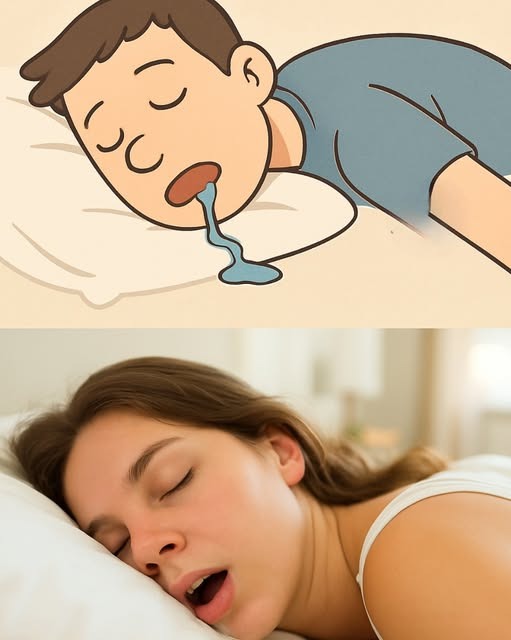
Waking up to a soaked pillow can feel deeply uncomfortable, even a little embarrassing. It’s the kind of small, quiet detail that can trigger bigger thoughts—questions about your body, about whether something is wrong, or whether it might be a sign of something more serious happening beneath the surface. In that early moment, still half-asleep, it’s easy for your mind to jump to conclusions, to interpret something simple as something concerning. But behind that small wet patch is actually a much more ordinary and surprisingly natural explanation tied to how your body functions during sleep.
As you fall asleep and move into deeper stages of rest, your body begins to relax in ways you don’t consciously notice. Muscles that stay active during the day—keeping your posture, controlling your movements, even managing subtle functions like swallowing—start to loosen. This includes the muscles around your jaw. As they relax, your mouth may open slightly without you realizing it. At the same time, your swallowing reflex, which normally clears saliva throughout the day, slows down significantly.
Saliva production, however, doesn’t stop. Your body continues to produce it as part of its normal function, even while you sleep. During the day, this isn’t something you notice because you’re constantly swallowing without thinking about it. But at night, with that reflex reduced and your mouth slightly open, saliva doesn’t get cleared as efficiently. Instead, it can begin to collect and, eventually, escape.
Your sleeping position plays a major role as well. If you sleep on your side or stomach, gravity naturally encourages saliva to move outward rather than stay in your mouth. It doesn’t take much—just a slight opening of the lips combined with relaxed muscles—for it to make its way onto your pillow. What feels like an unusual or concerning event is often just the result of basic physical processes working together in a different way than they do when you’re awake.
There are also additional factors that can quietly contribute to this. Nasal congestion is one of the most common. When your nose is blocked—whether from allergies, a cold, or chronic sinus issues—your body compensates by breathing through your mouth. This not only dries out your mouth but also makes it easier for saliva to escape, since your lips are more likely to remain open throughout the night.
Another possible factor is acid reflux. When stomach acid moves upward toward the throat, the body may respond by producing extra saliva as a protective mechanism. This increased production can add to the amount of saliva present during sleep, making drooling more likely. Even though this happens without you being aware of it, your body is essentially trying to defend itself, even while you’re resting.
In most cases, all of this is completely normal. Drooling during sleep is not a sign that something is wrong—it’s often a sign that your body has entered a deeper, more relaxed state. It reflects a level of rest where your muscles have fully let go and your system has slowed down. In that sense, it can actually indicate that your sleep is functioning as it should.
However, like many things related to the body, context matters. If drooling becomes noticeably worse, appears suddenly without an obvious reason, or is accompanied by other symptoms—such as difficulty swallowing, changes in speech, or trouble eating—it may be worth paying closer attention. In those cases, consulting a doctor can help rule out underlying issues related to nerves, muscles, or swallowing function.
But for most people, what seems concerning at first is simply part of the body’s natural rhythm during sleep. It’s a reminder that while you rest, your body continues to operate in ways that don’t always match your waking expectations.
So that damp pillow in the morning isn’t necessarily a sign of something wrong. More often, it’s just quiet evidence of how deeply your body was able to relax—something that, in its own way, is exactly what sleep is meant to do.