As Eleanor sat in the quiet of her sun-filled living room, the grandfather clock’s ticking served as a constant reminder of the fifty years that had passed her by. She should have been in the golden twilight of a well-worn life at seventy-five, but she didn’t feel like herself. She had been the obedient wife to Charles for fifty years, a man whose presence had become as constant and predictable as the furniture. Their marriage had simply deteriorated, like a shoreline given over to the tide’s silent, unrelenting draw, rather than ending abruptly or with a sensational betrayal. The closeness had long since vanished, to be replaced by a meaningless routine of coffee in the morning, courteous questions about the weather, and long evenings spent in quiet that felt more like a test of endurance than a friendship.
At this point in life, filing for divorce felt more like a last-ditch effort than a form of defiance. Her children, who were now middle-aged and had their own families and complicated lives, responded with a mix of confusion and silent condemnation. They saw her choice as an unneeded interruption to the family legacy and a late-stage whim. However, Eleanor saw it as a deeply honest deed. She came to the realization that she intended to use the few years or perhaps months she had left to write her own story as the main character. The life she had created with Charles was both a cage and a stronghold of security.
The court hearings were a clinical dissection of a lifetime together, and they were astonishingly sterile. The distribution of assets was chillingly efficient; there were no shouting bouts over the property or the silver. Throughout it all, Charles remained a mystery to her, his expression a mask of stoic resignation. Perhaps sensing the weighty atmosphere of a half-century coming to an end in a sterile office, their lawyer suggested they have a last lunch at a little café down the street once the last documents were signed. It was intended to be a final act, a dignified way to move from partners to acquaintances.
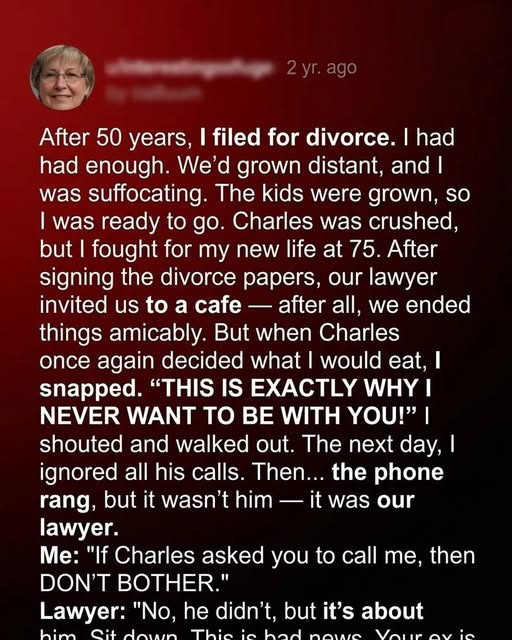
In a booth beside the window, they were seated across from each other. Eleanor recognized Charles’s age spots on his palms and the small creases around his eyes in the sunlight. Charles didn’t even glance at the menu as the waiter came over. As he had done every Friday for the past two decades, he ordered the grilled salmon for himself and the Cobb salad for Eleanor. Eleanor’s long-dormant hatred suddenly exploded at that precise time. The stifling presumption that her tastes were unchanging and that he was fully aware of and in control of her wishes was what infuriated her, not the choice of salad.
Eleanor accepted the gesture with a tight-lipped smile for the first time in her adult life. As she met his gaze, she experienced a rush of excitement in her veins. Her voice was solid, without the softness of submission or the quiver of aging. She informed him that she didn’t want the salad and, more significantly, that she didn’t want him to make any more decisions for her for the rest of her life. With the chair scratching loudly across the floor, she got up and left the restaurant without turning around. The whole weight of her independence struck her for the first time on that walk to her car.
Eleanor awoke in her new, smaller flat the next morning. There was complete silence, and for the first time, it didn’t feel lonely—rather, it felt like a blank canvas. Her phone was constantly buzzing with texts from her daughter and missed calls from friends, but she ignored it throughout the morning. She needed a day to just be herself, free from the responsibilities of being a mother, a wife, or a grandma. The sound of her own breath was what she needed. But late that night, a call from an unknown number broke the calm. It was their attorney, with a startling urgency in place of the professional façade.
He told Eleanor that Charles had passed out not long after getting home the night before. He was in the intensive care unit after suffering a big stroke. Eleanor was physically struck by the news. The room’s chilly air suddenly felt harsh as she sat on the edge of her bed. A complicated, whirling nebula of emotions had taken the place of the restaurant’s fury. Yes, there was terror, but there was also an odd feeling of separation. The only person on the planet who really knew the man in that hospital bed was her, even though she was no longer his legal next of kin.
Eleanor thought she had moved past the hospital hallways, but in the days that followed, she found herself back there. Every day she went to see Charles, observing the multitude of monitors that now controlled his life as well as the steady rise and fall of his chest. Her kids were also present, their expressions filled with sorrow and bewilderment, and they looked to her for guidance that she wasn’t sure she owed them. However, Eleanor came to a deep realization while sitting by Charles’s bed. His illness did not invalidate her departure. The divorce wasn’t an error; rather, it was a necessary break that made it possible for her to rejoin him out of true, detached compassion rather than obligation.
She came to the realization that you don’t have to want to live in your shared history in order to enjoy it. Without sacrificing her future to the ghosts of the past, she could pay tribute to the fifty years of their lives together—the upbringing of children, the shared losses, the everyday victories. Their chats changed as Charles gradually started to feel better. They were shorter, more present-oriented, and free of the burden of marital expectations.
Eleanor’s new life did not appear to be an exciting journey to a strange country. It appeared as though she was getting up and choosing her breakfast. It appeared as though she had enrolled in a local painting class where nobody recognized her as Mrs. Charles Miller. It appeared as though she spent three hours reading a book in a park because she felt like it, not because it fit into someone else’s schedule.
Eleanor had attained a level of being that most people spend their entire lives pursuing by the time she turned seventy-six. She had discovered a calm, steady tranquility. She came to see that terminating her marriage was a fulfillment rather than a failure. She had transitioned from one life to another. Although the route she took was challenging and occasionally lonely, it was her own. She had finally discovered that the most crucial dialogue you will ever have is the one in which you eventually tell yourself the truth, and that it is never too late to recover your soul. Eleanor entered her sunset years as the protagonist of her own gorgeous, late-blooming tale rather than a supporting role in someone else’s drama.