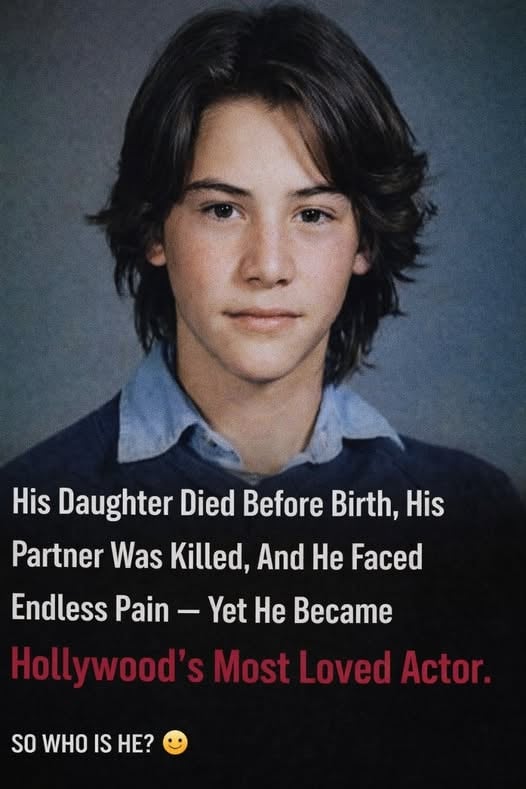
The world sees a calm face. A steady voice. A man who seems untouched by the chaos that so often follows fame. But what most people don’t see is the wreckage behind that calm—the years of instability, the losses that don’t fade, the kind of grief that reshapes a person from the inside out. Keanu Reeves didn’t arrive at kindness by accident. He built it, piece by piece, out of everything that could have made him harder instead.
He began life without anything resembling stillness. Moving from city to city, country to country, he grew up in a kind of constant motion that never quite allowed roots to form. His father’s absence wasn’t just physical—it left a space that followed him, shaping how he saw the world and his place in it. There was a quiet sense of dislocation, of always being slightly out of step, slightly outside of where he was supposed to belong.
School didn’t offer refuge. Dyslexia made learning feel like struggle after struggle, turning classrooms into places of frustration rather than growth. To others, it might have looked like lack of discipline or direction. But for him, it was something deeper—a system that didn’t know how to meet him where he was. Dropping out at seventeen was labeled as failure, a closed door, a sign that he had fallen behind.
In reality, it was the first honest step toward something that finally made sense.
Acting wasn’t just a career choice—it was a language he could speak fluently when others had failed him. It gave him structure without confinement, expression without judgment. But the path into that world was anything but easy. He took odd jobs, faced rejection after rejection, and worked his way through an industry that rarely rewards vulnerability. There were no guarantees, no safety nets—just persistence and a quiet belief that he could carve out space for himself.
And eventually, he did.
Fame arrived, bringing recognition, opportunity, and a place in the public eye. But what it didn’t bring was peace. Because no amount of success can shield someone from loss.
The death of River Phoenix wasn’t just the loss of a friend—it was a rupture, sudden and devastating. It left behind questions, pain, and the kind of absence that lingers long after the moment has passed. And then came something even more personal, more intimate in its heartbreak: the stillbirth of his daughter, a loss that carries a silence words can’t fully reach. Not long after, Jennifer Syme—his partner, someone tied to both love and grief—was gone too.
At that point, many people would have turned inward in a different way. Hardened. Withdrawn. Angry at the unfairness of it all. And it would have been understandable.
But he didn’t.
Instead of letting grief turn into bitterness, he transformed it into something quieter, but far more intentional. Kindness became not just a trait, but a choice—one made again and again, often without recognition. Anonymous donations given without expectation. Paychecks shared with crew members who needed it more. Moments of connection with strangers that carried no performance, no distance, no sense of superiority.
There’s something striking about that kind of response. It isn’t loud. It doesn’t demand attention. It doesn’t try to prove anything. It simply exists, steady and consistent, even when no one is watching.
Keanu Reeves carries his grief the way some people carry shadows—always present, never fully gone. But instead of letting it darken everything around him, he has found a way to soften it, to redirect it into something that touches others in quiet, meaningful ways.
And maybe that’s what people are really responding to when they see him—not just the calm, not just the humility, but the sense that beneath it all is someone who has every reason to be different, and has chosen, deliberately, not to be.
Because sometimes the strongest thing a person can do isn’t to overcome pain completely—but to refuse to let it define how they treat the world.