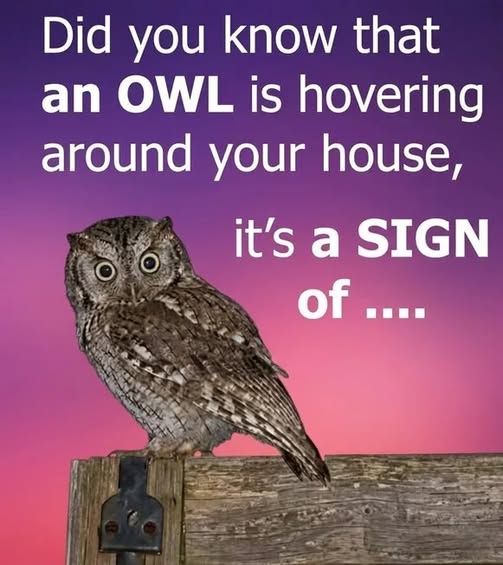
Owls appear as silent beings moving through the darkness on calm nights when movement slows and the atmosphere seems to calm down. They are hardly noticeable but clearly present. They are frequently felt rather than seen, such as a change in the atmosphere, a faint shadow moving overhead, or the far-off echo of a call that travels farther than anticipated. Owls have a reputation that combines natural elegance with an almost enigmatic appearance because of these moments, which have attracted human interest for ages.
Owls, which belong to the order Strigiformes, are extremely specialized nocturnal birds that were designed to survive in low light and quiet. its ability to fly silently is one of its most amazing traits. Owls have specially designed feathers that spread and soften sound, in contrast to most birds whose wings produce noisy movement as they cut through the air. They can glide nearly undetected because the margins of their wings are made to reduce turbulence. This adaption, which allows them to approach prey without being heard, is not only remarkable but crucial.
Precision hunting is just as well adapted to their physical makeup. Owls can see well even in low light thanks to their huge, forward-facing eyes, which are extremely sensitive to light. Owls are unable to move these eyes like people do because they are set in place. Rather, they make up for it by having a remarkable capacity to rotate their heads, sometimes up to 270 degrees, which allows them to see a vast area without having to move their bodies.
Their sense of hearing is as sophisticated as their vision. The ears of many owl species are asymmetrical, standing at slightly varying heights on the head. They are able to locate prey with astonishing accuracy thanks to this peculiar configuration, which enables them to perceive minute variations in sound. An owl may be able to determine its precise location from even the smallest rustle beneath leaves or the faint movement of an animal concealed behind snow.
Owls are crucial to the equilibrium of ecosystems because they are predators. They eat insects, reptiles, and occasionally other birds, but small mammals like mice, voles, and rats make up the majority of their diet. They can adapt to a variety of situations thanks to this dietary versatility. They can be found in rural areas, broad meadows, deep forests, and even cities, where they peacefully cohabit with people.
Owls use camouflage to avoid detection during the day. Their feathers frequently imitate the hues and textures of their surroundings, fitting in perfectly with the foliage, branches, or bark of trees. Even when they are in plain sight, they can remain undetected because they are perched in immobility. They are able to relax and save energy until nightfall, at which point they become vigilant and active.
Their behavior changes as night falls again. With a level of awareness that looks almost effortless, they take to the air, led by instinct and highly developed senses. They move with purpose, efficiency, and minimal waste. Every aspect of them demonstrates adaptation, with each characteristic fulfilling a function within the greater natural system.
Beyond their physical characteristics, owls have long been associated with human culture and fantasy. They have been connected to a variety of symbolic meanings in many cultures and customs. For instance, owls were associated with intelligence and wisdom in ancient Greece and were frequently associated with the goddess Athena. Their capacity to see in the dark was seen as an indication of insight—the capacity to see things that others were unable to.
Owls have been perceived differently in diverse cultures. Some customs view their appearance at night as a link to hidden facets of life and link them to change, transition, or the unknown. They are considered protectors—quiet observers of the earth after sunset—in some legends, but in others, their sounds are seen as warnings or messages.
The behavior of an owl is totally based on natural processes, despite various interpretations. Their sounds, rhythms, and motions are driven by survival rather than symbolism. When an owl is heard calling at night or appears close to a house, it is typically reacting to environmental cues like the availability of food or ideal nesting locations. Their presence is not a deliberate signal, but rather a part of the ecosystem’s natural cycle.
However, human reactions to owl encounters frequently go beyond just observation.
Something about their subdued demeanor inspires introspection. An owl stands for something distinct in a world that is frequently noisy and fast-paced: attentiveness, serenity, and a level of tranquility that contrasts with daily activity. An owl’s hoot or a glimpse of one perched in the shadows might cause a halt, bringing attention to the surroundings in a way that is both familiar and grounding.
Their sounds, which are frequently characterized as melodious or eerie, are useful for marking territory and interacting with other owls. However, these noises can have significance to human hearing that goes beyond biology. Even when it isn’t meant to be, the timing, tone, and distance all work together to create a feeling of intimacy.
Owls live at the nexus of perception and science.
On the one hand, they are extremely effective predators that are well suited to their natural habitat. However, they are a recurrent symbol in myths, beliefs, and cultural customs because of their presence, which begs for interpretation. They are fascinating and functional at the same time, which contributes to their allure.
When an owl shows up close by, it is taking part in the environment rather than disturbing it. It depicts an active, balanced, and constantly changing system. Their existence can serve as a reminder of how much goes on outside of our immediate consciousness and how life goes on in subtle, complex ways even when we’re not looking.
Ultimately, owls are important without symbolism.
They are valuable because they are animals that have been formed by evolution, possess extraordinary skills, and are vital to the ecosystems in which they live. However, how they are viewed adds another level, one that links nature with human cognition and observation with meaning.
They act modestly, move without attracting notice, and have a quiet yet intricate rhythm.
Additionally, their existence acts as a silent reminder that there is always more going on than we can see during the calm of the night, when everything appears to be at rest.